






AI SEO companies help businesses improve visibility by using artificial intelligence for keyword research, content creation, and technical audits. They support presence across traditional search engines, Google’s Search Generative Experience, and LLM assistants such as ChatGPT and Perplexity
HubSpot reports that about 75 percent of marketers expect AI search to increase traffic, which shows how quickly these methods are becoming part of everyday SEO work.
And for many U.S. teams, hiring SEO specialists from Latin America is the fastest and easiest way to leverage top talent while keeping execution consistent, controlling costs, and maintaining content quality aligned with strategic priorities.
Let’s look at what an AI SEO company does, which partners lead the market, and how to choose the right one based on your goals.
What Is an AI SEO Company (and How Does It Work)?
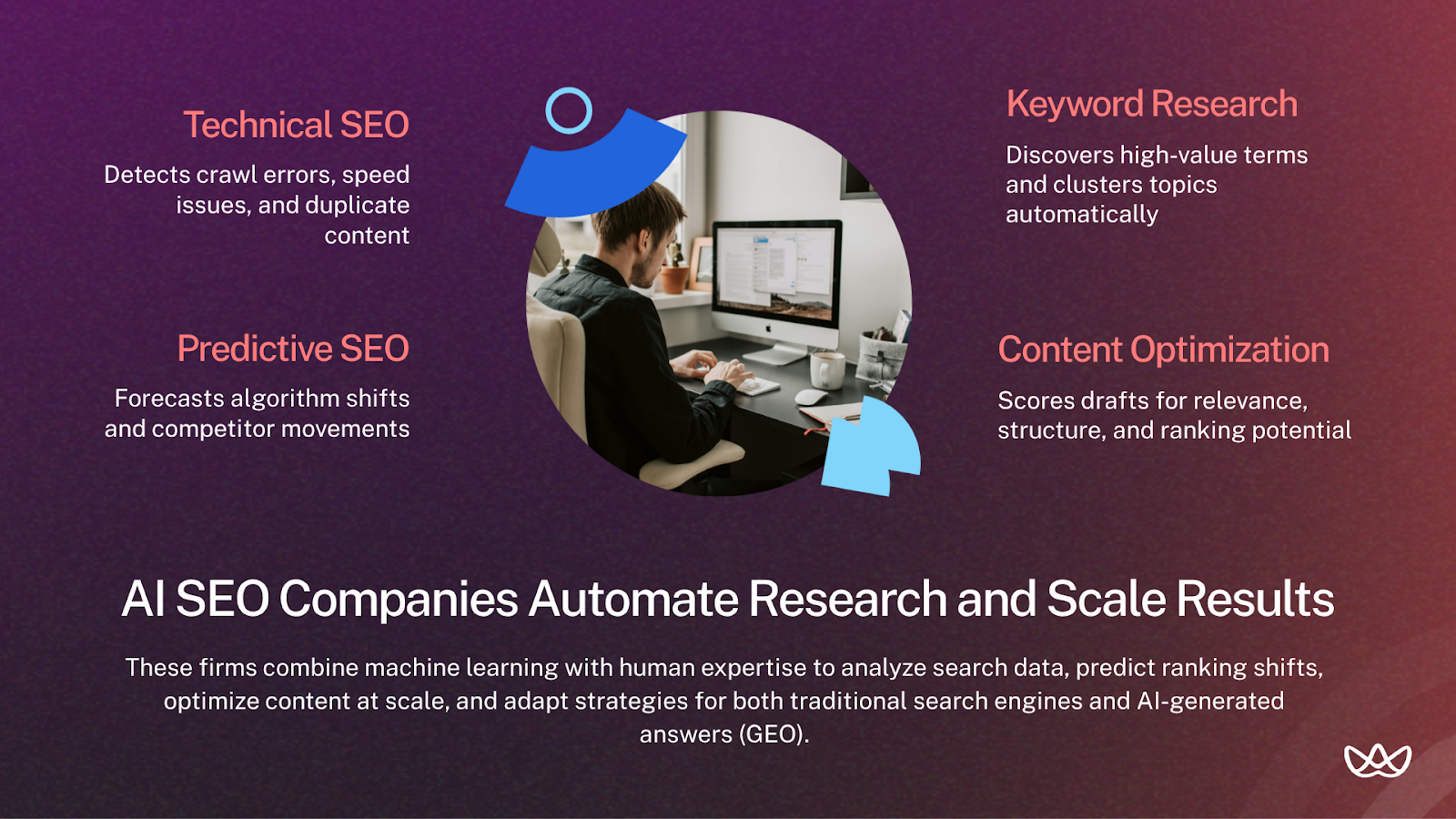
An AI SEO company uses artificial intelligence and machine learning to automate and enhance search engine optimization strategies, making them faster, more data-driven, and highly scalable compared to traditional manual methods.
These companies process data from websites, Google Search Console, Analytics, and competitors to identify trends, spot issues, and guide optimization decisions. Human specialists review and refine the results to ensure quality and strategy alignment.
Key services include:
- Keyword Research: Find high-value keywords and organize topic clusters.
- Content Optimization: Improve readability, structure, and ranking potential.
- Technical SEO: Detect errors, slow pages, and duplicate content.
- Predictive Strategy: Forecast trends and adjust approaches.
- Generative SEO (GEO): Optimize content for AI-generated search answers.
Differences Between AI SEO Companies and Traditional SEO Agencies
Traditional agencies rely on manual keyword research, scheduled reporting, and human-led content briefs. AI SEO companies use real-time data, predictive modeling, and automated content analysis. The main differences are speed and scalability, not necessarily outcomes.
AI firms handle more data quickly, while traditional agencies provide stronger brand customization and editorial oversight.
Key Takeaway: AI SEO companies increase efficiency through automation, but human SEO talent remains essential for creativity, tone, and brand context.
Key Benefits of Working with an AI SEO Company
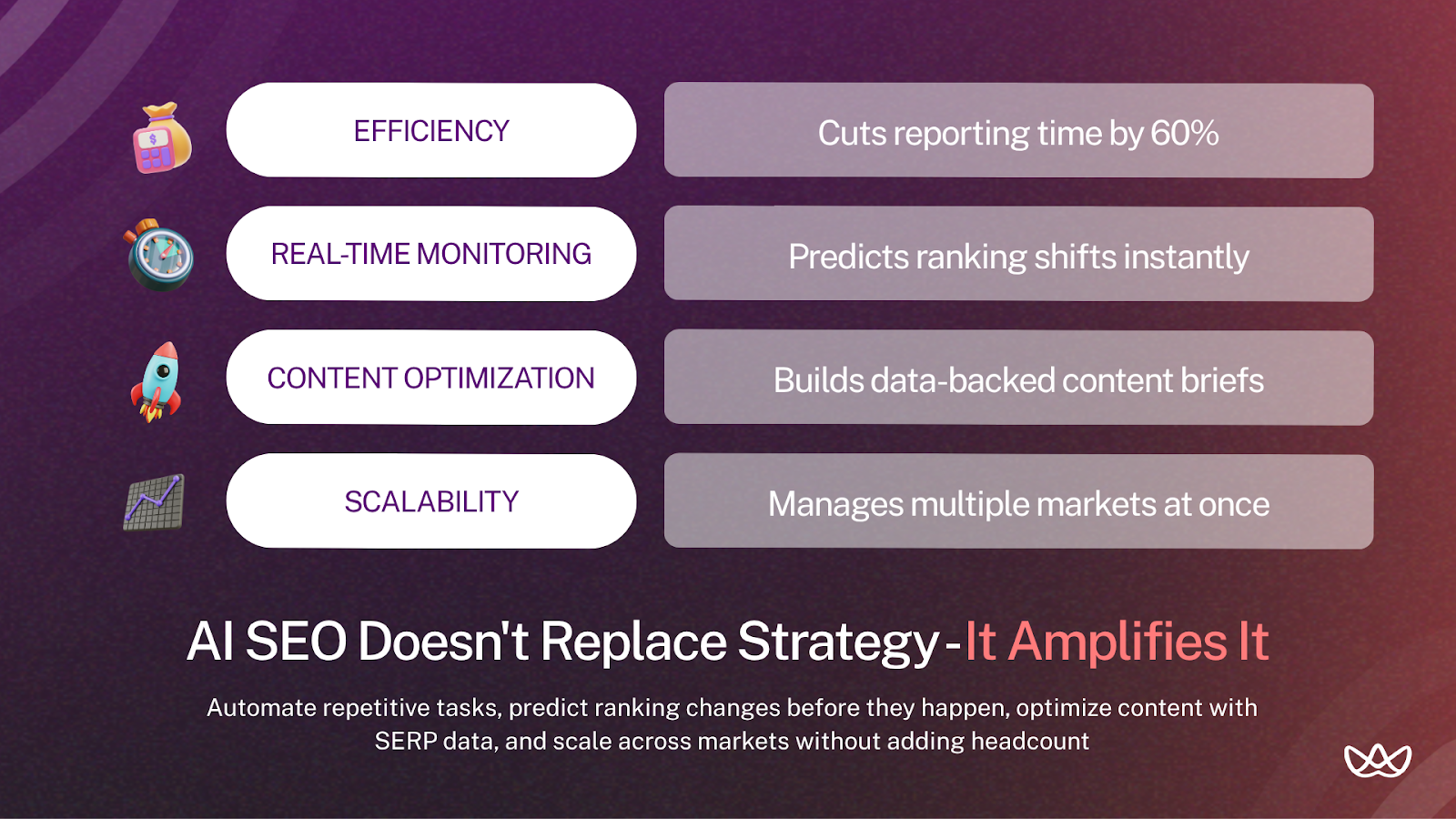
1. Increased Efficiency Through Automation
Automation handles repetitive SEO tasks like crawling competitor sites, tracking ranking changes, generating internal linking suggestions, and updating meta tags. Modern SEO workflows integrate real-time data feeds and automated reporting dashboards, which significantly reduce manual effort and free teams to focus on strategy, content refinement, and testing new growth opportunities.
Editorial judgment is still required for deciding which keywords to target and how to structure key pages, so automation complements rather than replaces human expertise.
2. Real-Time SERP Monitoring and Predictive Insights
Instead of relying solely on historical data, predictive models highlight pages most likely to be affected by ranking changes. Teams receive alerts when visibility shifts outside expected ranges, allowing faster responses to competitors or algorithm updates.
These insights also guide resource allocation. For example, if analysis shows long-form content performing better than listicles in a niche, teams can adjust their content plans before the trend fully emerges.
3. Data-Driven Content Optimization and Strategy
Content platforms analyze top-ranking pages for word count, headings, semantic keyword use, and readability. Writers use these insights to create briefs that match search intent while still differentiating through unique data, case studies, or brand examples.
Topic clustering identifies gaps and internal linking opportunities, improving site structure and topical authority. Optimization provides a baseline; human editors ensure content is original and aligned with brand goals.
4. Enhanced Scalability for Multi-Channel SEO
Companies managing multiple sites, international markets, or vertical campaigns benefit from standardized workflows for keyword research, content scoring, and technical audits. Automated translation and localization help adapt content for different regions, with native speakers reviewing for nuance.
Programmatic SEO can generate thousands of location- or product-specific pages from structured data, reducing the cost of scaling campaigns across clients, sites, or markets.
Why AI SEO Companies Outperform Manual Optimization
The most effective approach combines automated workflows with experienced SEO specialists. Automation handles data and repetitive tasks, while humans guide strategy, maintain quality, and ensure content aligns with brand standards.
Top 7 AI SEO Companies to Watch in 2026
1. Floowi - Scaling SEO Operations with Offshore Marketing Talent
Floowi connects U.S. companies with vetted SEO specialists in Latin America. Teams work in overlapping U.S. time zones, which makes collaboration straightforward. Specialists handle keyword research, content optimization, technical audits, and link building while using the same platforms in-house teams rely on.
This model works well for startups and mid-sized agencies that want to scale content production without paying for a full-service agency. You maintain strategic control while outsourcing execution directly into your workflow.
2. MarketerHire - On-Demand SEO Freelancers
MarketerHire is a marketplace for pre-vetted freelance SEO specialists. Companies post project needs and get matched with freelancers within 48 hours. This works best for short-term projects like content audits, keyword research sprints, or technical SEO fixes.
Freelancers bring their own tool stack and charge hourly or per project. Long-term availability varies, so it’s most useful for teams needing fast, specific task support.
3. NoGood - Data-Driven SEO and Growth Marketing
NoGood combines SEO with paid acquisition, conversion optimization, and analytics. They primarily work with SaaS companies and venture-backed startups, offering full-funnel strategy rather than just organic growth.
Projects often start around $15,000 per month. This approach is suited for companies seeking integrated marketing support beyond SEO, but it may be broader than needed if organic search is the only focus.
4. 51Blocks – White-Label SEO Services
51Blocks offers white-label SEO for agencies that want optimization without building internal teams. They manage keyword research, content creation, technical audits, and reporting under the agency’s brand.
This setup works for agencies reselling SEO services, with retainers starting around $3,000 per month for small accounts. Direct clients looking for transparency may prefer working with agencies under their own brand.
5. SmartSites - Full-Service SEO and PPC Integration
SmartSites combines SEO and paid search management, mainly for e-commerce and local businesses. Their approach aligns organic and paid strategies to maximize search visibility.
Monthly retainers start at around $5,000 and include both channels. This is practical for businesses needing multi-channel coordination but may not be cost-effective for purely organic campaigns.
6. SEO.ai - Automated Content Generation
SEO.ai focuses on producing content at scale. It analyzes SERP data, generates outlines, and drafts long-form articles for review and editing.
This works for publishers or content-heavy sites that need volume, but quality depends on editorial oversight and niche complexity. Pricing starts at $50 per month for basic usage. It’s best treated as a tool to accelerate content production, not a replacement for strategic planning.
7. LinkGraph - Link Intelligence and SEO Automation
LinkGraph specializes in backlink analysis and link building. The platform identifies link opportunities, evaluates domain authority, and predicts outreach success.
They also offer content and technical SEO, but the main value is in link strategy. Retainers start around $2,500 per month. Companies with strong content but weak backlink profiles benefit most from this approach.
How to Choose the Best AI SEO Company for Your Business
The right SEO partner does more than run reports or generate content. Good firms combine efficiency with hands-on strategy, making sure everything matches your brand voice and business goals.
A strong partner helps your team work more efficiently without replacing editorial judgment or strategic decisions.
Top Questions to Ask an AI SEO Company Before Hiring
- Which tools and platforms do you use, and who owns the data?
- How do specialists review and edit recommendations?
- How is brand tone and messaging preserved?
- Can you share case studies showing measurable ranking improvements?
- How do you respond to algorithm updates or sudden drops in rankings?
- What is included in reporting, and how often do you review progress?
- Do you offer flexible contracts or require long-term commitments?
- How do you ensure content originality and avoid duplication issues?
These questions help identify whether a company prioritizes automation for efficiency or uses it as a marketing angle without delivering better results.
Top AI SEO Trends to Watch in 2026
1. AI Content Scoring Systems
Content scoring platforms evaluate draft quality before publication, looking at relevance, readability, keyword coverage, and structure such as headings and lists. Higher scores often correlate with better rankings, but they don’t replace the need to match user intent or provide unique value.
These tools can highlight gaps in expertise or weak supporting evidence, helping content align with credibility standards. Editors still need to verify that recommendations reflect the brand’s actual authority on a topic.
2. Predictive Keyword Intent Modeling
Keyword intent is no longer fixed. Terms may shift from informational to transactional as a market evolves or new competitors enter. Predictive modeling tracks these changes and suggests content adjustments before traffic drops.
This approach helps teams stay ahead of trends instead of reacting to lost rankings. However, predictions are based on past patterns and may not account for sudden market shifts.
3. Semantic Search Optimization
Search engines now favor topical authority over exact keyword matches. Optimizing for semantics means covering related concepts thoroughly rather than focusing on single keywords.
Tools map topic clusters and suggest primary keywords plus related terms that signal expertise. This method works well for long-tail queries and helps a single page rank for multiple related searches.
4. Multimodal Content Indexing
Search engines index video transcripts, images, and audio alongside text. Optimizing these formats improves overall visibility, allowing videos to appear in YouTube and Google search results, and images to rank in visual search and shopping results.
This trend is particularly relevant for e-commerce, publishers, and educational platforms that produce diverse content. Success requires collaboration across teams that may not usually work together.
Key Takeaway: These AI-driven trends optimize workflows but still rely on experienced SEO professionals to interpret and execute strategies.
Common Challenges When Working with AI SEO Companies
The biggest risk is relying on automated processes instead of thinking strategically. Tools can handle repetitive tasks, but they rarely capture what makes your brand stand out without someone guiding them.
Data bias can push teams toward generic topics if the information feeding the system overrepresents certain industries or content types.
Transparency matters too. If a provider won’t explain how recommendations are made or show performance results, you’re left guessing whether the work actually delivers value.
When multiple clients target the same keywords, outputs can overlap. A manual review ensures content stays original and avoids search penalties.
When Should You Hire an AI SEO Company?
You should consider adding dedicated SEO specialists when your current approach starts slowing growth or stretching your team too thin.
- Traffic has plateaued despite regular publishing.
- Keyword research and reporting take days every month.
- You’re managing SEO across multiple markets, languages, or product lines.
- Competitors are consistently outranking you with similar content.
- Internal resources aren’t enough to handle everything, and hiring full-time staff isn’t feasible.
In these cases, bringing in specialists to manage analysis and execution allows your team to focus on strategy, messaging, and high-impact work.
For U.S. teams looking to scale efficiently, offshore SEO specialists offer flexibility and coverage in overlapping time zones. They plug into your workflow, maintain hands-on oversight, and keep execution consistent while your team directs overall strategy.
Getting Started
AI SEO is not a replacement - it supports skilled human judgment. Automation handles volume; humans handle strategy, meaning, and brand context.
For companies managing multiple sites, languages, or markets, scaling requires both reliable processes and people who understand your audience better than any algorithm.
Start building your SEO team with Floowi. Hire top vetted specialists from Latin America to form cost-effective teams that work in overlapping U.S. time zones. Start with the right people, then add the tools.
Frequently Asked Questions
What's the difference between AI SEO software and AI SEO companies?
SEO software gives your team tools to handle tasks like keyword research, audits, and tracking. It requires internal expertise to interpret the data and plan strategy. An SEO company goes further: experts manage strategy, implementation, and ongoing optimization, adding context and judgment that software alone can’t provide.
What AI technologies do top SEO companies actually use?
Most teams start with essential platforms for research, content, and technical work:
- Audits & Analysis: Semrush, Ahrefs, Moz, Screaming Frog.
- Content: Surfer, Clearscope, MarketMuse, and LLM-assisted tools.
- Google Tools: Search Console, Analytics, PageSpeed Insights.
- Technical SEO: HTTPS, Schema markup, responsive design.
These are common foundations. Many companies layer additional platforms, custom scripts, or generative content tools to handle specific client needs.
How do AI SEO companies ensure content quality and originality?
Quality control requires human review at multiple stages. Editors verify that AI-generated drafts match brand voice, add unique insights, and avoid duplication. Originality checks use plagiarism detection tools like Copyscape before publication.
How does Floowi's AI approach differ from competitors?
Floowi doesn't build AI tools. Instead, it provides access to hire vetted SEO talent in LATAM who are trained to use existing AI platforms effectively. This model separates technology from execution, giving clients more control over which tools their teams use while reducing labor costs.
How much do AI SEO companies typically charge?
Full-service AI SEO agencies cost $2,000-$10,000 per month depending on scope and company size. White-label providers start around $3,000 monthly. Offshore SEO talent through platforms like Floowi offers similar performance at 50-70% lower cost by removing agency overhead.
Can AI SEO handle multiple languages simultaneously?
Yes. Experienced teams combine technical setup and local knowledge:
- Native speakers: Ensure content is culturally relevant and readable.
- International SEO practices: Implement hreflang tags and other technical elements.
- Market-specific keyword research: Tailor content to local search behavior and language nuances.
What content projects benefit most from AI SEO?
Data-heavy or large-scale projects gain the most:
- Competitor content gap analysis to spot missed topics.
- Large site migrations with proper redirects and indexing.
- Technical content audits across thousands of pages.
- On-page optimization at scale, including metadata and content structure.
What questions should I ask when evaluating AI SEO companies?
- How do you measure success and what KPIs do you track?
- Can you show case studies from my industry?
- How do you combine tools with human strategy?
- How transparent is your reporting?
- How do you stay current with search algorithm updates?
- Do you cover both traditional search and new platforms like Google’s Search Generative Experience?




