

.png)
.png)



SEO still contributes most of the traffic for B2B teams. HubSpot’s 2026 State of Marketing report shows that websites, blogs, and SEO bring the highest ROI, and 75% of marketers expect AI search to increase traffic to their sites. That means, besides paid ads, organic rankings are still the main driver of traffic and leads.
The fastest way to cover this is to hire a freelance SEO expert. Freelancers can handle audits, optimization, and fixes without the cost or delay of a full-time hire. When steady execution is needed, many teams add a nearshore SEO team to manage routine tasks while the freelancer focuses on the more complex work.
In this guide, we’ll cover how to hire a freelance SEO expert, the types of roles to consider, and how freelancers can work alongside your nearshore team.
Why Hiring a Freelance SEO Expert Still Matters in 2026
Search engines change faster than most internal teams can keep up with. Updates like Google’s algorithm changes and the Search Generative Experience, along with Bing’s AI integration, require regular adjustments.
A freelance SEO expert stays on top of these changes because their work depends on fast adaptation. They can update schema when SGE changes how results are generated, adjust internal linking after ranking volatility, or test new snippet formats the week they roll out. This level of focus is hard for in-house teams that juggle broader responsibilities.
In-house teams often have many priorities at once. A freelancer can focus solely on search performance, which makes them useful during algorithm updates or when launching new products that need immediate visibility.
How SEO Shapes Long-Term Brand Visibility and Growth
Organic search is the highest-ROI channel for many B2B and e-commerce companies. Unlike paid ads, content that ranks well can generate traffic for months or years with minimal upkeep.
Freelance SEO experts help build that foundation efficiently. They identify quick wins, fix technical issues, and set up content frameworks that grow with your team, without the cost of a full-time hire.
Why In-House Teams Still Rely on Freelance SEO Support
In-house teams bring in freelancers when they need specific skills or extra hands for short projects.
Freelancers cover technical audits, content work, link building, local SEO, and digital PR. They also help during situations that need focused attention, like a product launch that requires several pages optimized on a short timeline or a site migration that needs clean redirects and checks before going live.
They take on these contained projects without the commitment of a full-time role. This is why many companies hire freelance SEO experts even when they have in-house teams.
What Does a Freelance SEO Expert Actually Do?
1. Keyword Research & Content Strategy
Freelance SEO experts don't just pull keyword lists from Ahrefs. They analyze search intent, map terms to buyer stages, and identify topical gaps your competitors haven't filled. Good keyword research informs content calendars, product descriptions, and even PPC campaigns.
They also spot emerging trends before search volume spikes. If you're in fintech, an expert might notice rising interest in "embedded finance APIs" six months before it becomes competitive.
2. Technical SEO & Site Health Optimization
Technical SEO covers everything search engines need to crawl, index, and rank your pages. This includes site speed optimization, fixing redirect chains, implementing structured data, managing XML sitemaps, and resolving duplicate content issues.
They use tools like Screaming Frog and Google Search Console to audit the site and focus on the fixes that matter most. For example, a slow checkout page has a bigger impact than a missing alt tag on a blog post.
3. On-Page and Off-Page Optimization
On-page work involves title tags, meta descriptions, header structure, internal linking, and content optimization. Off-page focuses on building authority through backlinks, digital PR, and brand mentions.
Freelancers approach both with data. They'll A/B test title tags to improve CTR, restructure internal links to distribute page authority, and pitch guest posts to sites with real domain authority instead of spammy directories.
4. Backlink Building & Authority Growth
Link building remains one of the hardest SEO tasks to execute well. Freelance link strategists have relationships with publishers, understand outreach that converts, and know how to create link-worthy assets like original research or interactive tools.
They also audit existing backlink profiles to identify toxic links that could trigger manual penalties. Disavowing bad links is as important as building good ones.
5. Performance Tracking and Reporting
Freelancers set up GA4 tracking, monitor rankings, track organic revenue, and build dashboards in Looker Studio or Tableau. Good reporting focuses on what actually affects the business.
Traffic growth means nothing if conversions stay flat. A skilled expert measures SEO performance directly against revenue, lead quality, and customer acquisition cost.
How Freelance SEO Experts Differ from Agencies
Agencies offer structured processes, account managers, and coverage across multiple roles. Freelancers focus on specific areas and can turn around tactical work much faster. For example, an audit that might take an agency three weeks can often be completed by a freelancer in five days.
Agencies are useful when you need ongoing management across SEO, content, and paid channels. Freelancers work better for defined projects or when your team has internal coordination but needs specialized skills to fill gaps.
10 Types of Freelance SEO Experts You Can Hire in 2026
1. Technical SEO Specialist
Technical specialists handle crawl budget issues, optimize Core Web Vitals, fix canonicalization problems, and manage log file analysis. They work closely with developers to implement structured data, handle JavaScript rendering for SPAs, and troubleshoot indexing anomalies.
If your site has 10,000+ pages, migrating platforms, or seeing indexation drops without clear cause, you need a technical specialist.
2. On-Page Optimization Expert
On-page SEO expertise restructure content for users and search engines. They optimize titles, improve internal linking, implement topic clusters, and align metadata with search intent. They also guide writers to improve content quality without affecting readability.
3. Link Building Strategist
Link-building strategists focus on building genuine authority. They create linkable assets, run digital PR campaigns, and earn placements on high-authority sites.
This often involves pitching data studies, collaborating with influencers, or producing research that attracts citations naturally
4. Local SEO Consultant
Local SEO specialists optimize Google Business Profiles, manage citation consistency across directories, build location-specific landing pages, and generate reviews.
For multi-location businesses, they implement structured data markup, manage NAP (name, address, phone) consistency, and run hyperlocal content strategies that help each location rank for "[service] near me" queries.
5. E-commerce SEO Expert
E-commerce SEO requires managing thousands of product pages, optimizing faceted navigation, implementing product schema, handling out-of-stock pages, and balancing SEO with user experience.
Experts in this niche understand platforms like Shopify, Magento, and BigCommerce. They know how to consolidate thin category pages, optimize for product discovery searches, and structure URLs for both crawlability and usability.
6. Content SEO Strategist
Content strategists don't write. They build frameworks that guide writers. This includes topic cluster models, editorial calendars based on keyword seasonality, content briefs with clear optimization targets, and competitive gap analysis.
They also optimize existing content through refresh cycles, internal link strategies, and content pruning to remove underperforming pages that dilute site authority.
7. SEO Copywriter or Content Creator
SEO copywriters produce content that ranks and converts. They balance keyword integration with readability, write compelling meta descriptions, and structure articles for featured snippet capture.
Good SEO copywriters understand search intent. They know when to write a listicle versus a how-to guide, and they adjust tone based on funnel stage.
8. SEO Data Analyst
SEO Data analysts extract insights from Google Analytics 4, Search Console, and rank tracking tools. They identify seasonal patterns, forecast traffic based on ranking movements, and attribute revenue to organic channels.
They also build custom dashboards that show stakeholders what matters: organic contribution to pipeline, assisted conversions, and content ROI.
9. International or Multilingual SEO Specialist
International SEO specialists implement hreflang tags, manage country-specific domains or subdirectories, and localize content for regional search behavior.
They understand cultural nuances in keyword research. "Lawyer" in the U.S. translates to "solicitor" in the UK and "abogado" in Spanish-speaking markets, each with different search volumes and competitive landscapes.
10. SEO Automation & AI Specialist
Automation specialists build scripts that scale repetitive SEO tasks. They use Python to automate reporting, scrape SERP data for competitive analysis, generate schema markup programmatically, and integrate SEO data with CRM or marketing automation platforms.
They also experiment with AI tools like ChatGPT and Claude for content briefing, meta generation, and keyword clustering.
Key Takeaway: Freelancers now specialize by platform and data stack, not just by industry.
Freelance SEO Experts vs Nearshore SEO Teams: What's the Difference?

Freelancers provide quick access to specialized skills. You can hire a technical SEO expert for a short audit or a content strategist for a few months to test a new approach.
Freelancers often manage multiple clients, so response times can vary. They work independently, which means your team needs to coordinate closely to make sure their work fits smoothly into ongoing projects.
Nearshore Teams: Scalability, Cost Efficiency, and Long-Term Support
Nearshore SEO teams work alongside your in-house staff but at lower costs. Because LATAM professionals share overlapping time zones with North America, you can collaborate in real time, which makes coordination much easier than with teams in Europe or Asia.
They also keep things consistent. Instead of juggling separate freelancers for technical SEO, content, and reporting, a nearshore team handles everything together, so work flows smoothly and nothing falls through the cracks.
LATAM nearshore teams often deliver 50–65% cost savings with U.S. time-zone collaboration. Nearshore partners like Floowi offer deeper vetting, consistent availability, and multi-role coverage that typical freelance platforms don't guarantee.
When to Transition from Freelance to Nearshore SEO
Move to a nearshore team when managing multiple freelancers starts slowing things down. If you’re juggling contractors for content, technical SEO, and reporting, a nearshore team keeps communication simpler and output more consistent.
Nearshore support also makes sense when SEO becomes critical to your business. Early-stage startups can experiment with freelancers, but growth-stage companies benefit from steady execution and accountability from dedicated nearshore professionals.
Indicators it’s time to transition:
- You’ve hired more than 2–3 freelancers and coordination is breaking.
- SEO drives more than 30% of your pipeline.
How to Find and Vet the Right Freelance SEO Expert
Where you source SEO talent affects execution, consistency, and the ROI of your projects. Here’s how to vet the right experts from the top five platforms:
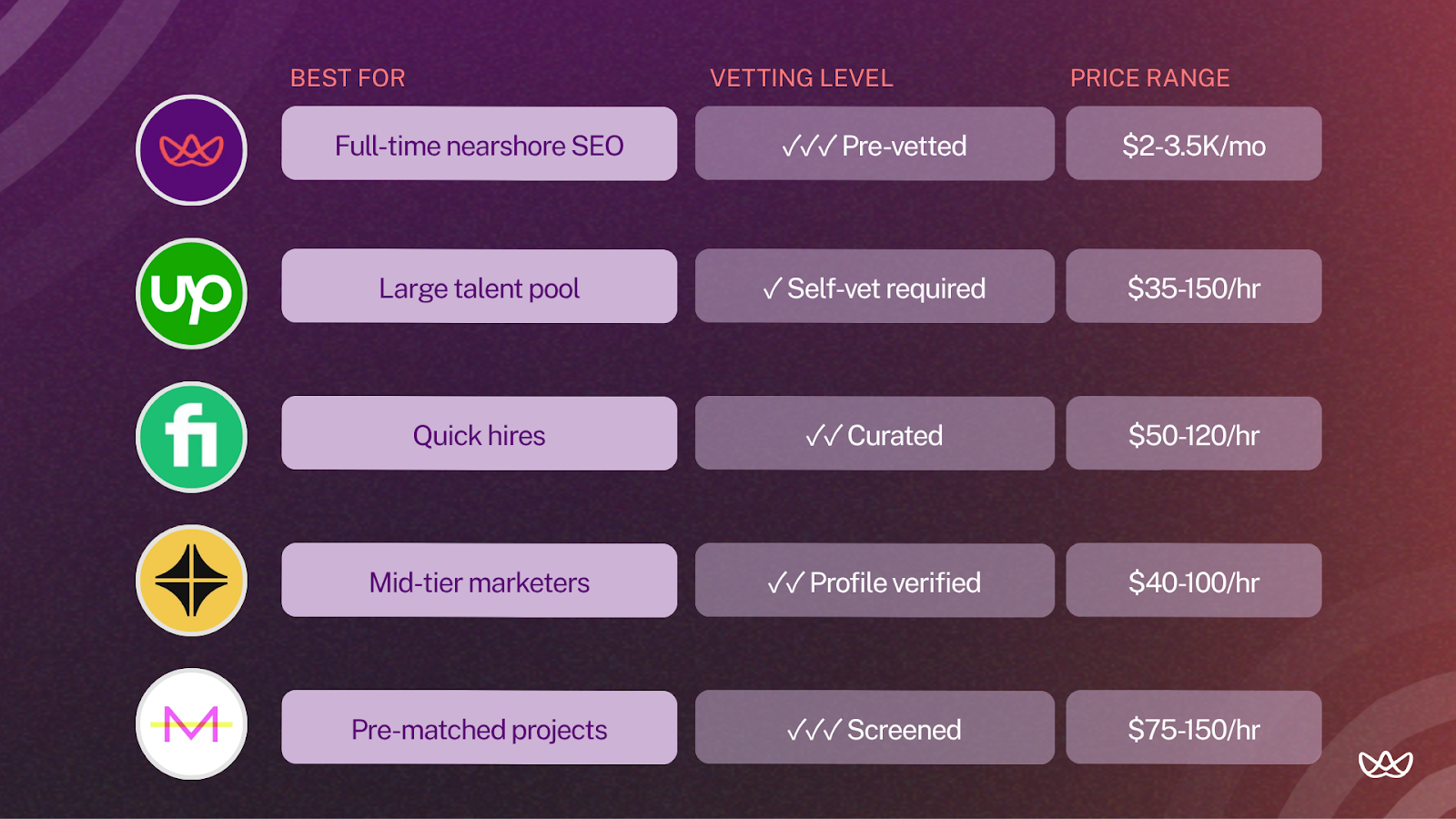
- Floowi: Floowi connects you with vetted nearshore LATAM SEO professionals, including full-time experts. Payroll, compliance, and benefits are handled, so you get consistent execution, real-time collaboration in U.S. time zones, and seamless integration with your team.
- Upwork: Upwork offers a huge pool of freelancers at various skill levels. Quality varies, so you need to check “Top Rated” status, review portfolios carefully, and run a paid trial to verify results.
- Fiverr Pro: Fiverr Pro lists higher-end freelancers, but “Pro” doesn’t guarantee effectiveness. You’ll still need to vet portfolios and references for relevant experience.
- Contra: Contra focuses on creative and marketing specialists. It works for finding mid-tier talent quickly, but you may need multiple hires to cover specialized SEO needs.
- MarketerHire: MarketerHire pre-screens freelancers and matches them to projects. It reduces risk, but pricing is higher and coverage is limited to project-specific roles.
Key Skills and Tools to Look For (Ahrefs, GA4, Semrush, Surfer)
Strong SEO experts should have hands-on experience with industry-standard tools:
- Ahrefs or Semrush for keyword research, backlink analysis, and competitive intelligence
- Google Analytics 4 for traffic analysis and conversion tracking
- Google Search Console for indexing issues and performance monitoring
- Screaming Frog for technical audits
- Surfer SEO or Clearscope for content optimization
During interviews, ask candidates to walk through a recent project using these tools. You'll quickly identify whether they understand the data or just run reports.
Portfolio Red Flags and Success Metrics
Request case studies that include specific metrics: organic traffic growth, keyword ranking improvements, conversion rate changes, and revenue impact. Be skeptical of anyone claiming "100% traffic increase in 30 days" without context. SEO results take time.
Red flags include vague descriptions like "improved rankings" without numbers, no access to verification (anonymized GA screenshots), and an overreliance on vanity metrics like domain authority without business outcomes.
Sample Interview Questions and Trial Projects
Ask candidates:
- Walk me through how you'd approach a technical SEO audit for our site.
- How do you prioritize SEO tasks when resources are limited?
- What's your process for recovering from a traffic drop after an algorithm update?
- How do you measure SEO ROI beyond traffic and rankings?
For trial projects, assign a small, paid task like auditing five pages for on-page optimization or creating a keyword map for a new content vertical. Quality experts deliver actionable insights, not generic recommendations.
How to Spot Fake SEO Experts (Red Flags to Avoid)
Avoid anyone who guarantees first-page rankings, promises immediate results, or uses outdated tactics like keyword stuffing and link farms. Real experts talk about testing, iteration, and long-term strategy.
Also watch for consultants who push proprietary tools you've never heard of, refuse to explain their process, or dodge questions about past results with "it's confidential."
Key Takeaway: Always test before signing; reliable freelancers deliver measurable insights within 7–10 days.
Freelance SEO Expert Pricing: What to Expect in 2026
SEO pricing varies widely based on geography, experience, and specialization. U.S.-based experts charge premium rates, while LATAM professionals offer comparable quality at significantly lower costs.
Quick comparison: A U.S. freelancer often costs two to three times more than a nearshore LATAM specialist.
Nearshore LATAM networks give a strong cost-to-quality balance, especially when you need English fluency and time-zone alignment. Cost matters, but the real value comes from how quickly the work ships and how well the specialist handles technical details that affect rankings.
Budget Planning for Short vs Ongoing Engagements
For one-off projects like audits or site migrations, expect to spend $3,000-$8,000 depending on complexity. Developing a content strategy usually runs $2,000-$5,000 for the initial framework.
Ongoing retainers start around $2,000/month for basic monitoring and reporting, and can go above $10,000/month for full SEO management covering content, link building, and technical work. Use retainers when you need steady support; hourly or project-based arrangements work better for short-term fixes or quick consulting.
Freelancer vs Nearshore SEO Costs: What's the ROI?
Freelancers cost less upfront, but you’ll spend more time coordinating, granting tool access, and integrating their work with your team. Nearshore teams cost more monthly, but they handle workflows independently, join meetings, and reduce friction with your in-house staff.
Which gives better ROI depends on your stage. Early-stage companies often benefit from freelancer flexibility, while growth-stage teams gain more from nearshore reliability and consistent execution.
Best Practices for Managing Freelance SEO Experts and Nearshore Teams
1. Set Clear KPIs and Communication Cadence
Define success metrics before work starts. If you're hiring for technical SEO, agree on which Core Web Vitals scores to target and the timeline for improvements. For content strategy, set expectations around keyword coverage, publish frequency, and traffic benchmarks.
Establish a communication rhythm. Weekly async updates work for most freelancers. Monthly deep-dive calls keep everyone aligned on priorities and roadblocks.
2. Use Project Management Tools for Transparency
Tools like Notion, ClickUp, or Asana create visibility into task status and dependencies. Set up shared boards where freelancers log completed work, flag blockers, and track KPIs in real time.
This transparency helps you spot issues early. If a freelancer misses two deadlines or delivers lower-quality work than expected, you can address it before it derails the project.
3. Align SEO Goals With Content and Growth Teams
SEO works best when it’s connected to the content your team produces and the product or growth goals you’re measuring. Make sure the keywords your SEO expert targets match what writers can create and what your product supports.
Monthly planning sessions between SEO, content, and product teams help everyone stay on the same page and prevent wasted effort on pages that won’t drive results.
Common Mistakes When Hiring Freelance SEO Experts (and How to Avoid Them)
1. Hiring Without Clear Objectives
Starting SEO without clear goals wastes time and budget. Saying "improve SEO" doesn’t guide action. Be specific: “Increase organic traffic to our pricing page by 40% in six months.” Clear objectives let freelancers focus on the right tactics and measure results accurately.
2. Relying Solely on Freelancers Without Process Alignment
Freelancers handle tasks, not systems. A freelancer can create content briefs, but if your team doesn’t know how to use them, nothing improves. Integrate freelancer work into your processes, assign internal owners, and set up review steps to ensure recommendations get implemented.
3. Why Overlooking Nearshore Options Limits ROI
Many companies default to freelance platforms without considering nearshore alternatives. Freelancers work great for short sprints, but nearshore teams provide better long-term value when you need consistent execution.
Nearshore professionals work full-time on your projects, integrate with your tools and processes, and cost 50-65% less than U.S. hires. For companies scaling SEO beyond occasional audits, nearshore becomes more cost-effective than managing a rotating roster of freelancers.
Getting Started
Freelance SEO experts handle specialized tasks and short-term projects, giving you fast, cost-effective results. Nearshore teams work alongside your in-house staff, collaborate in real time, and maintain consistent quality.
Combining freelancers for focused sprints with nearshore professionals for ongoing optimization lets you scale efficiently while keeping execution reliable and aligned with business goals.
Start building your SEO team with Floowi. Connect with vetted nearshore SEO professionals and freelance specialists, streamline collaboration, and get consistent execution for your projects.
Frequently Asked Questions
1. What's the difference between a freelance SEO expert and an SEO agency?
Freelancers deliver niche depth and flexibility. Agencies provide process scale and multi-role coverage. Freelancers cost less and move faster on tactical work. Agencies bring account management, integrated services across channels, and established workflows that reduce coordination overhead.
Choose freelancers for defined projects or specialized skills your in-house team lacks. Choose agencies when you need ongoing management across multiple marketing functions.
2. How do I verify an SEO expert's past results and case studies?
Request anonymized case studies with impressions, CTR, traffic, and revenue deltas. Ask for access to read-only Google Analytics or Search Console views so you can validate the numbers yourself.
Good experts provide context: industry, competition level, timeline, and specific tactics used. Be skeptical of anyone showing only upward-trending graphs without explaining the work behind the results.
3. How much does a freelance SEO expert cost per hour?
Typical ranges are $25-$150/hr depending on region and seniority. LATAM averages $25-$60/hr. U.S./Canada averages $75-$150/hr. Europe falls between at $60–$120/hr.
Specialists like technical SEO or international SEO command premium rates. Junior freelancers handling basic on-page optimization cost less but require more oversight.
4. Which SEO roles work best nearshore vs keeping in-house?
Execution-heavy SEO roles work well nearshore, like technical QA, content brief creation, link outreach, and weekly reporting. These need consistency, but not constant strategic input.
Keep things like brand strategy, executive messaging, and cross-functional planning in-house. Senior SEO work stays onshore since it relies on deep knowledge of your company priorities, product roadmap, and internal dynamics.
5. Should I pay SEO freelancers hourly or per project?
Hourly works best for audits, troubleshooting, and exploratory work where scope is uncertain. You avoid overpaying for tasks that finish faster than expected.
Project-based or retainer fees work better for multi-month roadmaps like content strategy development or site migrations. Fixed pricing gives budget predictability and aligns incentives around outcomes instead of hours logged.
6. What should be included in an SEO expert's deliverables?
For audits: prioritized list of issues, expected impact for each fix, and implementation guidance. For content: keyword-optimized briefs, internal linking recommendations, and meta templates.
For link building: monthly reports showing new backlinks, domain authority of linking sites, anchor text distribution, and lost links. For technical SEO: before/after screenshots, Core Web Vitals scores, and documentation of changes made.
Always request shared access to tools and dashboards so you can monitor progress between formal reports.
8. How hands-on do I need to be with freelance SEO experts?
Early in the engagement, expect daily or every-other-day check-ins to align on priorities and answer questions. Once they understand your business and workflows, you can move to weekly updates.
Technical specialists need less oversight than content creators because their work is more formulaic. Content strategists benefit from regular feedback to ensure briefs match your brand voice and audience understanding.
9. Besides rankings, what metrics prove SEO effectiveness?
Organic revenue is the gold standard. Track sales or leads attributed to organic search using GA4's attribution models.
Also monitor organic traffic to high-intent pages, conversion rate for organic visitors, assisted conversions where SEO contributed to a purchase path, and customer acquisition cost for organic channels compared to paid.
Engagement metrics like time on page and scroll depth indicate content quality. Rising branded search volume shows growing brand authority.
10. How do I combine freelance and nearshore SEO support effectively?
Use freelancers for short-term projects or specialized work - like a technical SEO audit, a link-building campaign, or setting up custom dashboards.
Let a nearshore team handle the ongoing execution - weekly content briefs, on-page optimization, backlink tracking, and reporting. Combining both gives you flexibility for expert tasks while keeping consistent, reliable SEO operations with vetted LATAM professionals.




