

.png)




Hiring a social media manager affects revenue, brand visibility, and client retention more directly than most marketing roles. Companies need someone who can execute content strategies, manage community engagement, run paid campaigns, and report performance in ways that inform business decisions.
The challenge is finding qualified candidates who balance creative execution with analytical thinking. U.S. talent pools offer experienced managers but at costs that strain budgets, especially for agencies managing multiple client accounts. LATAM markets now provide bilingual professionals with strong portfolios at 40-60% lower costs while maintaining quality and communication standards.
Here’s exactly how to hire a social media manager in 2026 - from timing the hire to evaluating skills, interviewing, onboarding, and budgeting.
What a Social Media Manager Actually Owns
A social media manager is a crucial role that primarily owns the execution and daily management of a brand's social presence and strategy, although the scope of their work differs between agency and brand-side (in-house) roles due to differing business structures and reporting lines.
The core ownership is of the social media channels themselves, the content calendar, community engagement, and performance analysis.
This ownership matters when you’re deciding how to hire a social media manager and what to screen for.
Core Responsibilities That Drive Revenue
Social media managers handle both strategic planning and tactical execution across platforms. Their core responsibilities directly impact how brands connect with audiences and convert engagement into business results.
Key responsibilities include:
- Create and schedule content across Instagram, LinkedIn, TikTok, Facebook.
- Manage community, responding within 2 hours during business hours.
- Report monthly performance: engagement, reach, conversions.
- Plan campaigns aligned with product launches and promotions.
- Maintain brand voice, messaging, and visual identity.
- Run paid social campaigns and track ROAS.
- Analyze competitors to find gaps and opportunities.
- Monitor crises and respond quickly.
Agency managers typically handle 4-8 client accounts, switching brand voices and objectives daily. In-house managers focus deeper on one brand while coordinating across departments.
Expected Outcomes: Engagement, Lead Flow & Client Retention
Strong social media managers deliver measurable business outcomes beyond vanity metrics like follower counts.
Expected performance indicators include:
- Engagement rate improvements of 15–30% quarter over quarter.
- Click-through rates of 2–5% on promotional content.
- Comment and save rates showing content value and shareability.
- Follower growth: 10–20% monthly for new brands, 3–8% for established accounts.
- DM response times under 1 hour for customer inquiries.
- Lead generation via gated content, landing pages, or demo requests.
- Revenue attribution from social-driven sales.
- Customer retention gains from consistent community engagement.
These metrics link social activity directly to business results, making the role’s value clear to stakeholders.
Differences Between U.S. Talent and LATAM Talent
Differences between U.S. and LATAM talent are generally categorized by compensation, work culture, communication styles, and practical factors like time zone alignment. U.S. companies frequently leverage the cost-effectiveness and strong skill sets of the growing LATAM talent pool.
LATAM professionals often bring 5+ years of experience managing accounts for international brands, making them immediately productive without extensive training. The cost savings let you hire senior-level talent at mid-level U.S. prices or build larger teams within the same budget.
What a Social Media Manager Does Day-to-Day
Daily workflows vary by company size and role scope, but core tasks remain consistent:
- Content sourcing & curation from brand assets, UGC, and trends.
- Scheduling posts using tools like Buffer or Hootsuite.
- Storyboarding video content for Reels, TikToks, Shorts.
- Creative briefs for designers.
- Community engagement responding to comments and DMs.
- Performance monitoring & reporting on key metrics.
- Strategy refinement based on results.
- Trend monitoring to spot new opportunities.
- Collaboration with marketing, sales, and product teams.
Time spent on creation versus strategy changes with experience. Entry-level managers spend about 70% on execution and 30% on strategy, while senior managers reverse that ratio.
When It's Time to Hire a Social Media Manager
It is time to hire a social media manager when your business's social media needs exceed your in-house capacity or expertise, and your current efforts are no longer driving measurable results. Hiring an SMM ensures a strategic, consistent, and professional approach to a vital marketing channel.
Operational Pressure Points: Content, Clients & Response Times
Specific operational signals indicate you need dedicated social media support:
- Posting drops below 3-5 times a week because no one has time to produce content.
- Some client accounts get daily posts while others stay quiet.
- Comments and DMs sit for more than 24 hours.
- Campaigns launch without proper social support.
- Reports become irregular or too shallow.
- Content quality declines because posts get rushed.
- Strategy-focused team members spend most of their time posting.
- Trend opportunities get missed because no one monitors platforms consistently.
These issues affect brand perception and performance. Slow replies hurt customer relationships, inconsistent posting reduces reach, and missed trends let competitors take attention.
Signs You're Understaffed or Losing Growth Opportunities
There are also strategic signals that hiring can’t wait:
- Revenue growth slows because social isn’t driving enough qualified traffic.
- Competitors gain audience share while your accounts stay flat.
- Product launches underperform due to weak social amplification.
- Client churn rises partly from low engagement and poor results.
- Team burnout increases from juggling too many tasks.
- New client pitches fall through when social capabilities look limited.
- Expansion to TikTok, YouTube, or LinkedIn keeps getting pushed back.
- Paid campaigns run without proper optimization.
Delaying hiring creates compounding problems. Competitors build the audience you could have owned, revenue opportunities fade, and your team stays stretched thin.
In-House, Freelance or LATAM Remote: How to Decide
It depends on your specific budget, desired control, long-term goals, and need for collaboration.
LATAM remote hiring combines the reliability of full-time employees with significant cost savings. You get dedicated resources who learn your brand deeply while paying substantially less than U.S. equivalents.
Startups and agencies benefit most from this model. You can hire senior talent at mid-level prices or build multi-person teams within budgets that would cover one U.S. hire.
What Happens If You Wait Too Long to Hire
Delaying the hire usually stacks problems faster than teams expect:
- Staff burnout as people stretch their workload past what’s realistic.
- Slower growth because posting frequency and quality start to slip.
- Higher client churn when communication feels delayed or inconsistent.
- Lost revenue when campaigns run without the social support they need.
- Competitors gain ground while your audience stays flat.
- Rushed hires that come from trying to fill the role under pressure.
- Higher spend on emergency freelancers or short-term support.
- Lower team morale when overworked staff feel stuck in constant catch-up mode.
The cost of waiting often ends up higher than hiring early. Declining performance, client churn, and turnover all create financial losses that go well past the salary of a dedicated social media manager.
Must-Have Skills for Agencies (Execution + Strategy)
Strong candidates balance hands-on execution with strategic thinking. Agencies need managers who can own accounts independently while aligning with broader marketing goals.
1. Content Creation & Brand Voice Adaptation
A good manager creates platform-specific content that fits each client’s voice. Agencies handle very different brands at once, so the ability to switch tone quickly is important.
Example: Someone may create educational LinkedIn posts for a SaaS client and fast-paced Reels for a fashion client without mixing the styles.
2. Campaign Execution & Timeline Management
Campaigns work best when posts build toward a clear goal. A strong candidate can plan sequences, work with designers, and keep everything on schedule.
Example: A Black Friday rollout usually needs teaser content, countdown posts, launch assets, and follow-ups. The manager keeps the entire workflow moving on time across platforms.
3. Analytical + Creative Balance
Great social media managers think creatively but rely on data to guide decisions. Creative ideas without numbers fall flat. Numbers without creative thinking lead to content nobody notices.
Example: If carousel posts consistently get higher saves, the manager shifts more content to that format and tracks how engagement trends over time.
Analytical skills to look for:
- Reading platform analytics and spotting patterns.
- Calculating engagement and conversion metrics.
- Running simple A/B tests.
- Connecting web traffic and conversions to specific posts.
- Building monthly reports with clear recommendations.
Creative skills that matter:
- Writing captions that encourage comments or clicks.
- Understanding basic visual principles.
- Adapting trend formats to fit brand goals.
- Storytelling that keeps audiences interested.
- Adjusting strategy when posts underperform.
4. Bonus Skills (AI, Editing, Cross-Platform)
Skills beyond core requirements increase efficiency and output quality:
Useful bonus skills include:
- Using AI tools for ideation and draft caption writing.
- Basic video editing in CapCut or simple Adobe tools.
- Light design skills in Canva or Figma.
- Repurposing one idea into multiple formats across platforms.
- Basic SEO for social posts.
- Running paid campaigns with ROAS goals.
- Managing influencer outreach.
- Building simple analytics dashboards.
These skills streamline execution and shorten the amount of back-and-forth needed between teams.
How U.S. vs LATAM Candidates Typically Differ in Skill Profiles
U.S. and Latin American (LATAM) social media manager candidates often show differences not in core technical capabilities, but in communication style, cultural context understanding, focus on personal relationships, and familiarity with U.S. market nuances and tools.
U.S. candidates:
- Familiar with enterprise tools and mature marketing tech stacks.
- Strong local industry networks.
- Comfortable with U.S. platforms and cultural trends.
- Higher salary expectations.
- Shorter average tenure.
LATAM candidates:
- Experience working with U.S., European, and regional brands.
- Bilingual in English and Spanish.
- High responsiveness and adaptability.
- Strong retention when offered fair pay and clear growth paths.
- Familiar with U.S. business expectations.
Skills That Predict a Successful Hire
The top-performing social media managers consistently show these traits:
- Ownership mindset where they treat each account with real accountability.
- Steady deadline habits without last-minute rushes.
- Clear communication when sharing plans, reporting, or raising concerns.
- Ability to adjust quickly when platforms shift or campaigns miss expectations.
- Initiative to spot opportunities or issues without needing direction.
- Bilingual strength for LATAM talent working across English and Spanish audiences,
- Curiosity about platform changes and industry movements.
- Resilience when handling tough feedback or demanding stakeholders.
You can usually spot these traits in how candidates talk about past work, explain decisions, and walk you through their portfolio.
How Much to Budget for a Social Media Manager
Budgeting for a social media manager involves considering the scope of work and the type of professional you hire (in-house, agency, freelancer, or remote), as costs vary based on expertise, location, and the range of services needed.
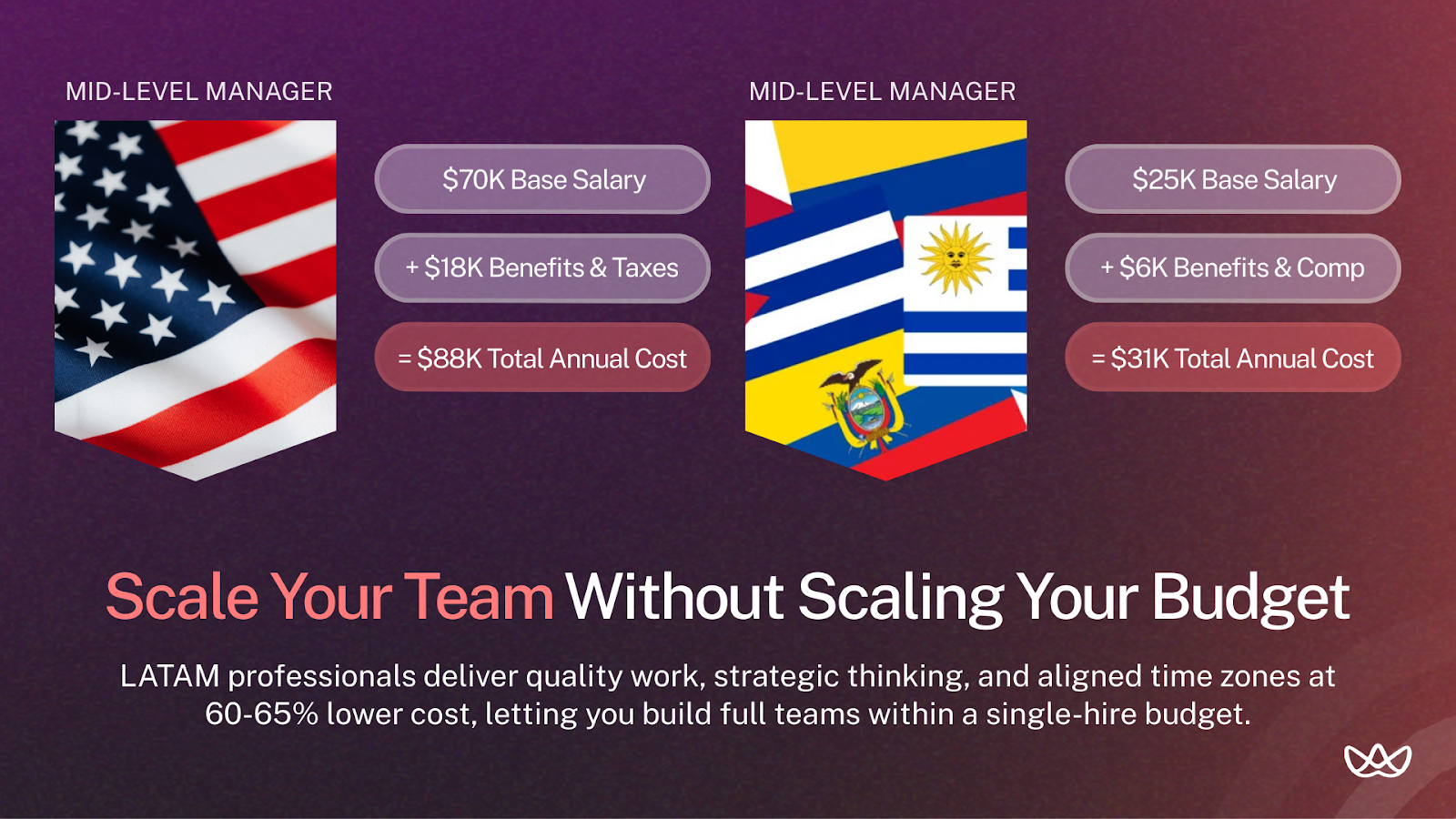
U.S. Salary & Freelance Rates
U.S. compensation varies significantly by location, experience, and employment structure:
- Entry-level full-time: $40K-$55K + $10K–$15K benefits.
- Mid-level full-time: $60K-$85K + benefits.
- Senior-level full-time: $90K-$130K + benefits and possible equity.
- Freelance hourly: $50-$90 for generalists, $100-$150 for specialists.
- Freelance monthly retainers: $4K-$8K for 80-120 hours.
- Agency contracts: $5K-$15K per month depending on scope.
Total employment costs typically run 1.25-1.4x base salary. For example, a $70K salary usually costs $90K–$95K fully loaded.
LATAM Salary Benchmarks
LATAM markets offer experienced professionals at substantially lower costs:
- Mexico: $18K-$30K (mid-level), $30K-$45K (senior)
- Colombia: $16K-$28K (mid-level), $28K-$42K (senior)
- Argentina: $15K-$25K (mid-level), $25K-$38K (senior)
- Brazil: $20K-$32K (mid-level), $32K-$50K (senior)
These salaries provide a solid local standard of living. Employer-of-record services typically add 15–25% for taxes, benefits, and compliance, so a $25K salary might cost $29K–$31K total - still far below U.S. equivalents.
Cost Comparison: In-House vs Remote vs Agency
Total annual costs across different hiring models:
The cost difference between U.S. in-house and LATAM remote hiring is substantial enough that you could hire 2-3 LATAM professionals for the price of one U.S. employee. That lets agencies scale client coverage or startups build complete social teams within limited budgets.
Why LATAM Is Becoming the Preferred Hiring Region in 2026
LATAM is attractive for hiring because it combines cost savings, time zone alignment, and skilled bilingual talent.
- Lower costs: Save 40-60% while maintaining quality.
- Time zone overlap: Teams work during U.S. hours.
- Bilingual talent: Serve English and Spanish audiences.
- Strong retention: Longer tenure with competitive pay.
- Larger talent pools: Faster hiring and ramp-up.
- Simplified process: Floowi handles vetting, payroll, and compliance.
Average Cost to Hire a Social Media Manager in 2026
Typical all-in costs by hiring model:
These figures include base compensation, benefits, payroll taxes, and platform fees where applicable. They don't include one-time recruiting costs or onboarding expenses which typically add $2K-$5K regardless of hiring model.
Where to Find Qualified Social Media Manager Candidates
Qualified social media manager candidates can be effectively sourced through targeted channels including specialized marketing staffing agencies like Floowi for pre-vetted professionals, professional networks like LinkedIn for broad recruitment and referrals, and major freelance marketplaces such as Upwork and Fiverr for flexible talent, supplemented by postings on general job boards like Indeed to maximize visibility.
The Role of Vetted Talent Partners (Including Floowi)
Vetted talent platforms address key hiring challenges: screening candidates for skills, verifying experience, and managing international compliance.
Pre-screening typically covers:
- English fluency: Conversation assessments and writing samples.
- Technical skills: Portfolio reviews and practical tests.
- Cultural fit: Communication style and work approach.
- Experience verification: References and past performance.
- Tools proficiency: Familiarity with standard platforms.
This process saves time by filtering out candidates who don’t meet basic requirements. You only see those who pass multiple evaluation stages.
Platforms offering employer-of-record services also handle payroll, taxes, benefits, and local labor law compliance, removing the complexity of international hiring. Trial periods or replacement guarantees further reduce risk, often spanning 30-90 days.
Hiring through vetted platforms allows you to focus on growth while the platform handles candidate matching and ongoing employment administration.
DIY Options: LinkedIn, Upwork & Creator Platforms
Self-service recruiting can save fees but requires more time and carries risk.
DIY recruiting works if you can handle skill evaluation and international employment logistics. Most agencies find vetted platforms easier and faster.
Pros & Cons of Job Boards for SMM Roles
Traditional job boards like Indeed, Monster, or Glassdoor fulfil specific purposes:
Pros:
- Wide reach exposing roles to large candidate pools.
- Familiar process for most job seekers.
- Relatively inexpensive posting costs.
- Good for U.S.-based hiring in established markets.
Cons:
- Flooded with unqualified applicants requiring extensive screening.
- Limited international reach for LATAM hiring.
- No skill verification beyond resume claims.
- Time-intensive review process for each application.
- Higher no-show rates for interviews and offers.
Job boards work better for entry-level positions where volume matters more than specialized skills. For mid-level and senior roles, targeted approaches through vetted platforms or networks produce better results faster.
How to Hire a Social Media Manager: Step-by-Step Process
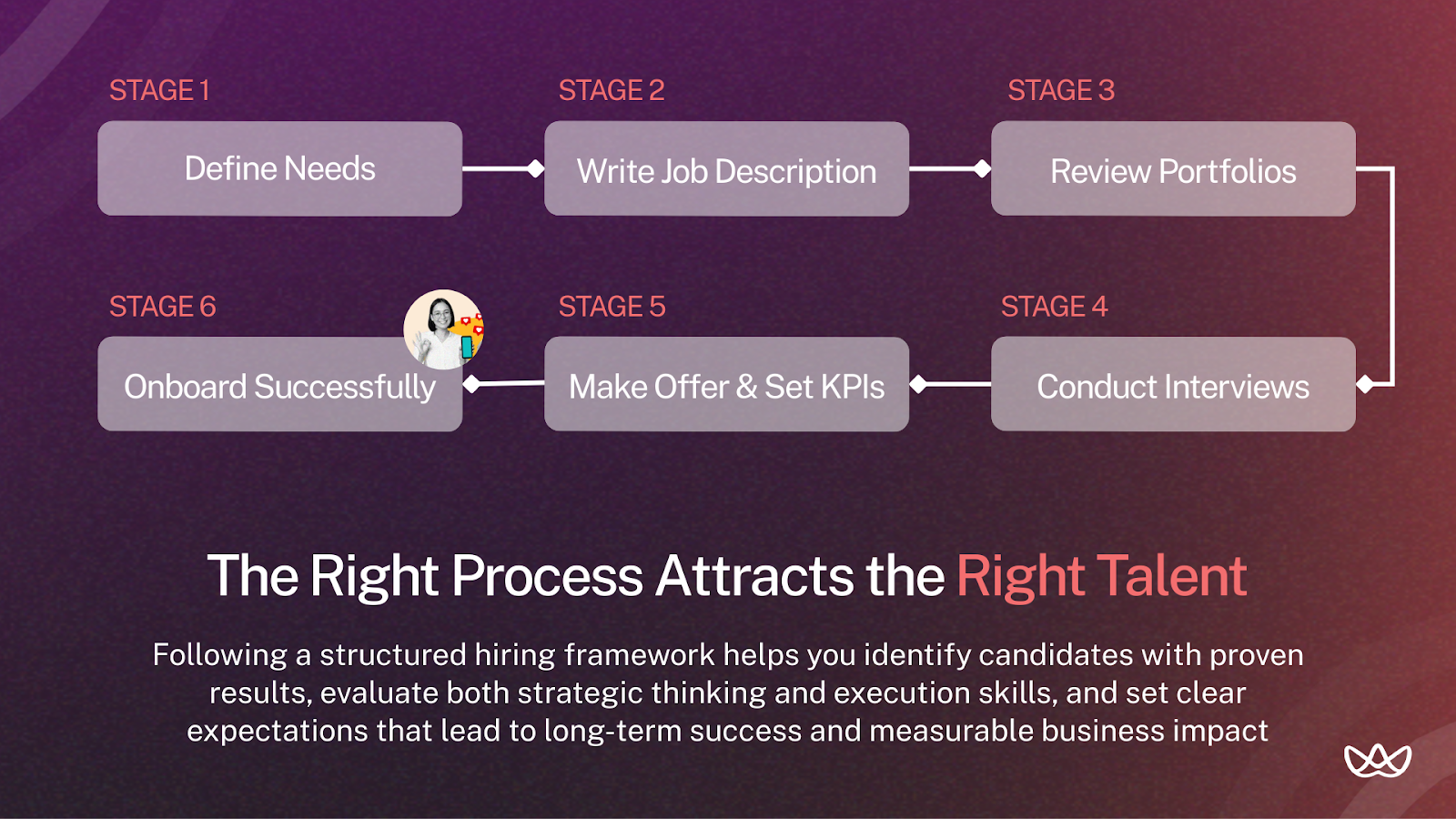
Step 1: Define Platforms, Goals & Output Expectations
Clear role definition prevents misalignment and disappointment:
- List platforms to cover (Instagram, LinkedIn, TikTok, Facebook, Twitter, YouTube).
- Set posting frequency per platform (daily, 3x/week, weekly).
- Define content types (posts, Reels, Stories, carousels, long-form).
- Establish performance goals (engagement, follower growth, conversions).
- Clarify collaboration needs (designer access, approval workflow, meeting schedule).
- Specify if paid social management is included.
- Determine reporting cadence (weekly dashboards, monthly presentations).
- Outline community management expectations (response SLAs, tone).
Document these expectations in writing before drafting job descriptions. This clarity helps candidates self-select based on whether they match your needs.
Step 2: Write a Role-Specific Job Description
Job descriptions attract qualified candidates and filter out mismatches:
- Use clear title: “Social Media Manager”.
- Specify platforms, content types, and tools (Hootsuite, Canva, Meta Ads Manager).
- List must-have vs nice-to-have skills.
- Include concrete performance expectations.
- State work hours and time zone for remote roles.
- Provide salary range or “competitive compensation”.
- Briefly describe company culture, team structure, and growth opportunities.
Avoid common mistakes:
- Listing too many requirements.
- Copying generic job descriptions.
- Omitting salary.
- Using corporate jargon instead of direct language.
Step 3: Portfolio Review + Skills Assessment
Portfolio evaluation separates strong candidates from weak ones before investing interview time:
What to look for in portfolios:
- Measurable results (engagement rates, growth, conversions).
- Variety in content formats and platforms.
- Strategic thinking in campaign sequences.
- Brand voice consistency.
- Clear writing in captions.
- Design sense.
- Problem-solving examples.
Red flags in portfolio reviews:
- Generic content that could apply to any brand.
- No performance metrics or results documentation.
- Inconsistent quality suggesting they cherry-picked best work.
- Stolen content from other creators without proper attribution
- Focus on vanity metrics like follower counts over engagement.
- Poor writing with grammar errors or unclear messaging.
Skills assessment approaches:
- Request 3–5 case studies with metrics.
- Assign practical tests, creating sample posts.
- Ask candidates to critique your social presence.
- Review their personal social accounts.
Skip candidates who cannot demonstrate results or refuse practical assessments.
Step 4: Interview Framework for Agencies & Founders
Strategy & Planning:
- Create a 90-day content plan, including posting frequency and content mix.
- Decide when to use trending vs evergreen content.
- Identify key metrics to track campaign success.
- Adjust strategy after underperforming campaigns.
Execution & Process:
- Describe workflow for creating, scheduling, and publishing posts.
- Manage multiple accounts without missing deadlines.
- Key tools used and why.
- Prioritize tasks when campaigns compete for attention.
Problem-Solving:
- Respond to negative backlash.
- Investigate sudden engagement drops.
- Handle disagreements with stakeholders.
Cultural Fit:
- Challenges in social media management and coping strategies.
- Staying current on trends and updates.
- Collaborating with designers and marketing teams.
Listen for candidates giving clear examples, showing reasoning, and owning results. Avoid vague answers or blaming others.
Step 5: Making an Offer, Setting KPIs & Onboarding
Strong offers include clear expectations alongside compensation:
Offer components:
- Base salary or hourly rate aligned with market benchmarks.
- Benefits package (health insurance, PTO, professional development).
- Equipment and tool allowances if working remotely.
- Trial period terms (typically 30-90 days with mutual evaluation).
- Start date with flexibility for notice period at current employer.
- Initial KPIs and success metrics for first 90 days.
KPI examples for new hires:
- Achieve [X] posting frequency across agreed platforms within 30 days.
- Increase engagement rate by [Y]% in first 90 days.
- Maintain response time under [Z] hours for community management.
- Complete comprehensive brand and platform audit within first 2 weeks.
- Submit first performance report by day 45.
Put everything in writing to avoid misunderstandings. Verbal agreements about expectations lead to conflicts later.
Step 6: Onboard & Train for First 30 Days
Effective onboarding accelerates time-to-productivity:
Week 1: Foundation
- Complete HR paperwork and system access setup.
- Review brand guidelines, voice, and visual standards thoroughly.
- Audit existing social presence and document findings.
- Meet key stakeholders across marketing, design, and leadership.
- Shadow current social activities to understand workflows.
Week 2: Strategy Development
- Present social audit findings with recommendations.
- Align on platforms, posting frequency, and content mix.
- Establish approval workflows and communication protocols.
- Begin content calendar development for upcoming month.
- Start community management with supervision.
Week 3: Content Creation
- Create first batch of original content with feedback loops.
- Test scheduling and publishing tools.
- Engage with audience building confidence in brand voice.
- Coordinate with designers on visual content needs.
- Review analytics and reporting tools.
Week 4: Independent Execution
- Own content calendar planning and execution.
- Manage community engagement independently.
- Submit first weekly or monthly report.
- Identify quick wins and opportunities for improvement.
- Establish regular check-in cadence with manager.
Provide clear feedback throughout onboarding. Strong performers want to know how they're doing and where to adjust. Poor performers need early correction before bad habits solidify.
Mistakes to Avoid When Hiring a Social Media Manager
Hiring pitfalls that damage results and waste resources:
- Confusing social media expertise with personal platform use (everyone uses Instagram but few manage it professionally).
- Skipping portfolio reviews and relying only on interviews.
- Hiring based on personality fit without verifying skills.
- Setting unrealistic expectations like "go viral" or "10x followers in 30 days".
- Underpaying then wondering why you can't attract quality candidates.
- Failing to define success metrics before hiring.
- Rushing the process due to urgent needs leading to poor choices.
- Ignoring cultural fit and communication style alignment.
Prioritizing Aesthetics Over Performance
Pretty feeds don't equal business results. Many candidates show beautiful portfolios with terrible performance metrics.
How to avoid:
- Require performance data for all portfolio pieces.
- Ask specifically about engagement rates, conversion rates, and business impact.
- Test analytical thinking through case study questions.
- Weight data analysis skills equally with creative abilities.
- Review candidates' personal accounts which often reveal true skill levels.
A social media manager who creates slightly less polished content but drives 3x engagement rate delivers more value than one focused purely on aesthetics.
Not Testing Analytical or Reporting Skills
Many candidates claim analytical abilities but struggle with actual data interpretation and reporting.
Testing approaches:
- Provide sample analytics data and ask them to identify insights.
- Request they explain how they'd calculate engagement rate or ROAS.
- Have them walk through a report they created for past clients.
- Ask about tools they use for analytics beyond native platform dashboards.
- Discuss how they've used data to change strategy in previous roles.
Strong analytical skills separate managers who optimize performance from those who just post content and hope for results.
Underestimating the Ramp-Up Process
New hires need time to learn your brand, audience, and systems before hitting full productivity.
Realistic expectations:
- Week 1-2: Learning and observation, minimal output.
- Week 3-4: Supervised content creation with heavy feedback.
- Month 2: Independent execution with regular check-ins.
- Month 3: Full productivity with consistent quality.
Agencies switching between multiple brands may need even longer ramp-up as managers learn each client's unique requirements. Factor this into hiring timelines and project planning.
Hiring Based on Tools, Not Outcomes
Tool proficiency matters less than strategic thinking and execution quality. Platforms change constantly but core skills transfer.
Better hiring approach:
- Focus on demonstrated results over specific tool experience.
- Assess learning agility and adaptability to new platforms.
- Prioritize strategic thinking and analytical skills.
- Consider willingness to learn over current tool knowledge.
- Look for transferable skills from similar tools.
A manager who mastered Buffer can learn Hootsuite quickly. One who never drove measurable results won't suddenly become strategic because they know your preferred tools.
Getting Started
Hire a social media manager as soon as operational gaps slow your team or hurt results. Focus on candidates who deliver measurable outcomes through strong content, analytics, and cross-platform strategy.
LATAM talent offers cost savings, bilingual skills, and smooth collaboration thanks to time zone alignment and international experience. Use vetted platforms to speed up hiring, handle compliance, and access pre-qualified candidates quickly.
Start building your social media team with Floowi and secure vetted LATAM SMMs in under 15 days before top talent fills up. Book your free consultation today.
Also check out our 10 Essential Interview Questions for Staff Accountants
Frequently Asked Questions
How do I hire a social media manager the right way?
Define your needs clearly first including platforms, posting frequency, and performance goals. Screen candidates through portfolio reviews focusing on measurable results. Interview for both strategic thinking and execution capabilities. Test analytical skills directly. Make offers with clear KPIs and expectations. Onboard thoroughly with brand training and gradual responsibility increases.
How do agencies evaluate portfolios for real business results when learning how to hire a social media manager?
Look for specific metrics like engagement rates, follower growth percentages, and conversion data rather than just pretty screenshots. Ask candidates to explain their strategy behind successful campaigns. Verify results by checking if metrics align with typical industry benchmarks. Request case studies showing before-and-after comparisons. Be skeptical of portfolios with no performance data.
Which KPIs should a social media manager own to drive measurable impact?
Engagement rate shows content quality and audience connection. Click-through rate measures how well content drives traffic. Conversion rate from social traffic indicates actual business impact. Response time affects customer satisfaction. Follower growth relative to ad spend shows organic reach efficiency. Revenue attribution connects social activity to sales when possible.
How do agencies assess portfolios for real results when hiring a social media manager?
U.S. candidates typically cost $60K-$85K for mid-level roles while LATAM equivalents run $18K-$30K. LATAM professionals often bring bilingual capabilities and international brand experience. Time zones align similarly with Colombia and Mexico matching U.S. hours. Cultural fit stays strong as LATAM professionals regularly work with American companies. Retention rates tend higher in LATAM due to competitive local compensation.
What's the average cost of hiring a social media manager in LATAM in 2026?
Mid-level LATAM social media managers cost $20K-$30K annually with total employment costs including benefits and compliance running $24K-$38K. Senior-level professionals range from $30K-$50K total cost. These figures represent 40-60% savings compared to U.S. equivalents while maintaining similar quality and output levels.
How do agencies define platforms and goals before starting the hiring process?
Start by analyzing which platforms your clients or brand actively use and where target audiences spend time. Set specific posting frequency goals per platform based on resources and audience expectations. Define success metrics like engagement rates, lead generation targets, or revenue attribution. Document content type requirements such as Reels, carousels, or long-form posts. Establish approval workflows and communication protocols.
What interview questions reveal strategic thinking and long-term motivation?
Ask candidates to walk through developing a 90-day content strategy showing planning depth. Request examples of campaigns they adjusted based on performance data. Explore how they stay current with platform changes and industry trends. Discuss their long-term career goals to assess alignment with your growth trajectory. Have them critique your current social presence revealing analytical thinking.
How can vetted partners reduce hiring risk for agencies?
Vetted platforms pre-screen candidates for English fluency, technical skills, and portfolio quality before you see them. They verify experience through reference checks and past performance reviews. Many offer trial periods or replacement guarantees if hires don't work out. They handle international employment compliance and payroll complexity. This reduces your screening time from weeks to days while improving candidate quality.
Should agencies hire full-time or freelance social media managers to scale fast?
Full-time hires provide consistency, deeper brand knowledge, and better availability for ongoing client needs. Freelancers offer flexibility for variable workloads but cost more hourly and have divided attention across multiple clients. For sustained growth, full-time LATAM professionals deliver the reliability of employees at costs closer to freelancers, making them ideal for scaling agencies.




