

.png)
.png)



How you structure your marketing team affects speed, focus, and results. A clear setup reduces overlap, improves collaboration, and helps leadership see what’s working. A weak one slows campaigns and wastes resources.
In 2026, hybrid work, automation, and offshore collaboration are part of how modern teams scale. At Floowi, we’ve seen more U.S. companies build mixed teams that combine onshore leadership with nearshore talent from LATAM for cost efficiency and consistent output.
Let’s look at what a marketing department structure really means and how to design one that supports growth.
What Is a Marketing Department Structure?
The marketing department manages brand visibility, lead generation, and customer retention through specialized roles and coordinated workflows. It's not just the people who make your website look good or run ads.
Marketing owns how prospects discover you, why they choose you over competitors, and whether they stick around after the first purchase.
Your structure depends on what the business needs most. A company focused on lead generation will organize its team differently than one focused on retention or brand visibility. The department’s purpose guides who reports to whom and which roles you bring in first.
A structure usually defines:
- Core roles and responsibilities.
- How work moves across the team.
- Reporting lines.
- How decisions are made.
How Structure Impacts Efficiency, ROI, and Collaboration
Structure influences performance in ways you notice most when it’s missing. When done right, it:
- Reduces overlap and confusion: Everyone knows their responsibilities, so work isn’t duplicated unintentionally.
- Aligns work with outcomes: Designers and content creators see exactly how their work impacts KPIs and conversions.
- Speeds up campaigns: Clear processes remove uncertainty about ownership, so campaigns move faster from concept to launch.
When structure is weak, decisions slow down, people constantly switch contexts, and even strong team members spend too much time in coordination rather than execution.
Difference Between Marketing Department Structure and Org Chart
An org chart shows hierarchy. Structure defines how strategy, execution, and reporting align to achieve marketing goals. You can have a perfectly clear org chart where everyone knows who their manager is, but still have a broken structure where work doesn't flow logically.
Structure vs Org Chart Comparison:
The org chart is usually fixed. Structure changes as the business evolves and the team handles new problems. A startup might have a flat org chart with everyone reporting to the founder, yet still build clear structural lanes for content, design, and paid acquisition.
Why Marketing Department Structure Matters in 2026
1. Adapting to Remote and Hybrid Work Models
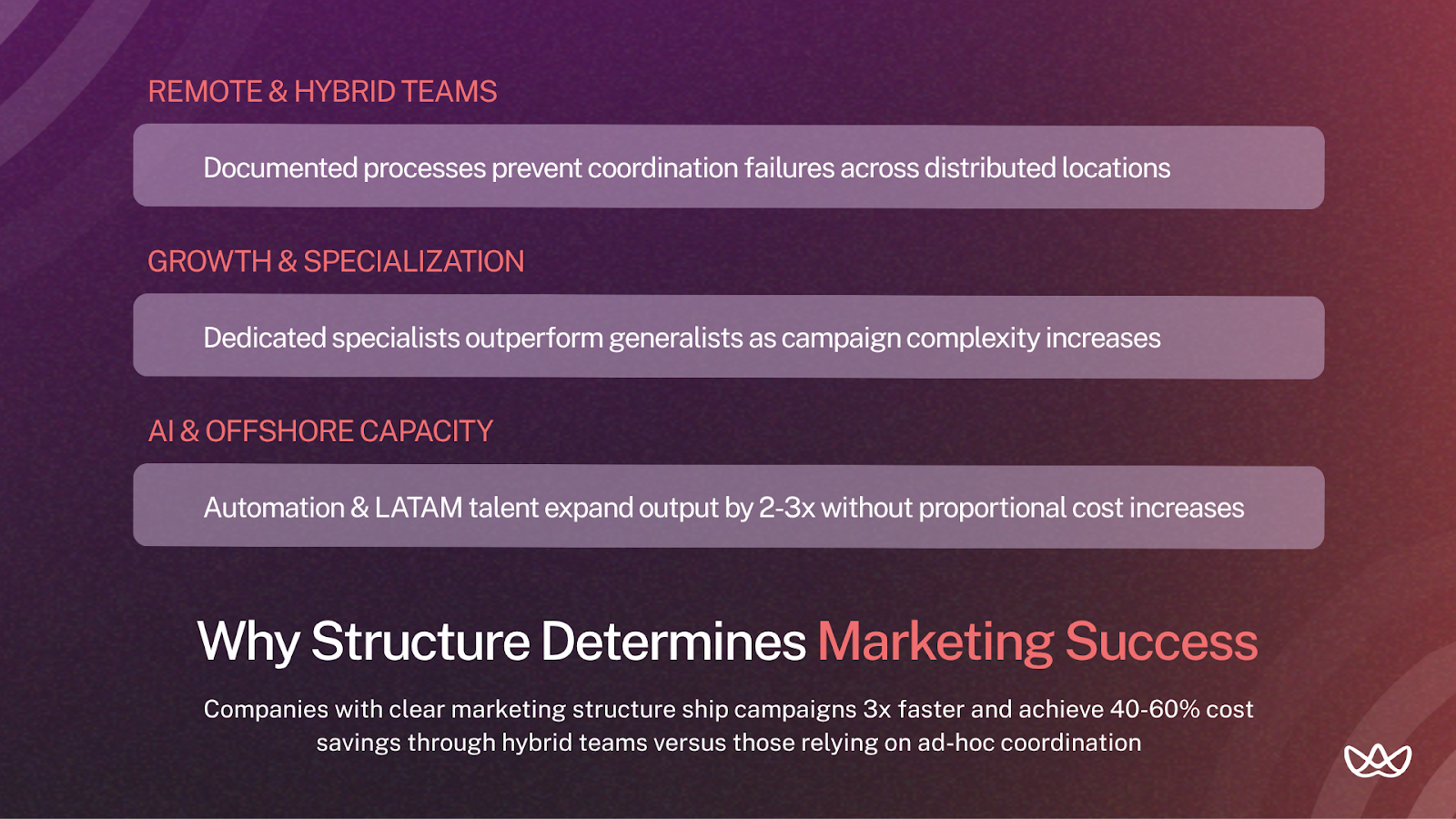
Remote and hybrid teams make structure essential. When part of your team works from an office and part from LATAM, you can’t rely on informal conversations to coordinate.
Processes need to be documented, and decision-making must be clear. Teams that invest in this upfront avoid communication breakdowns later.
2. Aligning Marketing Teams with Business Growth and Technology
Your structure should match your company’s stage. Early-stage teams rely on generalists who can cover multiple areas. As teams grow, specialization becomes necessary.
A dedicated SEO or paid media specialist will deliver better results than someone splitting time across multiple responsibilities.
Tools today allow small teams to achieve what used to require larger teams. But without clear structure, these tools add complexity instead of efficiency.
3. Integrating AI, Automation, and Offshore Support
AI and automation shift work from repetitive tasks to strategy and optimization. Offshore talent adds capacity and skills at lower cost. LATAM professionals can scale your team’s output at 40 to 60 percent lower cost than U.S.-based hires.
The team’s structure needs to reflect this. Roles move from execution only to execution plus oversight and strategy. Your team can do more without adding unnecessary headcount.
How Poor Structure Limits ROI and Speed
Without clear ownership, work duplicates or stalls. Campaigns take longer than necessary because approvals bounce between people unsure of responsibilities. Budgets get wasted on overlapping tools or agency work.
Clear structure connects strategy to execution. It allows hybrid and offshore teams to work efficiently, scale predictably, and maintain accountability.
5 Most Common Marketing Department Structures
There are several ways to organize a team, and your marketing department structure depends on your size, product mix, and how work moves through the organization.
1. Functional Structure: Organizing by Core Expertise
In a functional structure, each area (content, design, SEO, or paid media) has its own team. This setup works when you have enough people to support specialization, usually around 10 or more. Each team focuses on its area and develops depth of knowledge.
The benefit is efficiency and clear ownership. The downside is that it can slow cross-team projects if coordination is not managed well.
2. Product-Based Structure: Aligning Around Offerings
Here, marketing teams are assigned to specific products. Each team manages campaigns, messaging, and performance for its product. This setup allows teams to develop strong understanding of their product and customers.
The challenge is duplication and inconsistent practices across products. Without coordination, different teams might use different processes or tools, which can create gaps in brand consistency.
3. Channel-Based Structure: Organizing Around Distribution
Teams focus on specific channels such as SEO, social media, or paid advertising. This structure works when each channel requires specialized skills and strategies.
Channel-based teams are effective when reaching customers efficiently through different platforms is more important than product differentiation. Each team can focus entirely on optimizing its channel.
4. Customer Journey-Based Structure: Driving Lifecycle Impact
Teams are built around stages of the customer journey, like awareness, consideration, and retention. Awareness teams create top-of-funnel campaigns, consideration teams focus on educating prospects, and retention teams manage customer engagement after purchase.
This structure connects work directly to business outcomes. Teams measure success by impact on conversions and revenue rather than just completing tasks.
5. Hybrid or Matrix Models: Combining Structures
Hybrid models mix expertise-focused teams with project-specific squads. For example, a launch team might include members from content, design, paid media, and analytics, who return to their teams after the project.
These models require strong communication and clear project management. They allow faster execution for cross-functional work but can create complexity if reporting lines are unclear.
Key Roles in a Modern Marketing Department Structure
1. Leadership: CMO, Head of Growth
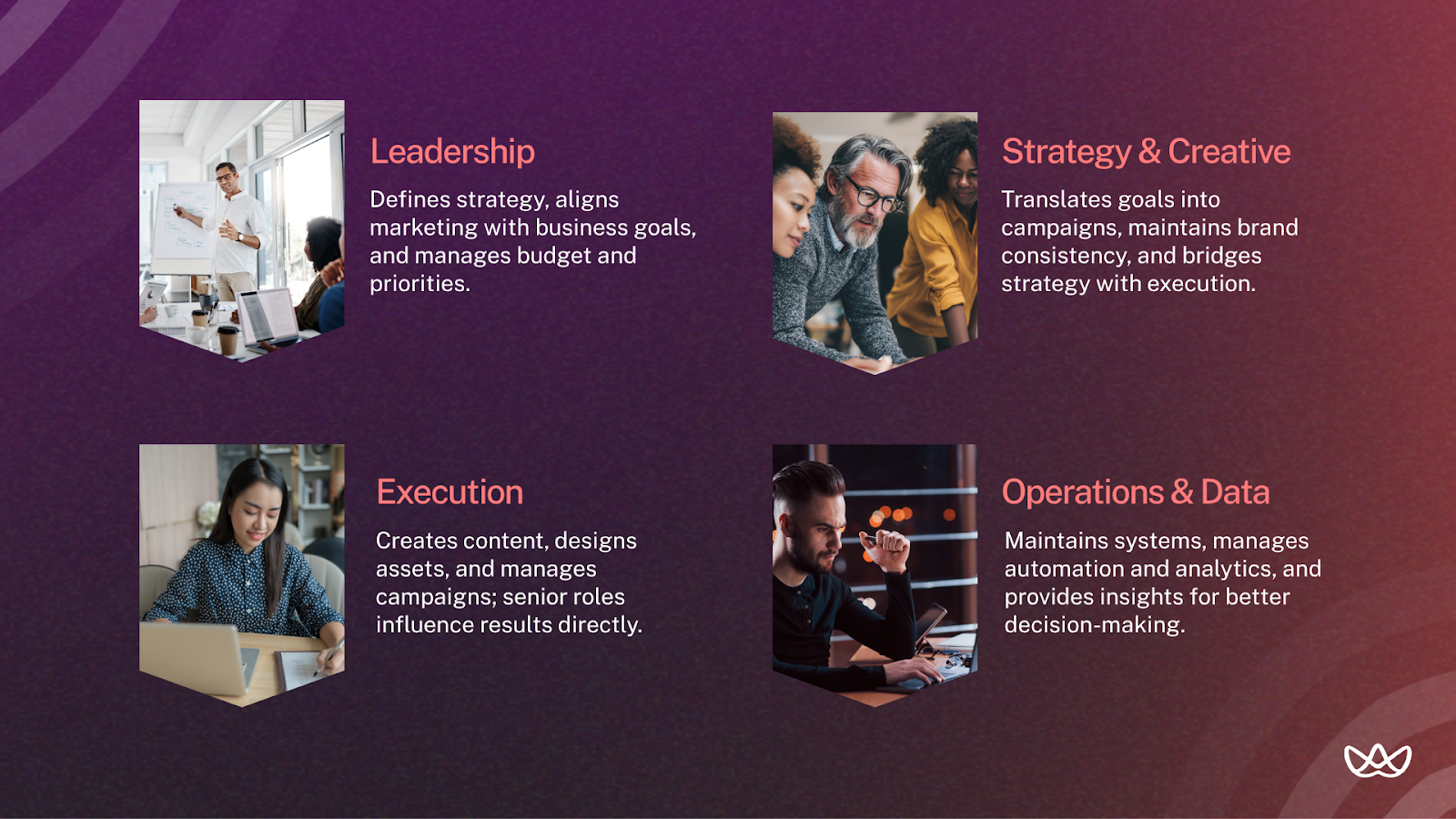
Leadership sets the direction and ensures marketing aligns with business goals. At a mid-stage company, a CMO focuses on positioning, budget allocation, and proving marketing’s impact to the board
Head of Growth roles are more common at startups, where the focus is on experimentation and rapid testing rather than brand building. The title matters less than the work itself: someone has to own the strategic layer and translate business goals into actionable marketing priorities.
2. Strategy & Creative: Brand Manager, Content Strategist, SEO Lead
These roles sit between leadership and execution. They turn strategy into campaigns that can be measured and managed.
Brand managers maintain consistency across channels and oversee messaging. Content strategists map content to objectives and manage editorial plans. SEO leads connect search strategy to content and technical initiatives.
These positions require both creative judgment and analytical thinking. They are not purely strategic nor purely executional - effective teams need people who can do both.
3. Execution: Designers, Media Buyers, Copywriters
Designers create landing pages and visuals. Copywriters write ads and content. Media buyers manage advertising spend across platforms.
Senior execution team members make decisions that directly affect results. A senior designer can influence conversion rates, and an experienced media buyer managing substantial ad spend drives measurable revenue. Strategy and execution often overlap at this level.
4. Operations & Data: CRM Manager, Analyst
Operations roles manage the systems that support marketing. CRM managers handle tools, automation workflows, and data integration. Analysts interpret data, spot trends, test hypotheses, and recommend changes.
These positions are often overlooked early on but become critical as teams scale. Without proper operations and analytics, even a skilled marketing team cannot run complex campaigns reliably.
Average Team Sizes and Reporting Lines (by Company Stage):
Startups keep it simple. A head of marketing plus a few people who can handle multiple responsibilities. Maybe a designer who also does some copywriting, a performance marketer who also manages SEO, and a content person who also handles social.
Mid-stage companies start specializing. You hire dedicated roles for major functions and add team leads to manage them. The CMO stops executing directly and focuses on coordination and strategy.
Enterprises build layers. Directors manage teams of managers who manage individual contributors. Structure becomes formal with defined processes, approval chains, and cross-functional coordination mechanisms.
Key Marketing Roles & Ideal Nearshore Fit (LATAM):
Best Tools and Technology for Marketing Department Efficiency
1. Collaboration: Slack, ClickUp, Notion
Slack handles real-time communication and organizes conversations into channels so team members see only what is relevant. ClickUp, Asana, or Monday track tasks and deadlines, giving visibility into who is working on what.
Notion centralizes documentation such as processes, templates, and strategy notes so new hires can onboard efficiently. Together, these tools help remote and hybrid teams stay coordinated.
2. Analytics: GA4, Looker, HubSpot
Analytics tools provide a single source of truth. GA4 tracks website behavior, Looker connects multiple data sources, and HubSpot combines CRM with marketing analytics. Integration is more important than the choice of individual tools.
Connected systems reduce manual work, maintain data consistency, and allow teams to make decisions with confidence.
3. Automation: HubSpot, Zapier, ActiveCampaign
Automation handles repetitive tasks such as lead nurturing, routing, and email sequences. HubSpot automates marketing processes, Zapier connects tools that do not integrate directly, and ActiveCampaign focuses on email campaigns. Automation saves time, reduces errors, and allows teams to focus on strategy.
4. AI: Jasper, ChatGPT, Notion AI
AI supports content creation and data analysis. Jasper and ChatGPT assist with drafting copy and research, while Notion AI summarizes notes and documents.
The biggest impact is on data. AI identifies patterns, trends, and anomalies that would take humans much longer to find. Human judgment is still required, but output is faster and more actionable.
How AI Tools Are Reshaping Marketing Department Structures
AI tools reduce operational slowdowns and allow smaller teams to handle more tasks efficiently. Work that once required extra hires can now be completed by existing team members using these tools.
This does not mean you need fewer people. It allows your team to focus effort on higher-value activities. For example, a content writer can spend less time on first drafts and more time on strategy, editing, and improving messaging.
Team structures adjust as certain roles become less central and new ones emerge. You may need fewer junior writers but more specialists who understand how to use AI tools effectively.
Offshore and Hybrid Marketing Department Structures
In a hybrid setup, your in-house team focuses on strategy and client communication. Offshore teams take care of execution, such as design, ad management, content production, and operational tasks.
The U.S. team defines campaigns and approves creative work. The LATAM team handles the actual production. Overlapping time zones allow collaboration during core business hours.
This approach is about extending your team’s capacity, not replacing it. For example, an agency that would need three additional designers in Austin can use five designers in Colombia for the same budget and maintain consistent output.
Roles Commonly Hired Offshore (Design, Paid Media, Operations)
Design work can be done effectively offshore. A graphic designer in Bogotá produces the same Figma files as someone in New York. Quality depends on skill and experience, not location.
Paid media management can also be handled remotely. Platforms like Facebook Ads Manager work the same everywhere. A media buyer with experience understands platform mechanics, auction dynamics, and creative testing regardless of location.
SEO specialists do not need to be physically in the U.S. to work effectively. Technical SEO, content optimization, and link building can all be done remotely. The main requirements are strong English skills and familiarity with U.S. search behavior.
Best Practices for Managing Nearshore or Offshore Teams
Make sure your in-house and offshore teams use the same tools. Project management, design software, and communication platforms should all match so nobody wastes time figuring out different systems.
Spend time on cultural onboarding. Explain how your team makes decisions, what your brand voice sounds like, and what quality looks like in practice. These details aren’t obvious from a job description but make a big difference in how well offshore team members work with you.
Set clear expectations for response times, deliverables, and meetings. Even if most work is asynchronous, regular video calls help everyone stay connected and aligned.
Compliance and Communication Considerations
When hiring offshore, use EOR platforms to stay compliant with labor and tax rules. Teams from Floowi’s nearshore solutions are bilingual, aligned with U.S. hours, and fully compliant.
Be clear about communication. Define when synchronous calls are needed and when asynchronous updates are enough. Set core hours and make sure decisions are documented so no one misses context.
How to Build a Scalable Marketing Department Structure
Startups: Generalist and Growth-Focused Teams
Early marketing teams need versatility. People wear multiple hats and take on different responsibilities without strict roles.
A typical team might include a senior person handling strategy and execution, a designer who also writes copy, and someone focused on growth channels like paid ads or SEO. Structure stays flat, decisions happen fast, and processes are minimal.
Mid-Stage Companies: Specialization and Process Alignment
Once the team grows past 8-10 people, functional leads and mid-level managers become necessary. One person manages content and social, another handles performance marketing, and someone oversees design and branding.
Processes like editorial calendars and approval workflows help keep the team aligned. Specialization improves output - dedicated SEO or media roles deliver better results than generalists splitting focus.
Enterprises: Integration and Global Coordination
With 30+ people, structure needs formality. Clear reporting lines, approval processes, and coordination are essential. Regional teams handle localization while global teams manage brand standards and large campaigns.
Leadership focuses on strategy. VPs and directors manage managers, and the CMO oversees cross-functional alignment and board communication rather than day-to-day execution.
Transitioning from Flat to Structured Marketing Teams
As your team grows, focus and process become necessary. People who handled multiple tasks will start specializing.
Communication needs structure through regular updates, meetings, and documentation.
Hiring changes too. Early hires handled flexible roles, while later hires follow defined processes. You need both and should adjust management and onboarding accordingly.
Common Mistakes in Marketing Department Structure (and How to Fix Them)
1. Overlapping Roles and Undefined Responsibilities
Make sure every deliverable has a clear owner. One person should be accountable even if multiple people contribute.
Use a RACI matrix and write job descriptions that focus on outcomes, not vague tasks.
2. Neglecting Data and Performance Measurement
Track every campaign with clear metrics tied to business outcomes, like leads or revenue, not just impressions.
Use dashboards to maintain visibility and review performance regularly to adjust resources toward higher-performing initiatives.
3. Underutilizing Offshore or External Talent
Offshore teams can handle production-heavy roles such as design, content, video editing, and ad management efficiently.
Hybrid structures, where strategic roles stay in-house and execution moves offshore, often deliver better results at lower cost.
How to Reorganize an Underperforming Marketing Department
Start by auditing workflows and identifying where campaigns get delayed. Talk with team members to understand issues from their perspective.
Restructure around outcomes rather than functions, for example, forming cross-functional teams like “demand generation” or “customer marketing” that own results rather than tasks.
Best Practices for Building a Sustainable Marketing Department
- Keep strategic leadership in-house and move production offshore. Your senior team manages planning, campaigns, and client communication while offshore teams handle design, content, and ad execution.
- Use automation to handle repetitive tasks like email nurturing, lead scoring, and reporting. Focus your team on strategy and optimization.
- Invest in continuous training and cross-team collaboration. Regular check-ins prevent overlap, improve coordination, and help teams adapt as tools and processes evolve.
- Define clear career paths to retain talent and show growth opportunities within the organization.
Getting Started
In 2026, a marketing team works best when leadership stays in-house, repetitive tasks are automated, and execution can be handled offshore. LATAM talent lets you scale capacity and speed without losing quality or creative control.
Build a marketing department structure that scales. Start with Floowi’s nearshore talent and cut costs while increasing output.
Also check out our 10 Offshore Outsourcing Examples for Business Efficiency
Frequently Asked Questions
What marketing structure works best for B2B vs. B2C companies?
B2B companies often prefer functional models focused on content and demand generation. B2C benefits from channel-based or hybrid models that emphasize platform-specific expertise and rapid testing.
When should I transition from generalist to specialist marketing structure?
Once campaign complexity requires role-specific ownership, typically around 8-10 team members. If people constantly context-switch between completely different tasks, specialization will improve output quality.
Which marketing roles are best suited for offshore hiring?
Design, media buying, SEO, content production, and marketing operations. Roles focused on execution rather than strategy or stakeholder management translate well to offshore models.
How does AI change traditional marketing department structure?
AI automates repetitive tasks, enabling leaner teams to produce more. This shifts role focus from pure execution toward strategy, optimization, and creative problem-solving.
What's the ideal ratio of strategists to executors in marketing?
Roughly 1:4 in high-growth companies. One strategic lead can effectively guide four execution-focused team members. This ratio shifts based on complexity and seniority.
Should all marketers report to the CMO or have sub-teams?
Depends on team size. Under 10 people, direct CMO reporting works fine. Above that, functional leads or directors managing sub-teams improve span of control and decision speed.
Can I mix in-house, agency, and offshore in one marketing structure?
Yes. Hybrid structures balance speed and cost. In-house handles strategy and core brand work, offshore provides execution capacity, and agencies supplement with specialized expertise as needed.
What KPIs should each marketing role own?
Align KPIs to role function. Content owns engagement and organic traffic. Paid media owns CPA and ROAS. SEO owns keyword rankings and organic conversions. Everyone should connect their metrics to revenue.
How can offshore and hybrid structures reduce marketing overhead?
They lower salary costs by 50-60% while expanding production capacity. This allows building larger teams at the same budget or maintaining smaller teams while increasing output.




