






Hiring remote staff is no longer an edge case. For many U.S. companies, it’s now part of how teams are built and scaled. When you hire remote staff, you’re hiring people who work outside a central office, often across regions and time zones.
Gallup data shows this shift clearly. In remote-capable U.S. roles, 26% of employees work fully remote and 52% work in hybrid setups. Only about one in five remain fully on-site. Remote work is now the norm, not the exception, and hiring practices need to reflect that.
For employers, remote hiring opens access to global talent pools, speeds up hiring for hard-to-fill roles, and helps control costs. It also introduces new challenges around vetting, compliance, payroll, and onboarding.
Let’s look at how to hire remote staff effectively, from hiring models to long-term team performance.
Why Hire Remote Employees
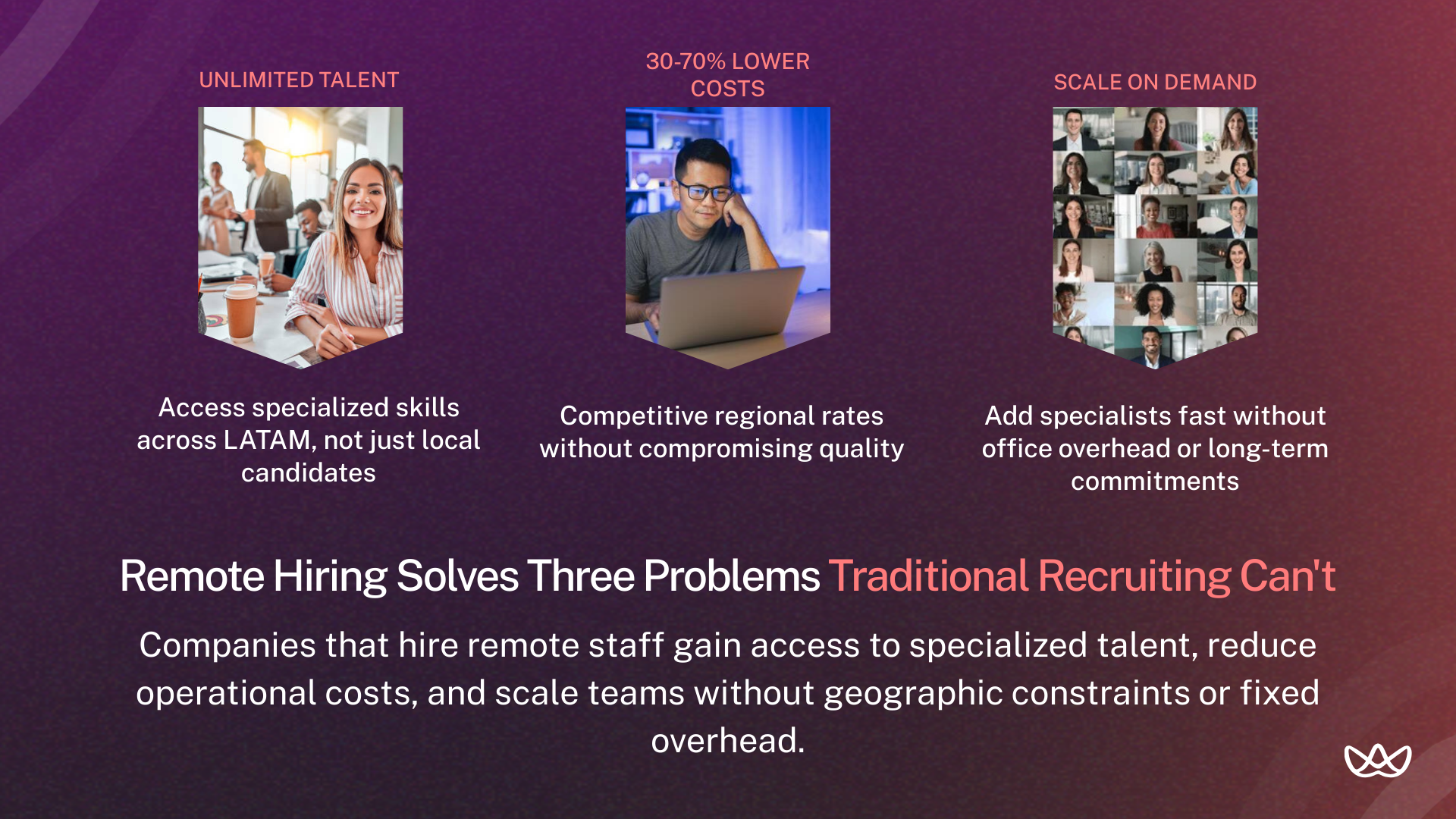
Remote hiring solves several problems that traditional local-only hiring can't address. The shift isn't just about pandemic-era workarounds. It's about accessing better talent faster while controlling costs.
1. Access to a Global Talent Pool
Local hiring limits you to whoever lives within commuting distance. Remote hiring removes geography from the equation entirely. You can recruit from thousands of qualified candidates instead of dozens.
Latin America has been known as one of the strongest regions for remote talent. Engineers, designers, marketers, and support specialists in countries like Mexico, Colombia, Argentina, and Brazil work in overlapping time zones with the U.S. Many professionals in these markets are bilingual and familiar with U.S. business practices. When you need a senior developer or account manager, you're no longer stuck waiting months for the right local candidate to appear.
The Floowi 2025 LATAM Hiring Benchmarks show that LATAM professionals bring technical depth and cultural alignment that makes cross-border collaboration work smoothly.
2. Cost Savings and Competitive Advantage
Remote hiring often costs significantly less than domestic hiring. For example, a senior digital marketing manager earning $110k in the U.S. may cost $45k–$65k in LATAM with similar skills and experience.
This isn’t about unfair wages - cost of living varies by region. A salary modest in New York can support a comfortable lifestyle in Mexico City or Bogotá. Paying competitive local rates attracts top talent while maintaining healthy margins.
Lower costs also let you build more specialized teams. Instead of one generalist handling multiple roles, you can hire dedicated marketing, creative, or content specialists without stretching your budget.
3. Flexibility, Scalability and Productivity Gains
Remote teams let you scale up or down without the friction of office leases or physical infrastructure. When a project ramps up, you can add contractors or part-time specialists. When it winds down, you’re not stuck with fixed overhead.
Productivity data challenges the old assumption that remote workers slack off. A 2024 Zoom report, Navigating the Future of Work, shows that 84% of employees feel more productive in hybrid or remote setups. Workers save an average of 54 minutes daily on commuting, and most reinvest that time into work tasks.
Flexibility also improves coverage. With team members across time zones, you can extend support hours or keep projects moving around the clock without forcing anyone into overnight shifts.
What It Really Costs to Hire Remotely (And How to Budget)
Hiring remotely includes more than salaries. You need to budget for regional pay differences - LATAM roles cost less than U.S. or Western Europe but are rising 8-20% annually - plus payroll, taxes, and compliance, which vary by country. Equipment, software, recruitment, and onboarding also add significant costs, so planning holistically ensures your remote hires are productive and legally compliant from the start.
For most U.S. companies, hiring remote staff in LATAM reduces total labor costs by 30-70% compared to domestic hires.
Salaries Across Regions & Cost Differentials
Salary expectations vary significantly by region. Software developers in LATAM earn between $53k–$63k annually for roles that would cost $85k-$160k in the U.S. Marketing managers, customer support specialists, and finance professionals show similar patterns.
U.S. salaries remain the highest globally, followed by Western Europe, then LATAM, with Asia-Pacific and Eastern Europe offering additional cost tiers. The cost differential reflects local purchasing power and market conditions rather than skill.
Payroll, Currency & Tax Considerations
Paying international staff introduces complexity. You need to handle currency conversion, local tax withholding, and compliance with each country's employment regulations. Most employers use payroll platforms, Employer of Record (EOR) services, or local entities to manage this.
EORs handle tax filings, benefits administration, and legal compliance for a monthly fee (typically 15–25% of salary), removing the need to establish a legal entity in each country.
Legal and Compliance Requirements
Misclassifying workers creates legal exposure. Different countries have different rules about what counts as an employee versus a contractor. In many LATAM countries, someone working exclusively for you and following your schedule is legally an employee regardless of contract wording.
Employee classifications come with requirements around severance, vacation, holidays, and profit-sharing. For example, Mexico limits workweeks to 48 hours and mandates 10% profit-sharing, while Colombia requires 15 consecutive days of leave after one year of employment. Using an EOR or local legal counsel reduces risk significantly.
Equipment, Setup & Infrastructure Costs
Remote employees need laptops, monitors, software licenses, and reliable internet. Some companies provide full hardware packages ($1.5k–$3k upfront), while others offer stipends.
Software subscriptions add $50-$150 per person monthly for tools like Slack, Zoom, project management platforms, and role-specific applications. Budget these costs upfront rather than as an afterthought; properly equipped employees are far more productive.
Recruitment, Onboarding & Hidden Expenses
Finding and vetting candidates takes time. Internal recruitment can require 20–40 hours per hire. Agencies charge 15-25% of first-year salary - for a $60k role, that’s $9k–$15k.
Onboarding includes training, documentation, and reduced productivity during the first 30-90 days. Budget 25-50% of salary for the first quarter to account for ramp-up time.
Freelance vs Contractor vs Employee vs Agency
Each hiring model works differently in terms of cost, speed, control, and reliability. Freelancers give you flexibility but can be less consistent, contractors keep ongoing work moving smoothly, employees provide stability for your core team, and agencies bring expertise fast - though usually at a higher cost.
Where and How to Source Remote Candidates
Finding remote talent starts with picking the right channels for your needs. Job boards provide lots of applicants but require careful screening, marketplaces let you hire quickly but can be less consistent, professional networks are best for passive or senior candidates, and agencies save time while ensuring compliance - especially for LATAM hires.
Remote Job Boards
Platforms like We Work Remotely, Remote.co, and FlexJobs reach candidates actively looking for remote work. You can get 50–200 applications per post, which is great for common roles but means more screening. Job boards work best if you have clear requirements and internal bandwidth, but they’re less effective for senior or specialized roles where passive candidates dominate.
Freelance & Contract Marketplaces
Upwork, Toptal, and Contra connect you with independent professionals and handle payments and ratings.
You can hire quickly - often within days - but freelancers juggle multiple clients, which can affect availability. Marketplaces are ideal for defined projects like website design, content creation, or short-term development sprints.
Professional Networks & Social Platforms
LinkedIn is strong for experienced professionals, letting you search by skills, location, and experience. Referrals from your team also produce high-quality hires. Social platforms work well for passive recruiting: you reach out to strong candidates directly. It takes more time but often yields better results for senior roles.
Staffing, Outsourcing Agencies & Global Talent Hubs
Agencies vet and shortlist candidates, saving you time and reducing risk. You interview a few pre-qualified people instead of sorting through hundreds of applications. LATAM-focused agencies also navigate local work culture, salaries, and legal requirements, making it faster and easier to build compliant teams across Mexico, Colombia, and Argentina.
For companies serious about building LATAM teams, working with specialists makes the process faster and more reliable.
Step-by-Step Hiring Process
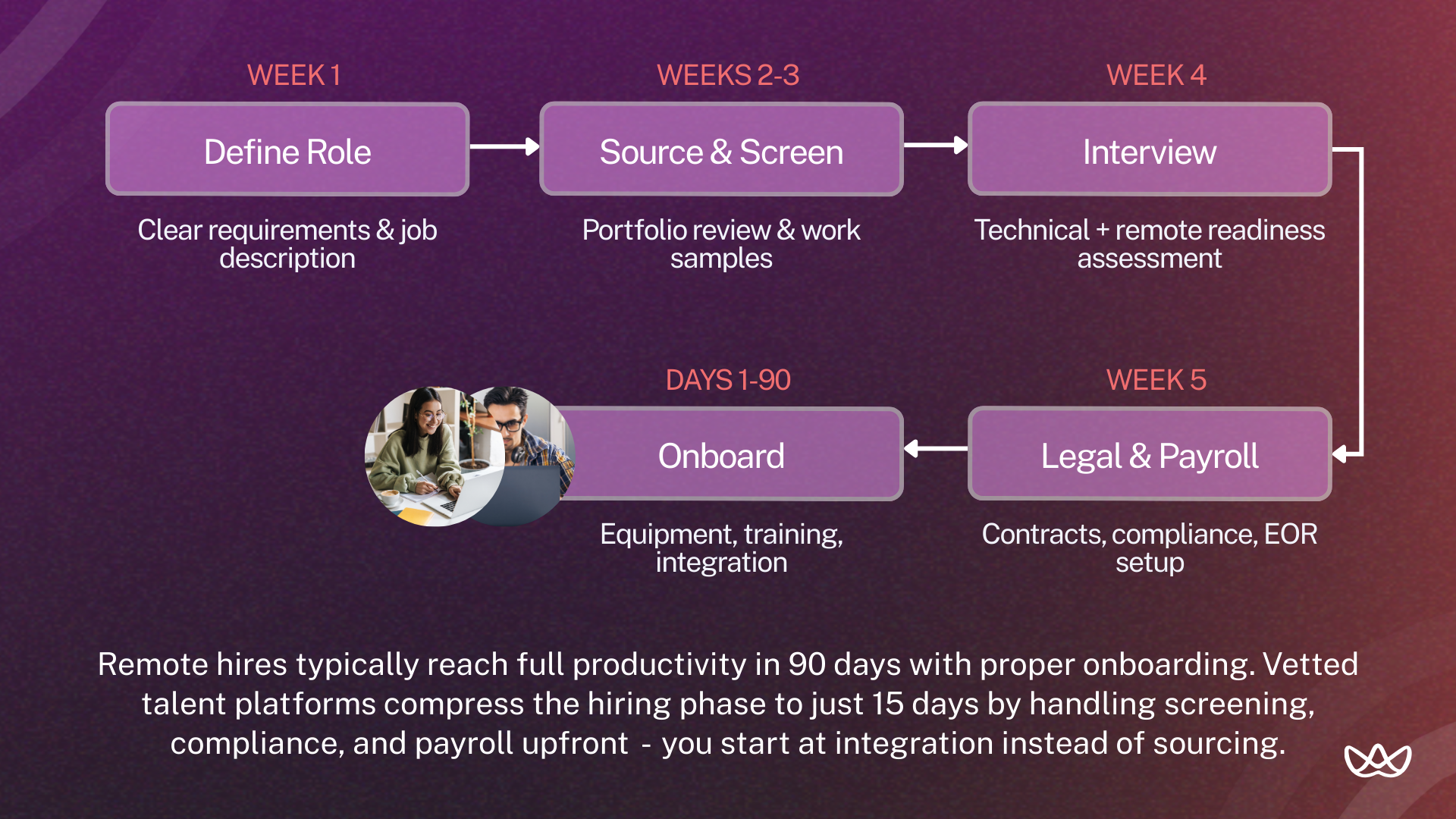
A successful remote hire starts with clear roles and expectations, the right hiring model, and thorough screening. Vet candidates with portfolios, references, technical tests, and communication samples. Handle legal, payroll, and compliance upfront, and plan a structured 30–90 day onboarding to set milestones and ensure early alignment.
Define Roles, Expectations and Job Descriptions Clearly
Vague job descriptions attract vague candidates. Before posting anything, document exactly what success looks like in this role.
Define core responsibilities, required skills, and how performance will be measured. Specify working hours expectations, required overlap with your time zone, and communication norms.
For remote roles, add details about tools and systems they'll use, how often they'll meet with the team, and what autonomy level they'll have. Clear expectations upfront prevent misalignment later.
Choose the Right Hiring Approach (Freelance, Contractor, Employee, Agency)
Match your hiring model to the work you need done. For a three-month website redesign, hire a freelance designer. For ongoing customer support, hire full-time employees or contractors.
Consider how much control you need. Freelancers work independently on deliverables. Employees integrate into your team and follow your processes. Agencies provide turnkey solutions but operate semi-autonomously.
Budget matters too. Employees cost more upfront but often deliver better value long-term. Freelancers and agencies cost more per hour but require no benefits or infrastructure investment.
Screening and Thorough Candidate Assessment
Screening separates strong candidates from weak ones before you invest interview time. Review portfolios, GitHub profiles, writing samples, or design work depending on the role.
Check references thoroughly. Ask previous managers or clients specific questions about work quality, communication style, and reliability. Generic "they were great" responses don't help. Probe for details.
Vetting Checklist:
- Portfolio proof points showing relevant work
- Reference checks with specific behavioral questions
- Technical tests or work samples demonstrating core skills
- Async communication sample to assess writing clarity
- Timezone availability and overlap with your team
For technical roles, give candidates real problems to solve. A 2-hour coding challenge or design exercise reveals far more than resume claims about proficiency.
Test asynchronous communication skills explicitly. Remote work requires clear written communication. Ask candidates to document a process, explain a technical concept, or respond to a mock support ticket. This shows whether they can communicate effectively without real-time back-and-forth.
Handle Legal, Payroll and Compliance Early
Don't wait until after you've made an offer to figure out legal requirements. Research local employment law, tax obligations, and compliance needs before you start interviewing.
Decide whether you'll hire as an employee or contractor. Each has different legal implications. Employees get more protections and benefits but cost more. Contractors offer flexibility but carry misclassification risk if they work exclusively for you.
Set up payroll infrastructure before your start date. Using an EOR service makes this straightforward. They handle tax withholding, benefits enrollment, and compliance documentation.
Onboarding Process: First 30-90 Days Planning
Onboarding determines whether new hires succeed or struggle. Plan their first 90 days before they start, not after.
Week one should cover logistics: equipment setup, system access, team introductions, and basic process training. Week two through four should involve real work with close support. By day 30, they should be contributing independently on smaller tasks.
Set clear milestones for 30, 60, and 90 days. Define what "success" looks like at each checkpoint. Schedule regular check-ins to address questions and course-correct early if needed.
Smart Interview Strategies for Remote Hires
Interviews need to capture both technical skills and remote work readiness - standard questions alone don’t tell the full story.
Core Questions for Any Remote Role
These help you see how candidates perform when no one’s watching:
- How do you structure your day when working independently?
Strong candidates describe routines, productivity systems, and task prioritization. Watch for self-discipline: do they set deadlines, track work, and avoid distractions without oversight? - Which tools have you used for remote collaboration?
Adaptability matters more than tool knowledge. Look for familiarity with async platforms like Slack, Asana, Figma, or GitHub, and evidence they can learn new tools quickly. Candidates who rely only on synchronous communication may struggle remotely. - Describe a remote-work challenge you overcame.
The best answers are specific: situation, action, result. “I handled timezone differences by recording video updates for my European client, reducing meetings and keeping the project on track” shows initiative. “I just dealt with it” does not. - How do you handle different time zones?
Effective remote workers plan overlap hours, use async updates, and schedule proactively while maintaining boundaries. - What keeps you motivated and connected remotely?
This reveals self-motivation and cultural fit. Remote workers thrive on outcomes, not visibility. If a candidate relies heavily on in-person interaction for motivation, remote work may not suit them.
Role-Specific Questions
Customize questions to test skills for the role:
- Developers: coding challenges, architecture discussions, remote debugging.
- Designers: portfolio review, critique exercises, async collaboration skills.
- Support: scenario-based questions to assess written communication and problem-solving.
Interview Rubric
Use this to standardize scoring:
Legal, Payroll & Contract Considerations for Remote Staff
How you structure employment from the start shapes taxes, legal risk, and compliance - getting it right upfront prevents headaches later.
Employment vs. Contractor vs. Agency
- Employees work directly with you, follow your processes, and integrate into your team. You handle taxes, benefits, and local employment rules.
- Contractors stay independent, control their own schedule, and deliver on agreed outcomes. They often cost more per hour but don’t need benefits.
- Agencies employ the person or team themselves, handle all obligations, and deliver pre-vetted talent. You have less control but reduce legal risk.
The right choice depends on how much control you need, your budget, and your risk tolerance. Core long-term roles usually work best as employees, while specialized or short-term work suits contractors or agencies.
Compliance, Taxes & Labor Laws
Each country has its own rules. Key areas include minimum wage, benefits, vacation and sick leave, working hours, and sometimes profit-sharing. Misclassifying someone as a contractor when they meet the legal definition of an employee can trigger back taxes and penalties. Local legal counsel or EOR services can help you stay compliant.
Payment Methods, Currency & Benefits
Reliable payment systems are essential - options include wire transfers, PayPal, Wise, Payoneer, or EOR platforms. Many companies pay in USD to avoid currency swings and sometimes adjust for local inflation.
Benefits requirements vary: health insurance, retirement contributions, or meal allowances may apply depending on the country.
Equipment Provision & Remote Work Infrastructure
Decide if you’ll provide equipment or give stipends. Full provisioning ensures security and consistency; stipends give employees flexibility. Budget roughly $2k–$4k per employee upfront for laptops, monitors, and software, plus $50-$200 per month for ongoing tools and services.
Onboarding and Integrating Remote Employees
Good onboarding gets new hires contributing fast and feeling part of the team. Skip it, and they get confused, frustrated, and more likely to leave.
Setting Expectations and Goals From Day One
Start with clarity: responsibilities, success metrics, and how performance will be measured. Put everything in writing - a welcome document with team structure, communication norms, tools, contacts, and immediate priorities helps new hires get up to speed.
Set specific 30-, 60-, and 90-day goals that are measurable. Instead of “learn our codebase,” say “complete three small feature tickets with minimal guidance.”
Fostering a Strong Remote Company Culture
Culture doesn’t happen automatically in remote teams. Build it intentionally. Encourage informal interactions through virtual coffee chats or async social channels.
Recognize achievements publicly and consistently. Trust is critical -focus on outcomes, not monitoring when work happens.
Providing Training, Tools and Support
New hires need clear training on systems, processes, and expectations. Assign a buddy or mentor for guidance during the first month. Ensure tools and system access are ready on day one to avoid wasted time.
Building Communication Rituals & Feedback Cycles
Create regular, predictable communication: daily standups, weekly meetings, and monthly one-on-ones. Mix synchronous and asynchronous updates: use live meetings for complex discussions and written updates for status reports. Provide continuous feedback—don’t wait for quarterly reviews.
Onboarding Framework Checklist:
Pre-start setup:
- Equipment ordered and shipped
- System access configured
- Welcome document sent
- Buddy assigned
Week 1 goals:
- Complete system access verification
- Meet all team members
- Understand first priority project
- Review all core documentation
30-day milestones:
- Complete first meaningful deliverable
- Demonstrate tool proficiency
- Participate in team meeting
- Submit first status update
60-day milestones:
- Work independently on assigned tasks
- Identify one process improvement
- Complete technical or role certification
- Present work to broader team
90-day milestones:
- Operate at full productivity
- Mentor incoming team member
- Contribute to planning or strategy
- Demonstrate mastery of core responsibilities
Feedback checkpoints:
- End of week 1 check-in
- Day 30 formal review
- Day 60 performance discussion
- Day 90 comprehensive evaluation
Documentation & handovers:
- Create personal process documentation
- Update team knowledge base
- Document tools and systems used
- Identify documentation gaps
Managing and Scaling a Remote Team Long-Term
Running a remote team long term means focusing on outcomes, keeping communication open, and being deliberate about culture and growth. When expectations stay clear and people see how they can improve and advance, teams scale without losing momentum.
Establishing Clear KPIs, Deliverables, and Accountability
You can’t see people at their desks, so focus on results. Set measurable KPIs - like tickets completed for developers or resolution time for support. Track deliverables, not hours. Make project ownership transparent so everyone knows who’s responsible for what.
Encouraging Open Communication and Transparency
Information silos kill remote teams. Document not just decisions, but the reasoning behind them. Create separate channels for updates, discussions, and urgent issues.
Encourage questions - no one should guess or stay silent.
Maintaining Culture, Engagement and Team Cohesion
Remote teams need intentional connection. Hold regular all-hands meetings, virtual coffee chats, or casual online sessions.
Recognize achievements specifically: instead of generic “good job,” highlight exactly what someone did and its impact.
Professional Development and Growth Opportunities
Career growth doesn’t happen by accident remotely. Offer learning budgets, mentorship opportunities, and clear promotion paths. When people see colleagues growing, they believe growth is real.
When & How to Scale: From Solo Remote Hires to Distributed Teams
Scaling remote teams follows different patterns than scaling office teams. You can add people across geographies without physical constraints, but coordination complexity increases.
Start with one or two hires. Learn what works before adding ten people. Get comfortable with communication patterns, time zone management, and cultural integration.
As you grow beyond 5–10 people, add structure. Team leads, clearer specialization, more formal processes. What worked with three people informally won't scale to thirty.
Consider regional clusters. Instead of one person in ten countries, build small teams in two or three regions. This creates local community and reduces timezone complexity.
Common Mistakes & Challenges - And How to Avoid Them
Most remote hiring problems are predictable and preventable. Here are the patterns we see repeatedly.
Difficulty Finding Qualified Global Candidates
Many companies struggle with sourcing because they're looking in the wrong places or with unrealistic expectations.
Relying only on job boards generates volume but not quality for specialized roles. Senior talent isn't browsing We Work Remotely daily. They're employed and need to be recruited actively.
Fix this by diversifying sourcing. Use LinkedIn for passive recruiting. Work with agencies that specialize in your target region or skill set. Build referral programs that reward employees for bringing in strong candidates.
Poor Skill Verification and Vetting
Resumes lie. Portfolios can be inflated or borrowed. Without proper vetting, you hire people who can't actually do the work.
Implement work samples as standard practice. For developers, require solving a real problem. For writers, request original content. For designers, ask them to critique existing work and propose improvements.
Check references thoroughly. Don't just confirm employment dates. Ask specific behavioral questions about how they handled challenges, worked with teams, and delivered under pressure.
Cultural Fit and Time-Zone Misalignment
Hiring someone whose working hours barely overlap with yours creates constant friction. They're starting when you're ending. Questions sit unanswered for 12+ hours.
Require minimum overlap periods. For U.S. companies, hiring in LATAM provides 3–5 hours of daily overlap. Hiring in Asia means minimal overlap and far more communication challenges.
Cultural fit matters but isn't about everyone being the same. Look for alignment on communication styles, work values, and approach to collaboration. Someone who needs constant reassurance won't thrive on a team that values independent problem-solving.
Payroll and Compliance Oversights
Treating compliance as an afterthought creates legal exposure. Tax authorities in various countries are increasingly aggressive about pursuing misclassified workers.
Use EOR services if you're not ready to establish legal entities abroad. Yes, they cost 15–25% of salary, but that's far cheaper than legal penalties and back taxes.
Review classification decisions annually. As roles evolve, someone who started as a legitimate contractor might meet the legal definition of an employee. Stay ahead of this.
Weak Onboarding and Low Retention Risks
People quit remote jobs at higher rates when onboarding is poor. They feel disconnected, unclear about expectations, and uncertain whether they're succeeding.
Invest in structured onboarding. Create checklists, assign buddies, schedule regular check-ins. The first 90 days determine whether someone stays or starts job hunting.
Measure onboarding effectiveness. Survey new hires at 30, 60, and 90 days. Ask what's working and what's confusing. Use that feedback to improve the process continuously.
Risk Matrix
Remote hiring comes with real risks, but most are predictable and manageable if you plan ahead. The matrix below highlights common issues companies face, how likely they are to occur, and what practical steps reduce their impact.
Frequently Asked Questions
How Do Remote Teams Provide Access to Specialized Global Talent?
Remote hiring removes geographic constraints, so you hire based on capability rather than proximity. This is especially valuable for specialized roles like growth marketing, lifecycle marketing, analytics, creative direction, and RevOps, where qualified local candidates are often scarce or expensive.
What Cost Savings Can Companies Expect Compared to Local Hiring?
U.S. companies commonly reduce labor costs by 30-70% when hiring in LATAM for comparable roles. The savings come from regional cost-of-living differences and lower overhead, not reduced expectations. When companies pay strong local market rates, they still attract experienced, competitive talent.
What Are Salary Benchmarks Across U.S., LATAM, EU, and APAC?
As of 2026, senior roles typically fall in these ranges: $85k–$160k in the U.S., $50k–$65k in LATAM, $70k–$100k in Western Europe, and $40k–$70k in parts of APAC. Marketing, design, and support roles follow similar regional patterns, with seniority, specialization, and local demand driving variation.
What Specialized Marketplaces Are Best for Remote Hiring?
Toptal works well for senior technical and creative roles where deep vetting matters. Upwork fits flexible contract needs. Contra suits creative work. For companies hiring long-term roles in LATAM, Floowi is often the best option when you want vetted professionals who work U.S. hours, integrate into teams, and stay long term rather than rotate between clients.
When Should Companies Hire Full-Time Remote Employees?
Hire full-time when the role is ongoing, tied to core operations, and requires long-term context and ownership. If success depends on deep collaboration and institutional knowledge, full-time remote employees usually outperform rotating contractors.
How Do Companies Build Efficient Screening Processes?
Efficient screening relies on proof, not promises. Work samples, structured interviews, reference checks, and async communication tests reveal how candidates actually operate. Resumes help with filtering, but performance signals matter more.
What Core Questions Test Remote-Work Readiness?
Strong questions focus on autonomy, communication, and accountability. Ask how candidates structure their day, manage time zones, communicate progress without meetings, and recover from blockers. Specific systems and examples signal readiness.
How Do Companies Decide Between Employee vs. Contractor vs. EOR?
Employees fit long-term, business-critical roles when you can manage compliance. Contractors work best for defined projects or fluctuating demand. EORs allow you to hire full-time internationally without setting up local entities, reducing compliance risk while keeping control.
Next Steps for Your Company
Start by identifying which roles could work remotely. Not every position fits remote work, but most knowledge work does. Decide whether you'll hire employees, contractors, or work with agencies based on your control needs and timeline.
Research legal requirements and compliance for your target regions. Set up payroll infrastructure or partner with an EOR before you start recruiting. This prevents delays when you're ready to hire.
Build job descriptions that emphasize remote work requirements alongside technical skills. Test your interview process to ensure it assesses both capability and remote-work readiness.
Hire vetted remote talent across LATAM today with Floowi and start building your high-performing remote team. Book your free consultation today.