


.png)



U.S. companies are increasingly turning to global talent providers to hire skilled professionals faster, reduce hiring costs, and navigate the complexity of international payroll and compliance. These providers connect businesses with pre-vetted talent in marketing, creative, engineering, and operations, handling sourcing, contracts, and legal requirements.
Remote work has opened access to global talent pools, often 40% to 70% more cost-effective than U.S. hires. Nearshore LATAM providers are especially popular because of time zone overlap and cultural alignment with American teams.
Let’s explore what global talent providers do, compare the top options for 2026, and see how to choose the right approach for your team.
What Is a Global Talent Provider?
A global talent provider is a company that helps businesses hire full-time international employees by handling sourcing, vetting, compliance, payroll, and onboarding across borders.
They work with remote talent in regions like LATAM, Eastern Europe, or Southeast Asia, giving companies access to needed skills without managing legal and administrative hurdles.
Many also act as an Employer of Record, so businesses can hire full-time staff abroad without setting up a local entity.
What "Global Talent" Really Means
Global talent refers to skilled professionals located outside your home country who work remotely for your organization. A global talent provider is a company that sources, vets, and facilitates the hiring of these international professionals while managing compliance, payroll, and onboarding logistics.
Unlike freelance platforms where you post jobs and sift through applications yourself, global talent providers do the screening upfront. They present candidates who match your requirements, have verified skills, and are ready to start within days or weeks rather than months.
How a Global Talent Provider Differs from Traditional Hiring Models
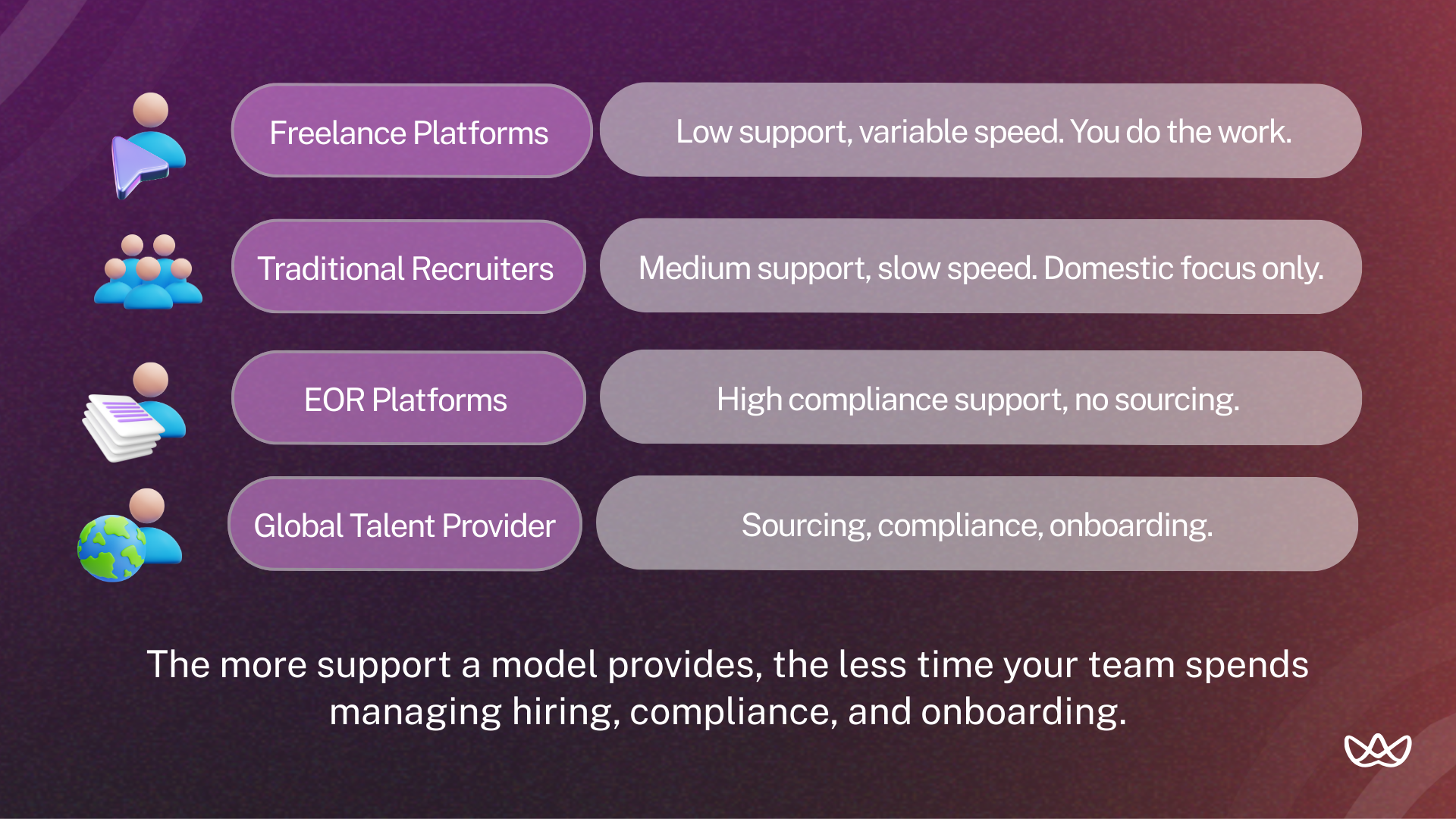
Hiring internationally can be confusing, and each model works differently:
- Traditional recruiters: Focus on local candidates and charge 15% to 25% of first-year salary. Limited global reach and no compliance support.
- Freelance platforms (Upwork, Fiverr): Marketplaces where you manage vetting, contracts, and payments. Quick access to talent but quality can vary. No full-time employment relationship.
- BPOs (Business Process Outsourcing): Take over entire functions like customer support. Less flexibility for individual roles and often offshore with time zone gaps.
- EOR-only providers: Handle payroll and legal employment but don’t source candidates - you still need to find talent yourself.
- Global talent providers: Combine sourcing, vetting, compliance, and ongoing support. They match qualified candidates to your specific needs and handle legal and administrative tasks so you can focus on your business.
Why U.S. Companies Hire Dedicated Remote Staff Through Global Talent Providers
U.S. companies use global talent providers to fill skill gaps and cut costs. They provide pre-vetted professionals in LATAM, Europe, and Asia, allowing faster team scaling and round-the-clock collaboration. Many act as an Employer of Record, letting companies hire abroad without setting up local entities.
1. Access to Pre-Vetted Global and Nearshore LATAM Talent
The vetting process matters more than the size of the talent pool. Global talent providers screen for technical skills, English proficiency, remote work readiness, and cultural fit before presenting candidates.
LATAM talent specifically offers strong English skills developed through education and prior work with American clients. Professionals from Mexico, Colombia, Argentina, and Brazil understand U.S. business culture and communication styles, which reduces onboarding friction.
2. Faster Hiring for Marketing, Creative and Tech Roles
Traditional U.S. hiring takes 30 to 90 days from job posting to start date. Global talent providers compress this to 7 to 21 days for most roles.
The speed comes from maintained candidate pools. Providers continuously source and vet talent, so when you have a need, qualified candidates are already available. You skip the weeks spent posting jobs, screening resumes, and coordinating initial interviews.
3. Cost Efficiency vs. U.S.-Based Hiring (U.S. vs LATAM Cost Comparison)
A senior marketing manager costs $90K–$130K annually in the U.S. The same role in Latin America costs $35K-$55K with comparable skills. Similarly, a senior graphic designer or content strategist in the U.S. ranges from $80K-$120K, while in LATAM it’s $30K-$50K.
These savings add up across teams. Hiring five marketing or creative roles in LATAM can save $180K–$350K per year without compromising quality.
4. Time-Zone Alignment and Operational Scalability
LATAM professionals work during U.S. business hours. A marketing or creative team member in Colombia or Mexico overlaps with your full workday, enabling real-time collaboration, same-day feedback, and participation in team meetings without awkward scheduling.
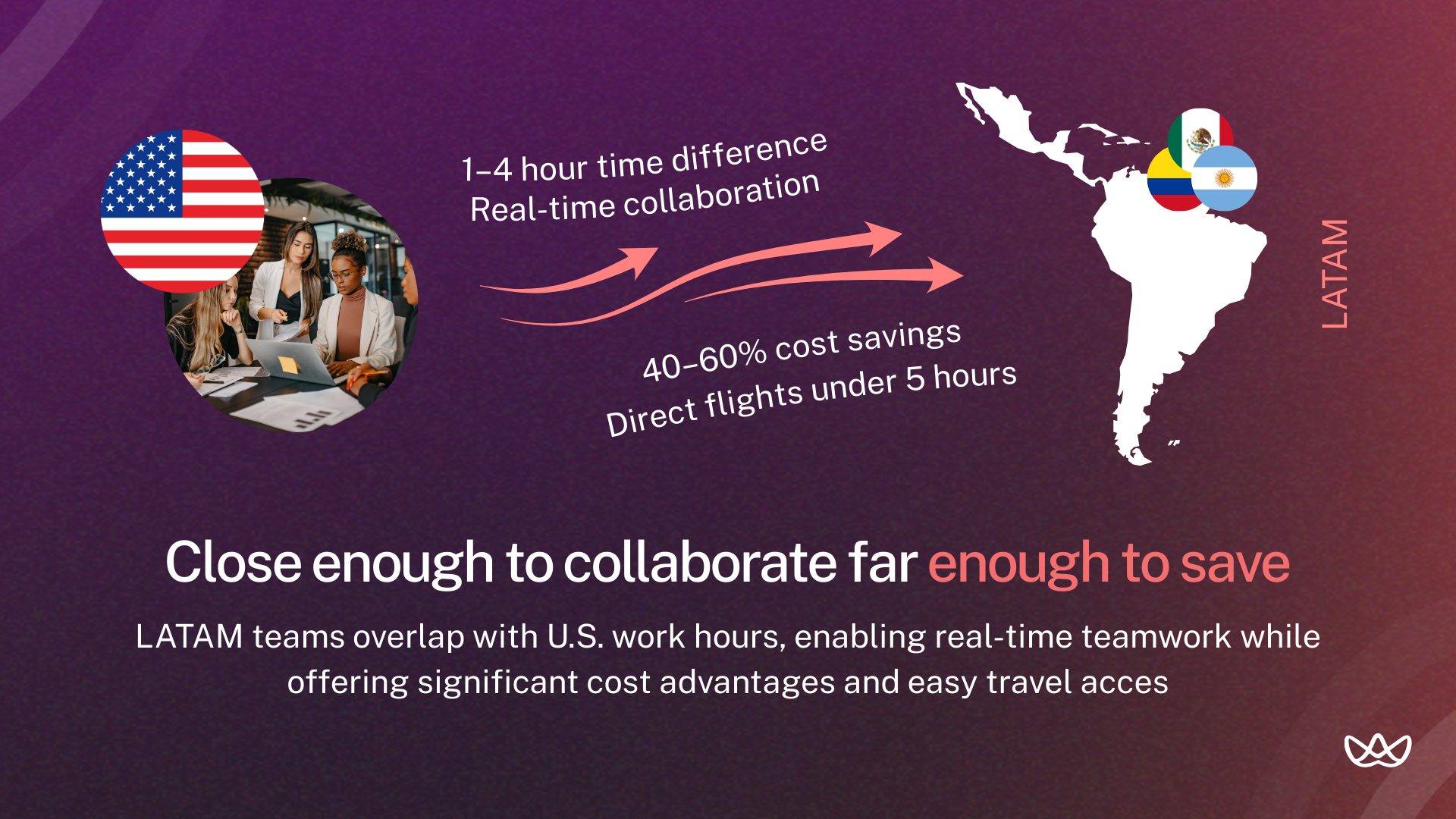
Offshore regions like the Philippines or India have 10–13 hour time differences. Collaboration there is mostly asynchronous, which can slow decisions and create communication gaps.
Top Global Talent Providers for 2026
Top global talent providers vary in focus, coverage, and services. Some specialize in marketing and creative roles, while others focus on tech or simply provide employment infrastructure.
Some global talent providers only handle employment infrastructure (EOR), while others also source and vet candidates.
1. Floowi (Best for U.S. Teams Hiring Full-Time Nearshore LATAM Talent)
Floowi specializes in providing full-time, dedicated nearshore talent from Latin America to U.S. companies, focusing on marketing, creative, and operational roles. The platform streamlines hiring with speed, cost-efficiency, and cultural alignment, sourcing from the top 1% of LATAM professionals to ensure quality and relevant experience.
Full Compliance, Payroll and Cultural-Fit Matching
Beyond sourcing, Floowi manages employment compliance, payroll, and benefits administration. Candidates are screened not just for skills but also for cultural alignment with U.S. business practices, communication norms, and team workflows.
Ideal for Agencies and Scaling Startups
The service model works well for agencies expanding marketing or creative capacity quickly and startups building operational teams without the overhead of domestic hiring. Nearshore LATAM talent ensures significant time zone overlap, enabling real-time collaboration, faster feedback loops, and smooth integration with existing U.S. teams.
2. Deel
Deel operates as an Employer of Record across 150+ countries. The platform excels at contractor management and compliance automation. Companies with existing candidates or distributed teams across many countries find Deel useful for consolidating payroll and legal employment.
Deel does not source talent directly. You bring candidates; they handle the employment infrastructure.
3. Toptal
Toptal positions itself at the high end of the market, claiming to accept only 3% of applicants. The platform focuses on senior engineering, design, and product roles. Rates reflect the premium positioning, often matching or exceeding U.S. freelance rates.
Best suited for companies needing elite specialists on project basis rather than ongoing full-time staff.
4. Remote.com
Remote.com combines EOR services with contractor management across 60+ countries. The platform emphasizes benefits administration, offering locally compliant health insurance, retirement plans, and equity compensation support.
Like Deel, Remote.com focuses on employment infrastructure rather than talent sourcing.
5. Andela
Andela started with African engineering talent and has expanded globally. The company focuses exclusively on software development roles, offering both full-time placements and project-based teams.
Strong fit for companies building engineering capacity, less relevant for marketing or creative roles.
6. Oyster HR
Oyster HR provides employer of record services with emphasis on employee experience and total rewards management. The platform supports hiring in 180+ countries with tools for managing distributed team compensation and benefits.
Primarily an infrastructure provider without talent sourcing capabilities.
7. WorkMotion
WorkMotion specializes in European employment, making it relevant for U.S. companies expanding into EU markets. The platform handles complex European labor law compliance including works councils, collective bargaining agreements, and GDPR requirements.
Less relevant for companies focused on LATAM or Asian markets.
8. Tecla
Tecla focuses on software engineering talent from Latin America. The company sources and vets developers, designers, and product managers for U.S. tech companies. Similar nearshore focus to Floowi but concentrated on technical rather than marketing roles.
Key Considerations Before Hiring Internationally
Hiring internationally means managing compliance, avoiding misclassifying workers, and following local labor laws and benefits. You also need to consider data rules, permanent establishment risks, and time zone overlap for smooth collaboration.
1. Cross-Border Compliance and Legal Requirements
Employment law varies dramatically by country. Contracts, termination requirements, benefits obligations, and tax withholding all differ. Working with a provider that handles compliance protects you from misclassification risks and legal exposure.
Key compliance areas:
- Employment contracts compliant with local law
- Proper worker classification (employee vs contractor)
- Tax withholding and social contributions
- Statutory benefits and leave requirements
- Termination procedures and severance
2. Cultural Intelligence and Team Alignment
International hires succeed when cultural expectations align. LATAM professionals generally share American work values around deadlines, communication directness, and accountability. Other regions may have different norms around hierarchy, feedback, and work-life boundaries.
Evaluate candidates for cultural fit, not just technical skills. Ask about previous experience with U.S. clients and communication preferences.
3. Time-Zone Overlap and Async Collaboration Readiness
Determine how much real-time collaboration your roles require. Customer-facing positions and collaborative creative work benefit from significant overlap. Independent technical work can tolerate asynchronous schedules.
LATAM provides 6 to 10 hours of overlap with U.S. time zones. Asia provides 2 to 4 hours at best, requiring adjusted expectations around response times and meeting availability.
Tech Infrastructure and Remote Onboarding Workflows
Remote employees need proper equipment, secure system access, and documented onboarding processes. Before hiring internationally, ensure you have:
- Equipment provisioning strategy (ship or stipend)
- VPN and security protocols for remote access
- Communication tools configured for distributed teams
- Documented onboarding checklists and training materials
- IT support available across time zones
Challenges in Global Talent Acquisition
Global talent acquisition faces intensified competition for niche skills, rising salaries, and evolving labor regulations. Companies also need to address cultural integration and retention, while managing cross-border payroll and secure remote access. Robust talent platforms help reduce turnover and legal risks.
1. Navigating Compliance, Labor Laws and Misclassification
Misclassifying employees as contractors creates significant legal and financial risk. Tax authorities worldwide scrutinize these arrangements. Penalties include back taxes, social contributions, statutory benefits, and fines.
Mitigation: Use providers that employ talent directly through compliant structures. Avoid long-term contractor arrangements for full-time work. Document the nature of the employment relationship clearly.
2. Onboarding and Retaining International Employees
Remote employees can feel disconnected without intentional effort. Turnover increases when international staff feel like second-class team members rather than integrated colleagues.
Mitigation: Include international hires in team meetings and company communications. Provide career development opportunities. Recognize contributions publicly. Invest in relationship building beyond task completion.
3. Ensuring Data Security and IP Protection
International employment creates data handling and intellectual property considerations. Employee data may be subject to privacy regulations like GDPR. Work product ownership requires clear contractual assignment.
Mitigation: Include robust IP assignment clauses in employment contracts. Implement data handling policies compliant with relevant regulations. Use secure communication and file sharing systems. Conduct security training for all employees.
5. Managing Compensation Expectations Across Regions
Salary expectations vary by location, but information flows globally. International employees may compare compensation with U.S. colleagues or benchmark against local market leaders. Resentment builds when differences seem arbitrary.
Mitigation: Develop transparent compensation philosophy. Explain how regional pay scales work. Provide competitive local compensation even if below U.S. rates. Focus on total value including stability, benefits, and growth opportunities.
Effective Remote Staffing Solutions and Global Hiring Strategies
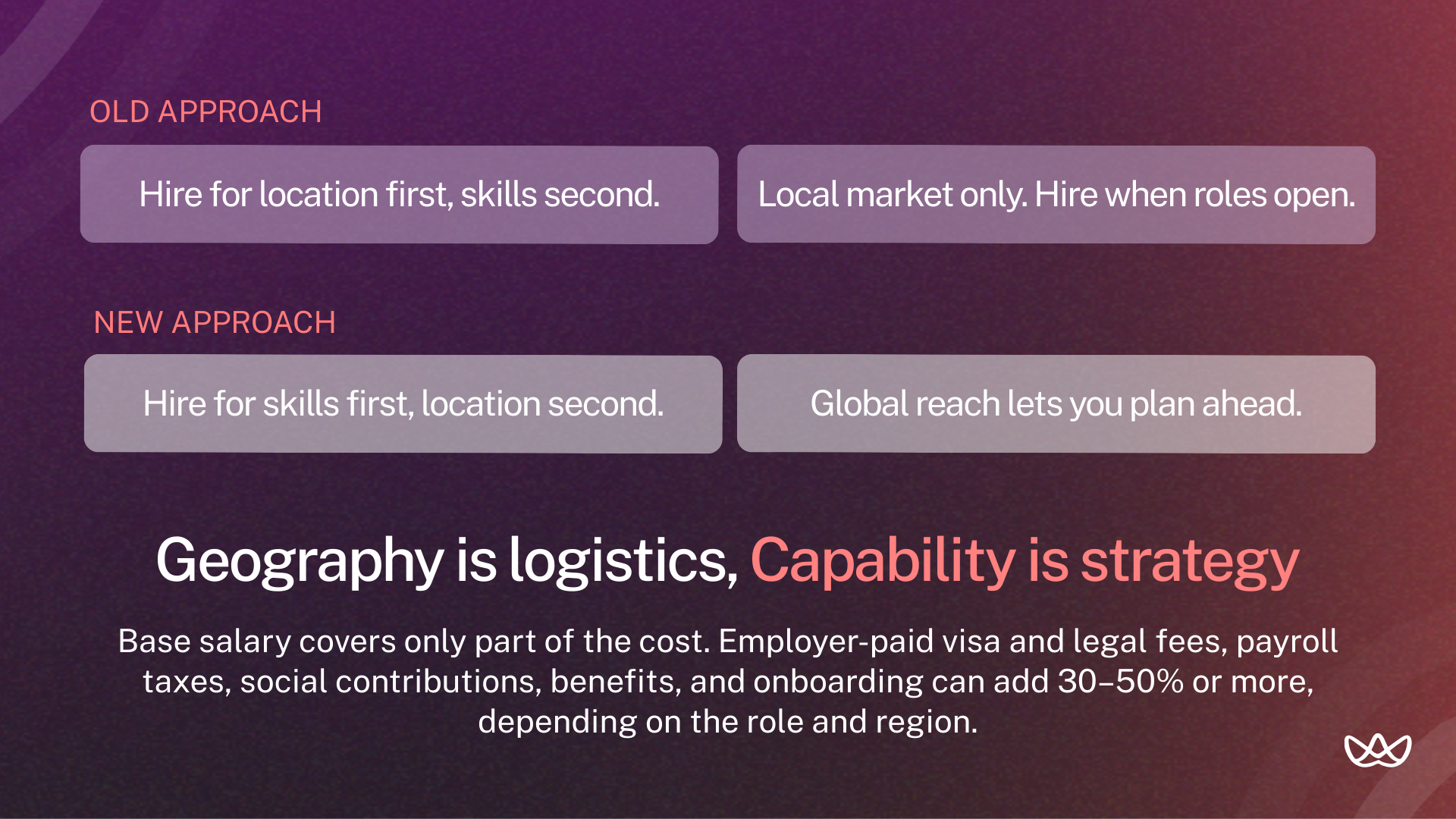
Global hiring now favors a "Nearshore-First" model, using talent in overlapping time zones for smoother collaboration. Companies combine EOR compliance with boutique sourcing for pre-vetted marketing and creative talent.
Retention relies on localized benefits and output-focused workflows, while platforms like Deel or Remote simplify payroll and compliance.
Adopting Remote-First or Hybrid Global Hiring Models
Companies succeed with international hiring when they design for it intentionally. Remote-first organizations build processes around distributed collaboration from the start. Documentation, async communication, and explicit coordination become standard practice.
Hybrid approaches work when clearly defined. Some roles may require U.S. presence while others work globally. Make these distinctions explicit rather than case-by-case.
Using Global Recruiting and Talent-Management Platforms
Technology simplifies global hiring logistics. Applicant tracking systems, video interviewing tools, and HR platforms designed for distributed teams reduce administrative burden.
For companies looking for pre-vetted candidates instead of DIY recruiting, explore Floowi’s top LATAM role profiles to see talent ready for hire.
Building a Compelling Global Employer Brand
International candidates evaluate employers carefully. Your reputation, growth trajectory, remote work culture, and employee treatment all influence candidate quality and acceptance rates.
Invest in employer branding that resonates globally. Showcase distributed team success stories. Highlight career growth of international employees. Demonstrate genuine commitment to remote work rather than treating it as a cost-cutting measure.
Hiring Based on Skills, Not Geography
The best approach focuses on capabilities rather than location. Define what success looks like in a role, then find candidates who can deliver regardless of where they sit.
This mindset opens opportunities. A brilliant designer in Argentina may outperform an average one in New York at a fraction of the cost. Geography becomes a logistical consideration rather than a filtering criterion.
Maintaining a Long-Term Global Talent Pipeline
Reactive hiring produces worse outcomes than proactive pipeline building. Maintain relationships with global talent providers even when not actively hiring. Know where you would source key roles before positions open.
Strong providers maintain candidate relationships over time. When you need someone quickly, they can present qualified options immediately rather than starting from scratch.
Offering Globally Competitive Compensation Packages
Competitive means different things in different markets. Pay that attracts top talent in Colombia differs from what works in Poland or the Philippines. Research local benchmarks rather than applying U.S. frameworks everywhere.
Beyond base salary, consider what matters locally. Health insurance significance varies by country. Paid time off expectations differ. Professional development opportunities may be highly valued where local options are limited.
Developing Cross-Cultural Intelligence Across Teams
Distributed teams work better when everyone understands cultural differences. Train managers on working across cultures. Create space for different communication styles. Acknowledge holidays and customs from all team locations.
Cultural intelligence improves over time with exposure. Start with awareness that differences exist and build understanding through experience.
How to Evaluate and Choose the Right Global Talent Provider
To choose the right global talent provider, focus on those with a track record in your niche, strong EOR compliance, and thorough vetting for skills and cultural fit. Look for transparent pricing, flexible contracts, and fast onboarding with dedicated support for international HR and logistics.
In-House Recruiting vs. Outsourcing vs. Global Talent Providers
Global talent providers make sense when you need international employees quickly and want compliance handled externally. In-house recruiting works better for domestic volume hiring. Outsourced recruiting suits occasional specialized needs.
Evaluating Compliance, Payroll, EOR and Hiring Capabilities
Not all providers offer the same services. Evaluate based on your actual needs.
Questions to ask:
- Do they source and vet candidates, or just handle employment?
- What countries do they cover?
- How do they handle compliance and employment law?
- What's included in their fees versus additional?
- How do they manage payroll and benefits?
- What happens if an employee doesn't work out?
Ranking Global Reach and Talent-Pool Quality
Coverage breadth matters less than depth in your target markets. A provider strong in LATAM serves U.S. companies better than one with shallow coverage across 150 countries.
Assess talent quality through trial hires or reference checks with existing clients. Ask about vetting processes, acceptance rates, and how they handle mismatches.
Cost vs. Value: Understanding ROI Beyond Salary Savings
The cheapest option rarely provides the best value. Factor in time savings, compliance risk reduction, candidate quality, and ongoing support when comparing providers.
A provider charging slightly higher fees but delivering better candidates faster may cost less in total when you account for productivity, retention, and avoided compliance problems.
Choosing Between Short-Term and Long-Term Talent Solutions
Some roles suit project-based engagement. Others require permanent full-time staff. Match the solution to the need.
Project work fits freelance platforms or contractors. Ongoing roles benefit from full-time employment through providers offering that structure. Mixing models creates complexity, so be intentional about which approach applies where.
Implementing Global Hiring Across Your Organization
Implementing global hiring means treating international staff as core team members. Start with an EOR to standardize payroll and benefits, use asynchronous tools to bridge time zones, and foster an inclusive culture with local holidays and professional development to fully integrate nearshore talent.
Defining Role Requirements and Ideal Candidate Profiles
Clear requirements produce better hires. Document not just skills and experience but also working style, communication expectations, and success metrics.
Involve hiring managers in requirement definition. Generic job descriptions attract generic candidates. Specific profiles enable targeted sourcing.
Onboarding Remote and Nearshore Employees Effectively
Remote onboarding requires more structure than in-office. New hires can't absorb information through hallway conversations and observation.
Effective onboarding includes:
- Pre-start equipment and access setup
- Documented first-week schedule
- Daily check-ins during initial period
- Clear assignment of initial tasks
- Introduction to key colleagues
- Explanation of tools and processes
- Regular feedback on early work
Building Strong Communication Rhythms and Performance Frameworks
Establish communication patterns from day one. Define expectations around availability, response times, meeting attendance, and status updates.
Performance management works the same as for local employees. Set clear goals, provide regular feedback, conduct structured reviews. The distance doesn't change the fundamentals.
Optimizing and Iterating Your Global Talent Strategy
Treat global hiring as an evolving capability rather than a one-time project. Gather feedback from managers and international employees. Identify what works and what doesn't. Adjust processes based on experience.
Track metrics that matter: time to productivity, retention rates, manager satisfaction, employee engagement. Use data to improve rather than assuming initial approaches are optimal.
Cost Considerations When Hiring Global Talent
In 2026, global hiring costs go beyond salaries to include benefits, social contributions, and severance. Providers like Floowi can cut labor costs by up to 70%, though platform or EOR fees and indirect costs like hardware, VPNs, and currency fluctuations should be considered. Nearshore regions help minimize hidden productivity and travel costs.
Salary Differences Across Key Hiring Regions
Hiring costs vary widely by region, with nearshore LATAM offering a strong balance of cost, time zone alignment, and cultural fit for marketing and creative roles. The table below shows typical salaries, strengths, and challenges across key regions.
Payroll, Taxes and Compliance Costs
Beyond base salary, budget for employer-side costs that vary by region.
- Social contributions: 15% to 35% depending on country
- Health and retirement benefits: Often mandatory, costs vary
- EOR or provider fees: 10% to 25% of compensation
- Equipment and setup: $1,000 to $2,500 one-time
Total employer cost typically runs 130% to 160% of base salary when using a provider.
Recruiting, Vetting and Platform Fees
Fee structures vary across provider types.
Freelance platforms: 5% to 20% service fee on payments Traditional recruiters: 15% to 25% of first-year salary Global talent providers: Monthly fee or 20% to 40% markup on compensation EOR-only platforms: $300 to $700 per employee per month
Evaluate total cost including your internal time spent on hiring activities. Providers charging higher fees but handling more work may cost less overall.
Your Next Step
Global talent providers become essential when you need to hire internationally faster than internal capabilities allow. Signs include: unfilled roles dragging on for months, domestic salary demands exceeding budget, or inability to find specific skills locally.
The right provider accelerates hiring from months to weeks while handling compliance complexity you shouldn't manage internally. For most growing U.S. companies, the question isn't whether to use a provider but which one fits best.
How Floowi Helps U.S. Companies Build Long-Term, High-Performing Global Teams
Floowi addresses the specific needs of U.S. companies hiring in Latin America. The combination of talent sourcing, compliance management, and cultural-fit screening removes friction from nearshore hiring. Specialization in marketing, creative, and tech roles means deeper candidate pools for the positions scaling companies need most.
For agencies and startups building distributed teams, Floowi provides the infrastructure to hire confidently without the overhead of managing international employment directly.
Build your nearshore team with vetted LATAM talent. Book your free consultation today.
Frequently Asked Questions
What exactly is a global talent provider?
A global talent provider helps companies hire international professionals by sourcing, vetting, and onboarding candidates while handling payroll and compliance. Unlike job boards or EOR platforms, they manage the entire hiring process from start to finish.
How do global talent providers differ from traditional recruiting agencies?
Traditional agencies focus on domestic placements and charge a one-time percentage of the hire’s salary. Global talent providers specialize in international full-time hiring, manage ongoing compliance, and often use predictable monthly fees rather than one-off costs.
Why is time-zone alignment critical for U.S. companies scaling distributed teams?
Having overlapping work hours makes real-time collaboration possible. LATAM talent overlaps 6–10 hours with U.S. time zones, allowing live meetings, fast feedback, and quicker decision-making. Teams in regions with 10+ hour differences often rely on asynchronous work, which can slow projects.
What makes Floowi ideal for U.S. companies hiring full-time nearshore LATAM talent?
Floowi focuses on marketing, creative, and operational roles for U.S. teams. Their LATAM talent provides time-zone alignment and cultural compatibility. They also handle compliance and screen for cultural fit, reducing hiring risks and smoothing onboarding.
How do providers help reduce hiring costs compared to U.S.-based recruiting?
LATAM talent typically costs 40%-70% less than U.S. equivalents. Providers cut internal recruiting costs by handling sourcing, vetting, and compliance, and faster hiring reduces the productivity loss caused by unfilled roles.
What compliance risks should companies evaluate before hiring internationally?
Risks include misclassifying workers, failing to meet local labor laws, tax errors, and inadequate IP protection. Working with providers that use compliant employment structures helps mitigate these risks.
How should companies compare in-house recruiting vs. outsourcing vs. global talent providers?
In-house recruiting works well for domestic volume hiring. Outsourced recruiting is suitable for specialized local roles. Global talent providers make sense for international full-time hires where speed, compliance, and quality matter most.
What's the best way to assess the quality of a provider's global talent pool?
Check their vetting process, acceptance rates, and client references. Starting with a trial hire is a practical way to evaluate candidate quality before committing to larger hires - quality matters more than pool size.



.png)



