

.png)
.png)



The global staff augmentation market reached $299.3 billion in 2023 and is projected to hit $857.2 billion by 2031. That growth rate makes one thing clear: U.S. companies are shifting how they build teams. Remote staff augmentation services have become the operational backbone for organizations that need skilled professionals without the 36-day average hiring cycle or the overhead of permanent headcount.
Over 32.6 million Americans now work remotely, representing 22% of the national workforce. But the bigger shift is happening across borders. Latin America's remote workforce grew from 3% to 30% since 2020, creating deep talent pools that align with U.S. time zones and deliver 30-50% cost savings compared to domestic hires.
Let’s break down how remote staff augmentation works, how it compares to other hiring models, and what U.S. companies should evaluate when choosing a partner.
What Are Remote Staff Augmentation Services?
Remote staff augmentation is a hiring model where external professionals join your team on a temporary or project basis while working under your direct management. Unlike outsourcing, where you transfer ownership of a deliverable to a vendor, augmentation keeps you in control of the work, the process, and the outcomes.
The staffing partner handles recruitment, vetting, payroll, and compliance. You handle the actual work direction. The result is a setup where external talent functions like an internal employee without the HR burden of traditional hiring.
How It Differs From Outsourcing, Consulting & BPO
.png)
These terms get used interchangeably, but they describe fundamentally different relationships:
- Staff augmentation: You manage the work directly. The professional reports to your team leads, follows your processes, and integrates into your existing workflow. You retain full control.
- Outsourcing: You hand off a defined scope of work to a vendor who manages the team, the process, and the delivery. You receive outputs, not daily oversight.
- Consulting: You engage experts for strategic advice, analysis, or specialized problem-solving. Consultants typically advise rather than execute.
- BPO (Business Process Outsourcing): You transfer entire business functions like customer support, accounting, or data entry to an external provider who owns the operation end-to-end.
The key distinction with augmentation is ownership. You keep it.
Where Remote Staff Augmentation Fits in Modern Hiring Models
Most companies operate with a mix of hiring approaches. Full-time employees handle core functions. Freelancers fill occasional gaps. Agencies deliver specialized projects. Staff augmentation sits between these options, offering more commitment than freelancers and more flexibility than full-time hires.
For agencies managing variable client workloads or startups scaling quickly, augmentation provides a middle path. You get dedicated professionals who understand your business without locking into permanent headcount that becomes a liability when demand shifts.
Why U.S. Companies Choose Remote Staff Augmentation
U.S. companies use remote staff augmentation to fill specialized skill gaps faster than traditional hiring allows. It gives teams quick access to global expertise for launches or seasonal demand without adding permanent headcount, while keeping costs lower and work closely integrated with internal teams.
1. Access to Skilled Global Remote Talent
The talent pool available to U.S. companies has expanded as remote and hybrid work have become common. Cross-border hiring now sits within standard operating models, and teams are no longer limited to candidates within commuting distance.
This shift matters most for specialized roles. Finding a performance marketing specialist, data analyst, or UX designer in a single U.S. market takes time. Expanding the search to regions like Latin America, Eastern Europe, or Southeast Asia broadens the candidate pool while maintaining quality.
2. Cost Efficiency & Operational Savings
Companies using staff augmentation often reduce labor costs compared to traditional hiring. This isn’t about paying less for the same work - it’s about accessing professionals in regions where compensation aligns with local cost of living rather than U.S. metro rates.
Beyond salary differences, you also avoid recruiting expenses, benefits administration, and the overhead of a larger permanent team.
3. Scalability Without Increasing Headcount
Agencies often deal with fluctuating workloads. One moment you need three extra designers for a new client, the next, a project wraps up and they’re idle. Staff augmentation makes team size flexible instead of fixed.
You can scale up when demand rises and scale down when it drops, while the staffing partner handles finding the next placement for those professionals.
4. Maintaining Control Over Projects & Processes
This is where augmentation separates from outsourcing. Augmented staff work within your systems. They attend your standups, use your project management tools, and follow your quality standards. You don't lose visibility or control by bringing in external talent.
For companies with established processes and standards, this matters. You're not adapting to a vendor's methodology. You're adding capacity to your existing operation.
5. Real-Time Collaboration & Workflow Transparency
Remote work tools have matured to the point where distributed teams can operate with the same visibility as co-located ones. Slack, Notion, Asana, Jira, and video conferencing create continuous touchpoints throughout the workday.
Augmented team members plug into these systems just like internal employees. You see what they're working on, when they're available, and how projects are progressing.
6. Improved Delivery Speed & Quality
Staff augmentation providers maintain networks of pre-vetted professionals. When you need someone, they don't start recruiting from scratch. They match you with candidates who have already passed technical assessments and background checks.
This cuts time-to-hire dramatically. While traditional hiring averages 36 days in the U.S., augmentation partners can often present qualified candidates within days and have someone onboarded within two weeks.
Common Models in Remote Staff Augmentation
Remote staff augmentation can take several forms, depending on how much control, flexibility, and risk you want to retain. Each model fits different project types, team sizes, and timelines.
Dedicated Remote Talent Model
You hire someone to work exclusively for your company, usually full-time. They’re focused on your projects, not juggling multiple clients. This model works well for ongoing roles where you want the person fully embedded in your team and processes.
Time & Material (T&M) Model
You pay for the hours worked. This gives flexibility when project scope isn’t fully defined or workloads change week to week. T&M works well for support, maintenance, or projects that evolve as they progress.
Fixed-Price or Scope-Bound Model
You set the deliverable and price upfront. The provider delivers within that budget, so it’s ideal when scope is clear and stable. The provider takes on more risk, but you need to define requirements precisely.
Managed Remote Team Model
The provider brings a full team with a lead or manager. You set the direction, and they handle day-to-day coordination. This works well for larger projects where you want a ready-to-run team without managing each person individually.
Nearshore vs. Offshore Structures (Including Nearshore LATAM Talent)
Nearshore means hiring from regions close to your time zone - mostly Latin America for U.S. companies. Offshore refers to more distant regions like India, the Philippines, or Eastern Europe.
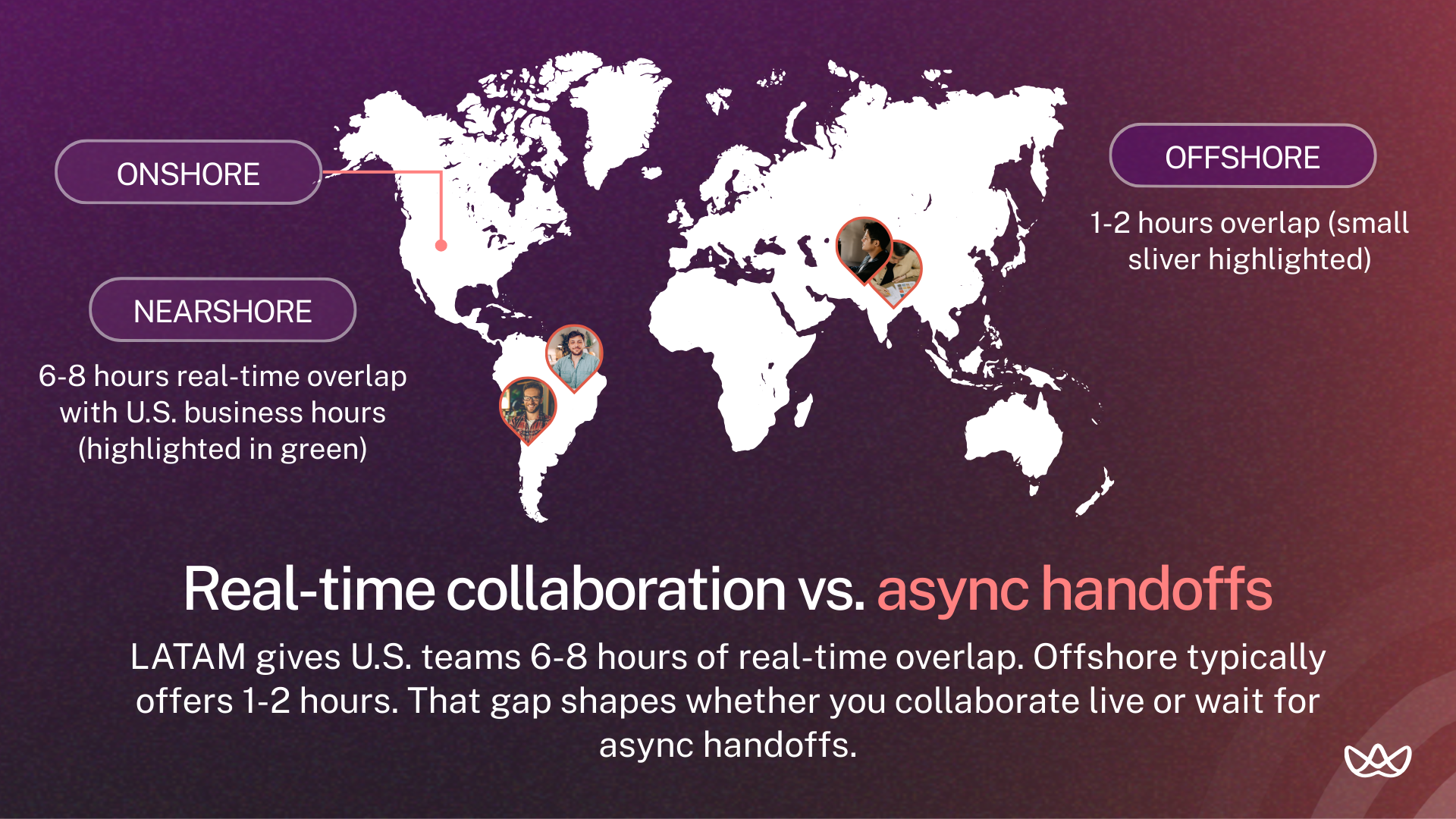
Nearshore LATAM talent offers an advantage: professionals in Mexico, Colombia, Argentina, and Brazil work within a few hours of U.S. time zones, allowing real-time collaboration that offshore teams often can’t match. Latin America now has deep talent pools for U.S. companies to access.
Freelance or Contract-Based Model
Individual contractors engaged for specific projects or periods. This provides maximum flexibility but requires more management overhead since you're coordinating with individuals rather than through a staffing partner.
Alternative Skill-Based Categories
Some providers organize talent by skill category rather than engagement model. You might engage a provider specifically for marketing talent, another for engineering, and another for operations support. This allows you to work with specialists in each domain.
When Remote Staff Augmentation Is the Right Fit
Remote staff augmentation suits U.S. companies needing niche skills or quick capacity. It lets you onboard experts in days for short- to mid-term projects or seasonal spikes, keeping oversight tight while scaling teams up or down without long-term payroll commitments.
1. Rapid Team Expansion
When new clients arrive or funding accelerates product development, domestic hiring can take months. Staff augmentation lets you add capacity within weeks, keeping projects on track while building permanent teams at a sustainable pace.
2. Project-Based or Seasonal Demand
Businesses with predictable peaks like e-commerce before holidays or marketing campaigns around launches - can scale teams up and down as needed. Augmentation provides skilled professionals for the duration of the peak, then allows for a smooth transition out, avoiding internal hiring and layoffs while maintaining continuity and quality.
3. Need for Specialized Technical Expertise
Some roles are temporary by nature. A company may need a Salesforce integration specialist, a data engineer for reporting, or an AI consultant for a short project. Staff augmentation gives access to these niche skills without permanent hires, letting teams meet technical requirements efficiently.
4. Startups or Lean Teams Scaling Operations
Early-stage companies often can't afford the overhead of a large permanent team. But they still need professional execution across multiple functions. Augmentation allows startups to operate with a core internal team supplemented by external professionals who scale with the business.
This approach preserves cash while maintaining execution quality. As the company grows and certain functions become permanently critical, those roles can transition to full-time hires.
How to Choose the Right Remote Staff Augmentation Partner
Before selecting a remote staff augmentation partner, focus on clear role definitions, time-zone fit, vetting rigor, onboarding, communication, and performance monitoring. These ensure smooth integration and faster productivity.
1. Define Role Requirements & Technical Needs
Before engaging any partner, document exactly what you need.
- What skills are required?
- What tools should the person know?
- What level of experience is necessary?
The more specific your requirements, the better the match you'll receive.
Vague requests produce vague results. If you need a "marketing person," you'll get a wide range of candidates. If you need "a paid media specialist with Google Ads certification and e-commerce experience managing $50k+ monthly budgets," you'll get precisely matched candidates.
2. Evaluate Cultural Alignment & Time-Zone Fit
Technical skills matter, but so does working style. Does the candidate communicate proactively or wait for direction? Are they comfortable with ambiguity or do they need detailed specifications? Do they work independently or prefer close collaboration?
Time zone overlap determines what kind of collaboration is possible. If you need someone available for daily standups and real-time Slack communication, nearshore talent with 6-8 hours of overlap makes more sense than offshore talent with 1-2 hours.
3. Key Vetting Criteria for Agencies
Ask potential partners about their screening process.
- How do they assess technical skills?
- Do they test for English proficiency?
- Do they evaluate soft skills and cultural fit?
- What percentage of applicants make it through their vetting?
The rigor of the vetting process directly impacts the quality of candidates you'll see. Partners who accept everyone will waste your time with unqualified applicants. Partners with selective processes deliver candidates worth interviewing.
4. Onboarding Standards & Integration Workflow
- How quickly can new team members become productive?
- What documentation and access do they need?
- Who handles equipment, software licenses, and system setup?
The best partners have structured onboarding processes that minimize ramp-up time. They've done this before and know what new team members need to hit the ground running.
5. Communication Practices & Tooling
Clarify how communication will work. Will augmented staff have access to your Slack workspace? Will they attend team meetings? How will you track their work?
Establish these expectations upfront. Misalignment on communication creates friction that undermines the relationship regardless of how talented the individual is.
6. Performance Monitoring & Quality Assurance
- How will you measure success?
- What happens if performance doesn't meet expectations?
- Is there a trial period?
- What's the process for replacement if things don't work out?
Reputable partners stand behind their placements. They want long-term relationships, not quick transactions. Understand the guarantees and support structure before engaging.
Common Challenges & How to Address Them
Distributed teams add flexibility but come with challenges in talent, communication, culture, visibility, and security. Addressing these upfront keeps your augmented team productive and aligned.
1. Talent Availability & Speed of Hiring
Not every skill is equally available. Highly specialized roles take longer to fill regardless of the model. If you need someone with rare expertise, start the search early.
Mitigation: Work with partners who specialize in your needed skill areas. Generalist platforms have breadth but may lack depth in specific domains.
2. Communication & Time-Zone Management
Even with nearshore talent, some time zone difference exists. Meetings need to accommodate multiple schedules. Async communication becomes more important.
Mitigation: Establish core overlap hours where everyone is available. Document decisions and context so people working at different times stay aligned.
3. Cross-Cultural Collaboration
Working styles vary across cultures. Directness, hierarchy, feedback norms, and communication styles all differ. What feels normal to you might feel unusual to someone from a different background.
Mitigation: Be explicit about expectations rather than assuming shared understanding. Create space for questions and clarification without judgment.
4. Maintaining Project Visibility & Control
With distributed teams, you can't walk over to someone's desk to check on progress. You need systems that create visibility without micromanagement.
Mitigation: Use project management tools consistently. Establish regular check-ins. Focus on outcomes rather than monitoring activity.
5. Security, Compliance & Data Protection
External team members accessing your systems create security considerations. Sensitive data, client information, and proprietary processes all need protection.
Mitigation: Work with partners who handle compliance professionally. Use appropriate access controls. Ensure contracts include data protection provisions.
Remote Staff Augmentation vs. Outsourcing, Consulting & BPO
Remote staff augmentation keeps control in-house, offers predictable per-person costs, and scales easily. Outsourcing and BPO hand execution to the vendor, with fixed or per-unit costs and less flexibility. Consulting provides guidance without full execution responsibility.
Control, Ownership & Flexibility Differences
The fundamental difference comes down to who manages the work. With augmentation, you do. With outsourcing and BPO, the vendor does. Consulting sits in between, providing expertise you apply rather than execution you delegate.
If maintaining control over process and quality matters to you, augmentation preserves that. If you want to hand off responsibility entirely, outsourcing makes more sense.
Cost Structures & Resource Allocation
Outsourcing typically involves fixed contracts for defined scopes. Augmentation typically involves ongoing costs based on team size and time. BPO often uses per-transaction or per-unit pricing.
Augmentation provides cost predictability at the individual level while maintaining flexibility at the team level. You know what each person costs but can adjust how many people you engage.
Long-Term Scalability Considerations
Outsourcing relationships can become difficult to unwind. Knowledge transfers to the vendor, and bringing work back in-house requires significant effort.
Augmentation maintains optionality. Because the work happens under your management using your systems, transitioning people or bringing work in-house is straightforward. You're not dependent on a vendor's proprietary processes.
Future Trends in Remote Staff Augmentation (2026 Outlook)
The future of remote staff augmentation is shaped by global talent access, hybrid nearshore/offshore strategies, AI-driven recruitment, and stricter compliance requirements. Companies that align with these trends can scale teams faster, maintain control, and reduce risk while optimizing costs.
1. Rising Demand for Global Remote Talent
Remote digital jobs are expected to grow by about 25 percent to reach 92 million by 2030, according to the World Economic Forum. As this trend unfolds, companies that haven’t built global hiring capabilities may struggle to access the talent they need. Building those capabilities now helps you tap into skilled professionals wherever they are.
2. Growth of Hybrid Nearshore/Offshore Models
Companies are becoming more sophisticated about matching work types to regions. Real-time collaboration work goes nearshore. Async work can go offshore. The result is optimized cost and collaboration across different functions.
3. AI & Automation Impact on Hiring Models
AI is speeding up recruitment and making staff augmentation faster to deploy. Beyond basic automation, agent‑driven AI now helps generate job content, automate repetitive tasks, engage candidates via chatbots, and prioritize assessments.
It also enables data‑driven sourcing, enhances interview insights, and accelerates scheduling and evaluation. These tools expand capacity and efficiency while keeping human oversight in place.
4. Stronger Focus on Compliance & Transparency
As global hiring becomes common, regulatory scrutiny increases. Worker classification, data protection, and tax compliance all require attention. Partners who handle these complexities will become more valuable than those who leave compliance to the client.
Frequently Asked Questions
How Do Companies Access Skilled Global Talent Through Augmentation?
Staff augmentation partners maintain networks of pre-vetted professionals across regions. You define your requirements - skills, tools, experience - and they present candidates that match. This gives you access to talent pools that would be difficult or slow to reach through traditional recruiting alone.
What Cost Efficiencies Can U.S. Firms Expect From Remote Staff Augmentation?
Companies typically save 20-50% compared to hiring locally, depending on the role and region. Beyond lower salaries, you avoid recruiting fees, benefits administration, and office overhead, making staffing more predictable and flexible.
How Do Companies Scale Teams Without Increasing Internal Headcount?
Augmentation provides professionals who work for your company but remain employed by the staffing partner. This lets you expand capacity for projects or peaks without adding permanent headcount or long-term overhead.
What Vetting Criteria Should U.S. Companies Use When Selecting an Augmentation Partner?
Look for partners with rigorous screening processes, role-specific expertise, and proven time-zone alignment. Check how they assess technical skills, English proficiency, and cultural fit. Ask about candidate rejection rates, replacement guarantees, and client references to verify quality.
How Do Communication Practices Impact the Success of Augmented Remote Teams?
Clear communication is essential. Establish overlapping work hours, use shared tools consistently, document context, and hold regular check-ins. Even highly skilled professionals can face friction without structured communication.
What Tools Help Maintain Project Visibility and Control With Remote Augmented Teams?
Project management platforms like Asana, Jira, or Monday help track tasks and progress. Slack or Microsoft Teams support real-time messaging, while video calls maintain face-to-face connection. Time tracking or reporting dashboards give additional visibility when needed.
How Do Companies Address Compliance and Data Protection When Working With Remote Talent?
Use partners who handle worker classification, tax compliance, and data protection. Implement access controls, and ensure contracts cover confidentiality, IP ownership, and compliance obligations. These steps protect both your company and clients.
How Does Staff Augmentation Differ in Control and Ownership Compared to Outsourcing?
With staff augmentation, you maintain control over the work, process, and outcomes. Outsourcing delegates responsibility to the vendor, while consulting provides advice without direct execution. Augmentation adds skilled capacity under your management instead of replacing your team entirely.
How do remote staff augmentation services differ from outsourcing and BPO?
Remote staff augmentation adds dedicated professionals who work directly under your management and integrate into your team. Outsourcing and BPO hand off entire functions or processes to a third party that manages the work, staff, and outcomes with less day-to-day control from your side.
Your Next Move
Remote staff augmentation helps U.S. companies fill skill gaps or meet short-term capacity needs without the delays of traditional hiring. Nearshore LATAM talent aligns well on time zones, communication, and English proficiency, keeping workflows smooth.
Define your role needs, work with vetted partners, and set up clear onboarding and reporting. This ensures your extended team integrates efficiently, letting you scale while maintaining control over quality and project outcomes.
Key Takeaways:
- Enables fast, flexible global team expansion.
- Nearshore LATAM talent offers cost-quality benefits with real-time collaboration.
- Preserves control while reducing operational risk.
- Vetting and integration standards affect long-term success.
Build your nearshore team with vetted LATAM talent through Floowi. Book your free consultation today.




