






The global outsourcing market hit $854.6 billion in 2025 and continues growing at 5.46% annually. Within that market, offshore staff augmentation services have become a common model for U.S. companies that need to scale without long-term hiring commitments, allowing access to skilled professionals at 30-70% lower cost than domestic roles while retaining direct control over the work.
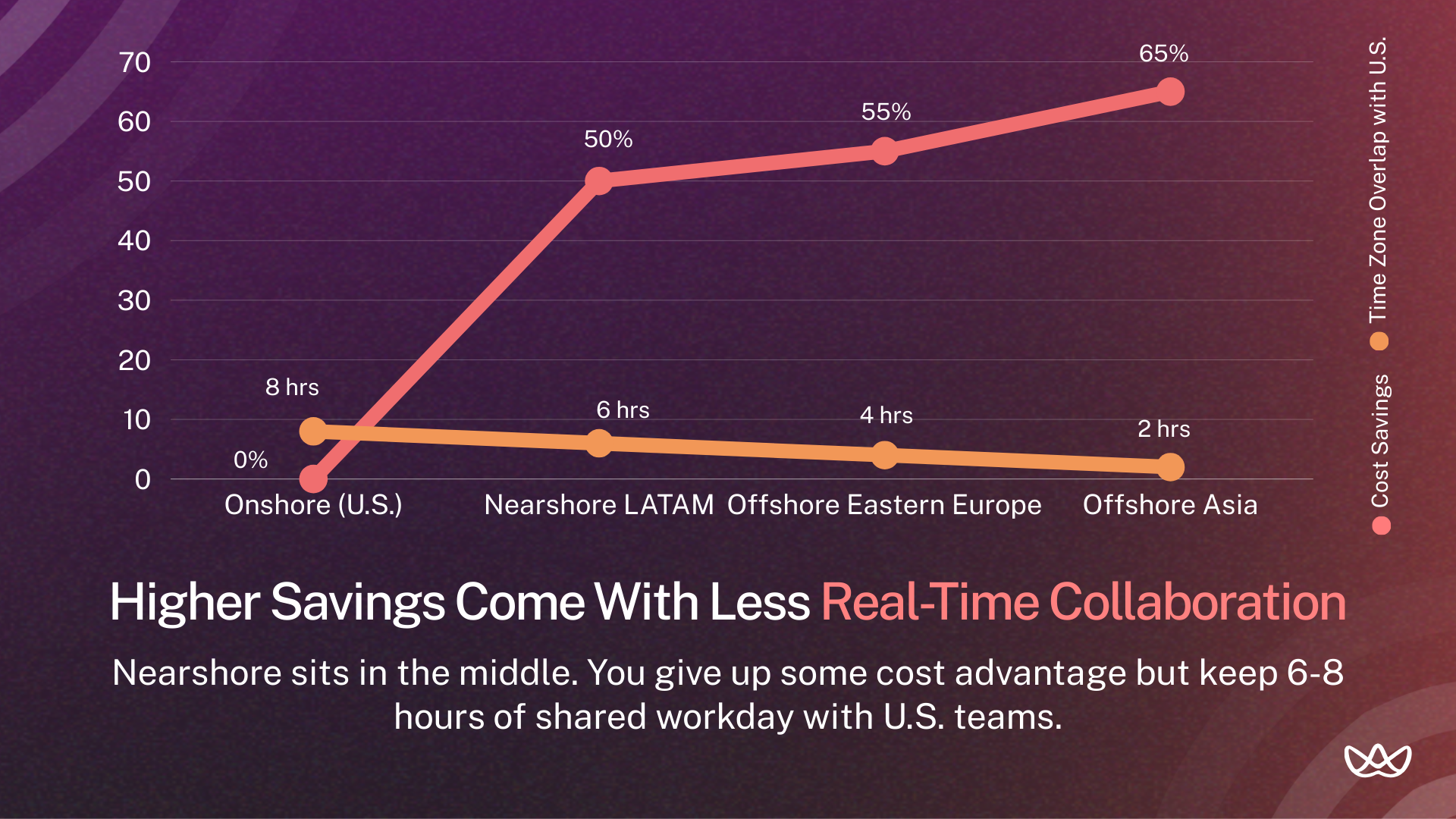
But offshore isn't one-size-fits-all. The compromise between cost savings and time zone overlap shapes every hiring decision. Companies working with teams in Asia gain significant labor arbitrage but face 10-15 hour gaps that limit real-time collaboration. Nearshore alternatives in Latin America offer smaller savings but share 6-8 working hours with U.S. teams.
Let’s explore how offshore staff augmentation works, the models available, and what to evaluate when choosing a partner.
What Are Offshore Staff Augmentation Services?
Offshore staff augmentation services involve hiring external professionals from distant geographic regions who integrate into your existing team while working under your direct management. The staffing partner handles sourcing, vetting, payroll, and local compliance. You handle work direction, priorities, and quality standards.
Unlike project outsourcing, where you hand off deliverables to a vendor, augmentation keeps you in the driver's seat. The offshore professional becomes part of your daily operations, attends your meetings, uses your tools, and reports to your team leads.
How It Differs From Nearshore, Onshore, Outsourcing & BPO
Offshore staff augmentation is a hybrid model where you hire individual, full-time experts from distant countries (for example, in Asia) who work as a direct extension of your internal team. Nearshore models, by contrast, usually involve talent in regions like Latin America, closer to U.S. time zones.
By geography:
- Onshore: Hiring within your own country. Highest cost, no time zone issues.
- Nearshore: Hiring from neighboring regions. For U.S. companies, this means Latin America. Moderate savings with 4-8 hours of overlap.
- Offshore: Hiring from distant regions like Asia or Eastern Europe. Highest savings, minimal overlap (1-4 hours typically).
By control:
- Staff augmentation: You manage the work directly. External talent integrates into your team.
- Outsourcing: Vendor manages the work and delivers outputs. You receive results, not oversight.
- BPO: Vendor owns entire business functions like support or accounting end-to-end.
The offshore vs nearshore decision comes down to priorities. If cost reduction is primary and your work tolerates async communication, offshore delivers maximum savings. If real-time collaboration matters, nearshore makes more sense despite smaller cost advantages.
Offshore Staff Augmentation Services Models Explained
Offshore staff augmentation models vary in cost, control, and oversight, so the right choice depends on your project and how involved you want to be with the team.
Project-Based Model
You engage offshore talent for a defined scope with clear deliverables and timelines. The engagement ends when the project completes. This works well for specific initiatives like building a new feature, migrating systems, or executing a campaign.
The project-based model provides cost predictability since you agree on scope and price upfront. However, it requires precise specifications. Ambiguous requirements lead to scope creep and cost overruns.
Dedicated Team Model
You hire offshore professionals who work exclusively for your company on an ongoing basis. They become extensions of your internal team, learning your processes, tools, and culture over time.
This model works best for long-term needs where continuity matters. The dedicated team builds institutional knowledge that improves quality over time. The tradeoff is less flexibility since you're committing to ongoing capacity rather than project-specific resources.
Hybrid / Blended Model
You combine elements of both approaches. A core dedicated team handles ongoing operations while project-based resources scale up for specific initiatives. This provides stability plus elasticity.
Many companies start with project-based engagements, then transition high-performers to dedicated roles. The hybrid model lets you test the relationship before committing to long-term arrangements.
Flexible Contract & Time-and-Materials Variants
Time-and-materials (T&M) contracts charge based on hours worked rather than fixed deliverables. This works when requirements evolve during execution or when you need ongoing support without predictable scope.
T&M provides maximum flexibility but requires tighter oversight. Without fixed budgets, costs can escalate if scope expands or productivity lags. Clear tracking and regular reviews keep T&M engagements on track.
Top Benefits of Offshore Staff Augmentation Services
Despite the coordination challenges that come with far-away time zones, offshore augmentation remains popular for specific reasons.
Cost Efficiency and Predictable Spend
The primary driver is economics. Software engineers in India or Eastern Europe cost 50-70% less than U.S. equivalents. For roles that don't require constant real-time collaboration, this arithmetic is compelling.
Beyond salary differences, you eliminate recruiting costs, office space, equipment, and benefits administration. The staffing partner handles these expenses as part of their fee structure, creating predictable monthly costs.
Access to Large, Specialized Global Remote Talent Pools
Some skills are more abundant in certain regions. Asia (India, Pakistan, Philippines) produces large numbers of engineering, marketing, and creative professionals annually. Eastern Europe specializes in complex software development and technical roles.
Offshore access means you're not competing only in your local market for global remote talent. When a specific skill is scarce domestically, offshore channels often have availability.
Faster Hiring and Reduced Ramp Time
Offshore staffing partners maintain pre-vetted networks. Rather than starting recruitment from scratch, they match you with candidates who've already passed technical assessments and background checks.
This cuts time-to-hire significantly. While domestic hiring averages 36-42 days, offshore partners can often present qualified candidates within a week and have someone working within two weeks.
Scalability and Capacity for Rapid Growth
Offshore augmentation provides elastic capacity.
- Need five more developers for a product launch? Scale up.
- Project complete? Scale down.
The staffing partner absorbs the risk of finding the next placement for those professionals.
This elasticity is particularly valuable for agencies and startups with variable workloads. You match capacity to demand without the commitment of permanent headcount.
Ability to Focus Internal Teams on Core Work
Delegating execution work to offshore teams lets your internal staff focus on strategy, client relationships, and high-value activities. Your senior people spend time on decisions rather than delivery.
This division of labor improves remote staffing solutions efficiency. The work still gets done under your direction, but your most expensive resources concentrate on what only they can do.
For more on evaluating offshore options and how regional benchmarks compare, see the Floowi Data Brief: 2025 Hiring Benchmarks in LATAM.
When Offshore Staff Augmentation Services Is the Right Fit
Choosing offshore staff augmentation depends on the type of work, budget, collaboration needs, and sensitivity of the tasks. Projects that are well-defined, have clear deliverables, and can tolerate limited overlap are usually the best fit.
Evaluating Project Scope and Complexity
Offshore works best for well-defined work with clear specifications. Tasks that can be documented, assigned, and reviewed asynchronously translate well across time zones. Complex work requiring constant back-and-forth discussions becomes harder to manage offshore.
Consider how much context transfer each task requires. If someone can pick up a ticket, complete the work, and deliver results with minimal clarification, offshore execution works well. If every task requires extensive discussion, the time zone gap creates friction.
Budget Considerations and Total Cost of Ownership
The headline savings are real, but total cost includes management overhead. Someone needs to write detailed specifications, review deliverables, and coordinate across time zones. Factor this coordination time into your cost calculations.
Also consider quality costs. If offshore deliverables require significant rework, the savings evaporate. The best offshore engagements invest upfront in clear processes and documentation that reduce downstream corrections.
Collaboration Needs, Overlap Hours and Timezone Tradeoffs
Synchronous communication drops by about 11 percent for every hour of time‑zone separation between team members. With offshore teams in Asia, you might share only 1–2 hours of overlap with U.S. business hours.
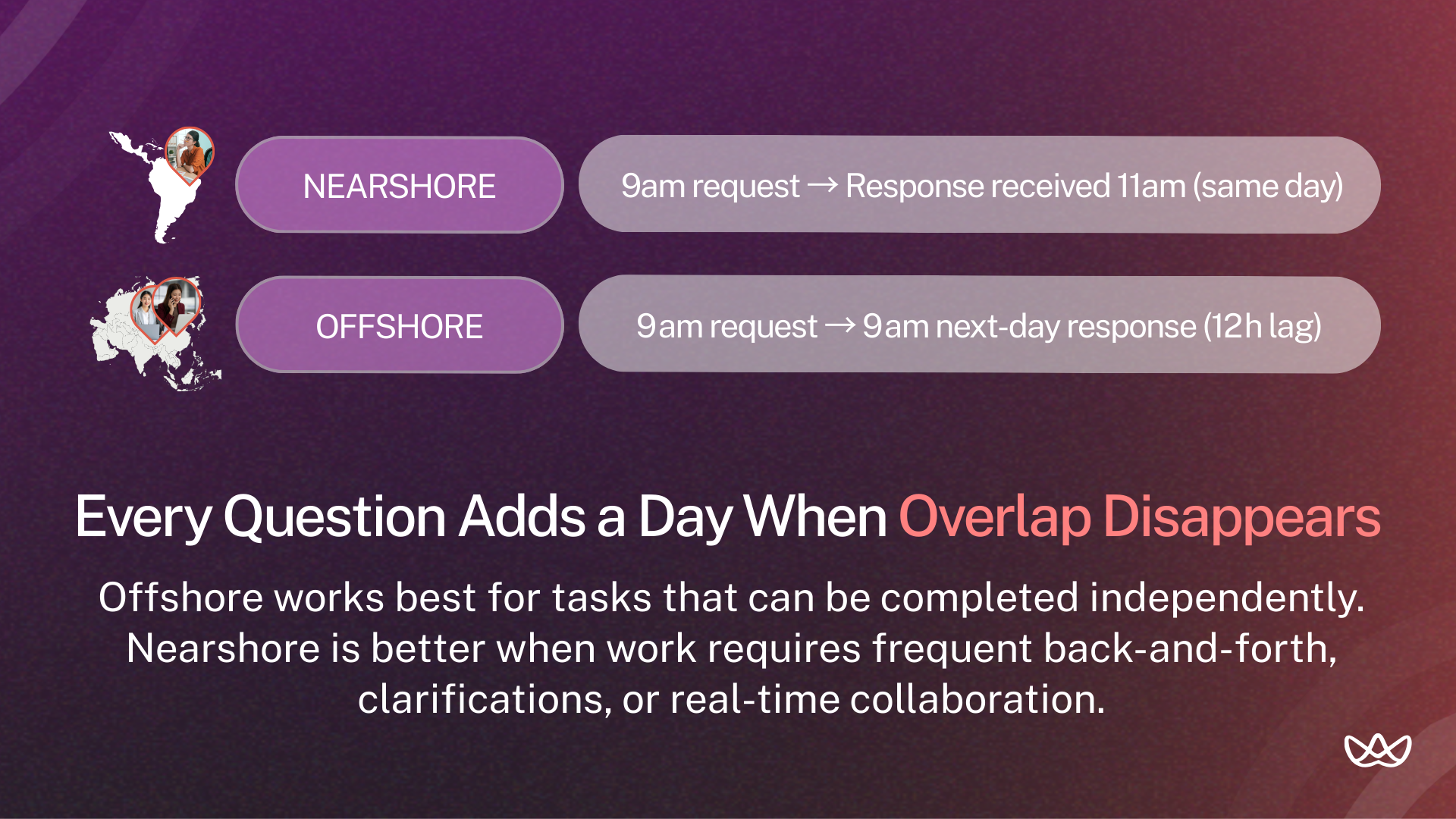
This constraint shapes what work can go offshore. Independent execution tasks work well, but collaborative work requiring frequent discussion becomes harder to manage across large gaps. Be clear about your collaboration needs before committing to offshore arrangements.
Security, Compliance and IP Sensitivity
Some work involves data or intellectual property that creates risk when handled offshore. Regulatory requirements, client contracts, or competitive sensitivity may limit what you can delegate.
Evaluate these constraints early. Reputable offshore partners handle compliance professionally and sign appropriate agreements. But some organizations have policies that restrict offshore work regardless of contractual protections.
Challenges & Risk Management
Offshore staffing comes with challenges like time-zone gaps, maintaining quality, unexpected costs, and compliance requirements. Setting up clear processes, documentation, and agreements helps keep work running smoothly.
Successful offshore staff augmentation depends on proactively managing time zones, quality control, and compliance risks.
Time Zone and Scheduling Management
The biggest operational challenge is coordination across 10-15 hour time differences. Meetings require someone to take inconvenient hours. Urgent issues can't be addressed until the next business day in the other region.
Mitigation: Establish clear handoff protocols. Document everything so work can continue without real-time discussion. Rotate meeting times so the burden doesn't fall consistently on one team. Use async video updates for status communication.
Quality Control, Oversight and Accountability
Distance makes it harder to observe work in progress. Problems may not surface until deliverables arrive, by which point significant rework is required.
Mitigation: Break work into smaller increments with frequent checkpoints. Review early deliverables closely to calibrate quality expectations. Establish clear acceptance criteria before work begins. Create feedback loops that catch issues early.
Hidden Costs, Scope Creep and Misalignment
Offshore engagements can expand beyond initial estimates when requirements aren't fully specified or when communication gaps lead to rework.
Mitigation: Invest time upfront in detailed specifications. Use fixed-price arrangements where scope is clear. For T&M work, establish budget alerts and regular reviews. Address misalignment immediately rather than letting it compound.
Data Security, Legal and Compliance Risks
Offshore work introduces legal complexity around data protection, intellectual property, and employment regulations in foreign jurisdictions.
Mitigation: Work with partners who handle local compliance as part of their service. Ensure contracts include appropriate data protection, confidentiality, and IP assignment provisions. Verify that partners meet relevant security certifications for your industry.
How to Choose the Best Offshore Staff Augmentation Services Partner
To choose the best offshore partner for creative and marketing work in 2026, focus on agencies with pre-vetted talent in your niche, verified case studies, and transparent pricing. Ensure they follow strong security standards and have clear communication protocols with enough time-zone overlap for real-time collaboration.
1. Match Technical Expertise to Role Requirements
Not all offshore providers specialize in the same areas. Some focus on engineering, others on creative work, others on operations. Match the provider's strength to your actual needs.
Ask for examples of similar placements. What roles have they filled? What industries do they serve? A provider with deep expertise in your domain will deliver better-matched candidates than a generalist, like the curated talent available through Floowi for growing agencies.
2. Review Reputation, Case Studies and References
Track record matters. Ask for client references and actually call them.
- What was the onboarding experience?
- How did the provider handle problems?
- Would they work with them again?
Red flags include: vague answers about their vetting process, unwillingness to provide references, pressure to sign quickly, and pricing that seems too good to be true.
3. Evaluate Communication, Project Management and Delivery Practices
- How does the provider support ongoing engagement?
- Do they assign account managers?
- What reporting do they provide? How do they handle performance issues?
The best providers have structured processes for onboarding, regular check-ins, and issue resolution. They don't just place candidates and disappear. They actively support the relationship.
4. Check Pricing Transparency and Contract Flexibility
Understand exactly what you're paying for.
- Are there setup fees?
- What's included in the monthly rate?
- What happens if you need to scale up or down?
Avoid providers with opaque pricing or rigid long-term commitments. The best partners offer transparent fee structures and reasonable flexibility for changing needs.
5. Assess Security, Compliance and Onboarding Support
Ask specifically about data protection practices, background check procedures, and compliance with relevant regulations. For sensitive work, verify security certifications and audit reports.
Also evaluate onboarding support. Does the provider help with equipment, system access, and initial training? A smooth onboarding process gets new team members productive faster.
6. Confirm Long-Term Collaboration and Retention Metrics
High turnover undermines the value of augmentation. Every time someone leaves, you lose institutional knowledge and restart the ramp-up process.
Ask providers about their retention rates. What do they do to keep talent engaged? The best providers invest in their professionals' growth and satisfaction, which translates to longer tenures on your engagements.
Top Offshore Staff Augmentation Services Providers (Recommended)
The following providers focus on different segments of the market. Selection criteria include geographic focus, role specialization, vetting rigor, and client support structure.
1. Floowi - Recommended for LATAM Marketing, Creative & Embedded Talent
Floowi operates as a nearshore alternative to traditional offshore providers. The focus is Latin American talent for marketing, creative, and operations roles rather than engineering. This positioning serves agencies and startups that need higher time zone alignment with U.S. teams while accessing cost advantages.
The model emphasizes embedded talent that integrates into client teams rather than project-based outsourcing. Vetting includes English proficiency, technical skills, and cultural fit assessment.
2. Toptal
Toptal positions itself as access to the "top 3%" of freelance talent globally. The vetting process is rigorous, with reported acceptance rates under 3%. Coverage includes developers, designers, finance experts, and project managers.
Best suited for companies needing senior-level individual contributors for specific projects. Pricing reflects the premium positioning.
3. Andela
Andela connects companies with engineering talent from Africa and Latin America. Originally a training-focused organization, it now operates as a marketplace of pre-vetted developers. This model allows you to quickly access engineers with strong technical skills and experience in distributed team setups.
It’s particularly valuable if you need reliable developers from emerging markets and want someone who can integrate smoothly into existing workflows without extensive onboarding.
4. BairesDev
BairesDev provides IT staffing primarily from Latin America, maintaining a large bench across multiple technologies and experience levels. The advantage here is speed and flexibility: you can scale teams quickly to meet project demands.
BairesDev also emphasizes nearshore alignment, meaning fewer time-zone headaches when coordinating with U.S. teams. It’s a solid choice for agencies and startups that need to expand engineering capacity fast without compromising on quality.
5. Tecla
Tecla specializes in full-time LATAM talent for U.S. startups, focusing on long-term integration rather than short-term project work. Time-zone alignment and cultural compatibility are key selling points, making it easier to manage teams in real time.
Tecla works best if you want dedicated team members who embed into your operations, whether for marketing, creative, or operational roles. This is particularly useful for startups aiming for continuity and minimal friction in remote collaboration.
6. Arc.dev / X-Team
Arc.dev (formerly CodementorX) and X-Team operate global developer marketplaces but take slightly different approaches. Arc emphasizes efficient matching, helping you quickly find developers suited to your project’s tech stack and experience requirements.
X-Team prioritizes developer engagement and community, which can lead to better long-term retention and motivation. Both are suitable for a wide range of engagements, from short-term sprints to building long-term distributed teams.
7. Deel
Deel functions primarily as an Employer of Record (EOR) platform, handling payroll, compliance, and contracts for international hires. It’s ideal if you’re sourcing talent independently but want a trusted infrastructure for legal employment abroad.
Deel allows companies to hire globally without creating local entities, reducing administrative overhead and ensuring compliance with labor laws in multiple jurisdictions.
8. Remote.com
Remote.com provides similar EOR services, covering payroll, benefits, and legal employment across 60+ countries. The platform is particularly useful for companies looking to build fully distributed teams while maintaining compliance with local employment regulations.
Remote.com simplifies onboarding, salary management, and benefits administration, which can otherwise become complicated when hiring internationally.
9. Oyster HR
Oyster combines EOR services with additional HR features like onboarding, hiring, and people management tools.
This makes it a good choice if you want more than basic compliance - Oyster helps manage teams at scale while maintaining consistent HR processes. It’s particularly valuable for startups or agencies that need structured HR support alongside international hiring.
10. Other Boutique Nearshore/Offshore Specialists
Smaller boutique providers often focus on specific regions, industries, or skill sets. They can provide more personalized service, deep domain knowledge, and flexibility compared with larger platforms.
When evaluating boutique firms, prioritize those with proven experience in your niche. These providers excel when you have specialized needs that require hands-on attention or highly tailored talent solutions.
How to Onboard Offshore Augmented Staff Successfully
Onboarding works best when you set clear goals, establish communication norms, run a short trial, organize handoffs, and keep track of performance - this helps offshore teams stay aligned and productive.
1. Define Clear Goals, KPIs and Deliverables
Before someone starts, document exactly what success looks like. What will they deliver? How will you measure quality? What are the key milestones?
Vague expectations create problems downstream. The clearer your specifications upfront, the smoother the engagement will run.
2. Set Communication Rhythms and Overlap Hours
Establish when you'll connect synchronously and what communication happens async. Identify the core overlap hours when both teams are available.
Document response time expectations. If someone sends a message during your night, when should they expect a reply? Setting these norms early prevents frustration.
3. Run a Paid Trial or Pilot Phase
Most providers offer trial periods. Use them. A two-week pilot with real work reveals whether the fit is right better than any interview process.
Pay attention to communication quality, work product, and how problems get handled. These early signals predict long-term success.
4. Formalize Handoffs, Documentation and Knowledge Transfer
Create systems for passing work between time zones.
- What gets documented?
- Where does it live?
- How do handoffs happen?
Good documentation reduces dependency on real-time communication. When someone can pick up context from written materials, the time zone gap matters less.
5. Track Performance and Iterate Processes
Establish metrics from the start and review them regularly.
- What's working?
- What needs adjustment?
- Where are the friction points?
The best offshore relationships improve over time as both sides learn how to work together effectively. Build in regular retrospectives to capture these learnings.
Frequently Asked Questions
How Do Companies Calculate Total Cost of Ownership When Hiring Offshore?
Beyond base salaries, consider staffing partner fees, management time, collaboration tools, and any rework due to quality issues. Compare this total to fully-loaded domestic costs, including benefits, office space, recruiting, and onboarding. Looking at the complete picture helps avoid surprises and ensures offshore hiring truly delivers savings.
What Timezone Tradeoffs Should U.S. Teams Expect When Working Offshore?
Teams in Asia and the Philippines typically share 1-4 hours with U.S. business hours, while Eastern Europe offers 4–6 hours, and Latin America 6-8 hours. Fewer overlap hours mean more async work, longer feedback cycles, and careful planning for meetings and handoffs.
How Do Companies Ensure Quality Control and Avoid Misalignment With Offshore Talent?
Break work into manageable chunks with frequent check-ins. Provide detailed specifications upfront and set clear acceptance criteria. Feedback loops catch problems early, preventing small issues from becoming bigger setbacks. Regular calibration ensures the work meets expectations consistently.
What Oversight Practices Help Prevent Scope Creep in Offshore Engagements?
Document requirements clearly before starting. Use fixed-price agreements for defined work and set budget alerts for time-based contracts. Any scope changes should go through a formal approval process to keep projects on track and avoid hidden costs.
How Do Companies Mitigate Data Security and Compliance Risks When Hiring Offshore?
Choose providers that handle local compliance professionally. Contracts should include data protection, IP rights, and confidentiality clauses. Verify security certifications and limit system access based on roles to protect sensitive information.
What Reputation Signals Indicate a Strong Offshore Partner?
Look for providers willing to share client references, explain their vetting process, and demonstrate transparent pricing. Evidence of long-term client relationships, published retention metrics, and reasonable contract flexibility all indicate reliability and professionalism.
What Contract Flexibility Matters Most for Fast-Growing Teams?
Flexible contracts allow you to scale up quickly when needed and scale down without penalty. Trial periods before committing long-term help test the fit, while clear processes for replacing underperforming talent ensure teams stay productive.
How Do Retention Metrics Help Evaluate Long-Term Offshore Collaboration?
High turnover can signal issues with culture, compensation, or management. Ask providers about retention rates and reasons for departures. Those who invest in their team’s growth and satisfaction are more likely to deliver stable, reliable talent over time.
Your Next Step
Offshore staff augmentation services deliver real cost advantages, but the model requires honest assessment of your collaboration needs. Maximum savings come with maximum time zone gaps. If your work tolerates async communication, pure offshore makes economic sense. If you need real-time collaboration, nearshore alternatives offer better balance.
The engagement model matters too. Project-based work suits defined scopes. Dedicated teams build knowledge over time. Hybrid approaches provide flexibility. Match the model to your actual needs rather than defaulting to the cheapest option.
Decision Checklist for U.S. Teams Evaluating Providers
- Define role requirements and success criteria before engaging providers
- Assess time zone requirements honestly based on collaboration needs
- Evaluate provider specialization and track record in your domain
- Verify vetting processes, retention metrics, and client references
- Understand total costs including management overhead
- Start with trials before committing to long-term arrangements
- Establish clear documentation and handoff processes
- Build in regular reviews and continuous improvement
Key Takeaways
- Offshore augmentation scales teams cost-efficiently with access to deep global talent at 30–70% savings.
- Savings come with less time-zone overlap and more coordination needs.
- Quality, security, and communication practices drive long-term success.
- Floowi provides a nearshore option with better U.S. alignment for marketing, creative, and operations roles.
Build your nearshore team with Floowi using vetted LATAM talent and book your free consultation today.




