

.png)
.png)



Hiring a social media manager in 2026 requires more than posting a job ad and picking the candidate with the most followers. The role has expanded significantly. You need someone who understands AI-assisted workflows, can manage content across multiple platforms simultaneously, and adapts to algorithm changes without missing deadlines.
For agencies handling multiple clients, the complexity multiplies. Each brand needs a distinct voice, separate content calendars, and dedicated community management. Finding talent who can handle this workload while maintaining quality is one of the harder hiring challenges right now.
Many agencies now hire vetted offshore social media managers to get experienced professionals at competitive rates. This guide covers everything you need to know: costs, skills to evaluate, where to find talent, and how to structure your hiring process.
What a Social Media Manager Actually Does for Agencies
For agencies, a social media manager acts as the strategic voice and personality of multiple client brands in the digital world, focusing on strategy development, content creation, community engagement, and data analysis to drive measurable business results. The role is multifaceted, requiring creativity, organization, and analytical skills.
What a Social Media Manager Is (Modern Definition)
A social media manager manages a brand’s presence across platforms, handling content planning, community engagement, analytics, and coordination with other teams. Today, AI handles routine tasks, so the manager focuses on interpreting data, keeping the brand consistent, and growing the audience.
They combine strategy with human judgment, using AI tools to work more efficiently while making decisions that truly connect with people.
Evaluate Revenue & Client-Impact Responsibilities
Social media managers directly affect business outcomes. They influence customer acquisition cost through organic reach, protect brand reputation by handling negative feedback quickly, and support retention by keeping audiences engaged. For agencies, their work determines client satisfaction and contract renewals.
- Organic reach reduces paid ad dependency and lowers CAC.
- Fast response to issues prevents reputation damage.
- Consistent engagement supports sales pipeline activity.
- Quality content keeps existing clients happy with results.
Assess Content, Community & Analytics: The Combined Role
The modern SMM wears multiple hats. Content work includes building calendars, drafting posts, and scheduling across platforms. Community work covers DMs, comments, and escalation handling. Analytics work involves pulling platform data and turning it into recommendations the team can act on.
- Content: calendars, drafts, asset preparation, scheduling.
- Community: comment moderation, DM responses, issue escalation.
- Analytics: platform metrics, performance reports, optimization recommendations.
Evaluate Client Communication & Multi-Brand Management
Agency SMMs often handle 4 to 10 brands at once. This demands strong organization, clear voice switching between accounts, and systems that prevent cross-posting mistakes. Client communication skills matter because the SMM frequently becomes the primary contact for social-related questions.
Why You Should Hire a Social Media Manager (vs. Doing It In-House)
Hiring a professional social media manager or agency instead of managing it in-house offers a multitude of benefits, primarily revolving around specialized expertise, significant time savings, and a more strategic approach to growth.
Assess Cost, Time & Quality
Founders and marketing leads often try to handle social media themselves. This works temporarily but creates problems as the business grows. Quality suffers when social becomes one of twenty tasks competing for attention. Hiring a dedicated manager improves consistency and frees leadership to focus on strategy.
- Dedicated focus produces better content quality
- Response times improve when someone owns the channel
- Posting consistency supports algorithm performance
Evaluate Scaling Content Volume & Campaign Complexity
As agencies add clients or companies expand their social presence, content volume increases. Managing three platforms for one brand is different from managing five platforms for eight brands. A skilled SMM builds systems that scale, including templates, approval workflows, and asset organization that prevent chaos.
Assess Reducing Founder/Team Burnout & Operational Risk
Social media never stops. Comments come in on weekends, crises emerge without warning, and algorithms reward consistent posting. When founders handle this themselves, burnout follows. Delegating to a dedicated manager removes this operational burden and reduces the risk of dropped balls during busy periods.
Evaluate Opportunity Cost of Founders Managing Social Media
Every hour a founder spends scheduling posts is an hour not spent on strategy, sales, or product development. Calculate what founder time actually costs. If a founder's effective hourly rate is $200 and they spend 10 hours weekly on social, that's $2,000 per week in opportunity cost. Hiring a capable SMM at $25-40/hour creates immediate value.
How Much It Costs to Hire a Social Media Manager in 2026
Costs for social media managers vary depending on where you hire and the experience level. US in-house hires cost the most but give full-time focus and alignment with your team.
Freelancers are flexible and can fill gaps, but output may be less consistent. Full-time LATAM hires are often more affordable while still providing reliable, dedicated work.
Assess US In-House vs US Freelance
US-based in-house social media managers cost between $45,000 and $100,000 annually depending on seniority and location. Add benefits, equipment, and management overhead, and the true cost increases by 20-30%. Freelancers charge $30-75 per hour but often lack availability for full-time workloads.
Evaluate LATAM Full-Time Vetted vs Offshore Agencies
LATAM professionals offer experienced talent at 40-60% lower cost than US equivalents. Full-time vetted hires through LATAM social media talent partners provide dedicated resources with US time zone overlap. Offshore agencies cost less but often deliver inconsistent quality and communication challenges.
Assess Budget Bands by Seniority & Scope
Junior talent handles execution with supervision. Mid-level manages campaigns independently. Senior talent leads strategy and mentors others. Match seniority to your actual needs rather than defaulting to senior hires that cost more than necessary.
Skills & Experience to Look For When You Hire a Social Media Manager
When hiring a social media manager, focus on essential hard skills, critical soft skills, and relevant experience. The right candidate can combine creative content with data-driven strategy, maintain a consistent brand presence, and deliver measurable results for your business.
Evaluate Must-Have Hard Skills (Aligned to KPIs)
Key Hard Skills:
- Content creation and copywriting for multiple platforms.
- Basic design skills (Canva, Figma basics).
- Platform-native analytics interpretation.
- Scheduling tool proficiency.
- AI tool usage for content assistance.
Analytics Stack Mastery (Meta Suite, GA4, Metricool)
Analytics skills separate order-takers from strategic contributors. A capable SMM pulls data from Meta Business Suite, understands Google Analytics 4 basics for traffic attribution, and uses tools like Metricool or Sprout Social for cross-platform reporting. Ask candidates to walk through a report they built and explain what actions came from the data.
Cross-Platform Publishing Workflows (Creator Studio, Hootsuite, Buffer)
Evaluate tool proficiency through practical demonstration. Can they set up a content calendar in Hootsuite? Do they understand the differences between scheduling tools? Have them explain their workflow for managing multiple accounts without making cross-posting mistakes.
Assess Essential Soft Skills for Remote & Client-Facing Work
Remote work demands strong async communication. Candidates should demonstrate proactive updates, clear written communication, and comfort with video calls. For client-facing roles, evaluate how they handle difficult questions and whether they can explain technical concepts in plain language.
- Proactive communication without constant prompting.
- Clear written updates and documentation.
- Adaptability when priorities shift.
- Ownership mindset for client accounts.
Evaluate Nice-to-Have Differentiators (Video, Paid Basics, Trend-Spotting)
Video editing skills add value as short-form content dominates. Basic paid advertising knowledge helps SMMs understand how organic and paid work together. Trend-spotting ability means they can identify relevant opportunities and adapt quickly. These skills differentiate strong candidates but should not be hard requirements for most roles.
Where to Hire a Social Media Manager in 2026
You can hire a social media manager through specialized freelance platforms, major professional networking sites, and targeted digital marketing job boards. The best option depends on your needs: freelance, full-time, or an agency partnership
Best Platforms & Companies to Hire Talent
1. Vetted Nearshore LATAM Platforms (e.g., Floowi - Full-Time Talent)
Nearshore platforms pre-vet candidates for skills, English proficiency, and work history. Floowi's full-time social media manager hiring options provide dedicated professionals who work during US business hours. Time zone alignment enables real-time collaboration, and full-time commitment means the talent focuses on your accounts exclusively.
2. LinkedIn
LinkedIn works well for finding candidates with verifiable work history. You can see their content, check recommendations, and assess professional presentation. The downside is high volume of applications and significant time investment to screen properly.
3. Upwork/Freelancer Marketplaces
Freelancer platforms give quick access to a large talent pool. Hourly tracking and escrow payments offer some protection. Quality varies a lot, and top talent can get poached or increase their rates quickly. These platforms work best for project-based work rather than long-term commitments.
4. Job Boards (Indeed, Remote-Specific Boards)
General job boards generate many applications but require time to screen. Remote-specific boards like We Work Remotely or Remote OK attract candidates already experienced in distributed work. Expect to spend 10–15 hours screening for each hire.
5. Creative Communities (Behance, Dribbble)
Design-focused platforms are useful for finding social media managers with strong visual skills. They’re best when content creation is a primary responsibility. They’re less effective for candidates who focus on analytics or strategy.
6. Specialized Agencies & Recruiting Partners
Recruiting partners handle sourcing, screening, and initial vetting. They cost more upfront but save time and reduce hiring mistakes. They work well for agencies hiring multiple roles or companies without internal recruiting capacity.
When Agencies Should Avoid Freelancer Marketplaces
Freelancer marketplaces aren’t ideal when you need consistent availability, long-term commitment, or work that involves sensitive client information. Freelancers often juggle multiple clients and may be unavailable during critical periods. For ongoing agency work, dedicated full-time hires are usually more reliable.
Assess Pros & Cons of Each Hiring Channel
Different hiring channels have clear advantages and limitations. Nearshore partners and recruiting agencies give you vetted talent and save time but cost more. LinkedIn and job boards provide access to many candidates but take time to screen. Freelance platforms are fast for short-term projects but aren’t always reliable for ongoing work.
Evaluate When to Choose a Recruiting Partner vs DIY
Do your own sourcing if your team has recruiting capacity, time to screen candidates thoroughly, and enough hires to justify building a process. A recruiting partner is the better option when you need to move quickly, don’t have hiring expertise, or past DIY efforts didn’t work well.
Often, the cost difference isn’t as big as it seems once you consider the time saved and mistakes avoided.
In-House vs Offshore vs Freelance: Which Is Better for Agencies?

Choosing the right hiring model depends on your priorities for cost, control, speed, and collaboration. Each option has trade-offs that affect your team and client outcomes.
Assess Cost, Control & Speed
In-house hires give you the most control but come with the highest cost. Freelancers offer flexibility but may not always be available when you need them. Offshore talent can save money but sometimes creates communication challenges. Nearshore LATAM hires provide a balance of cost savings while staying aligned with US time zones and culture.
Evaluate Culture, Communication & Timezone
Time zone overlap directly affects how well teams collaborate. Working with someone 12 hours away means relying on async communication and waiting for feedback. LATAM talent works during US business hours, which allows same-day responses, real-time collaboration, and participation in team meetings.
Hire Offshore LATAM Talent When Appropriate
Hiring in LATAM works well when you need full-time dedication at a lower cost, value real-time collaboration, and want professionals familiar with US market expectations. Many LATAM social media managers have experience with US clients and understand local marketing norms.
Assess Quality Consistency: Why Full-Time Nearshore Talent Outperforms Freelancers
Freelancers often juggle multiple clients, which can split attention. Full-time nearshore hires focus on your accounts exclusively. This leads to better quality work, faster responses, and a deeper understanding of your brands. The difference in consistency usually becomes noticeable within the first month.
The Hiring Process: Step-by-Step
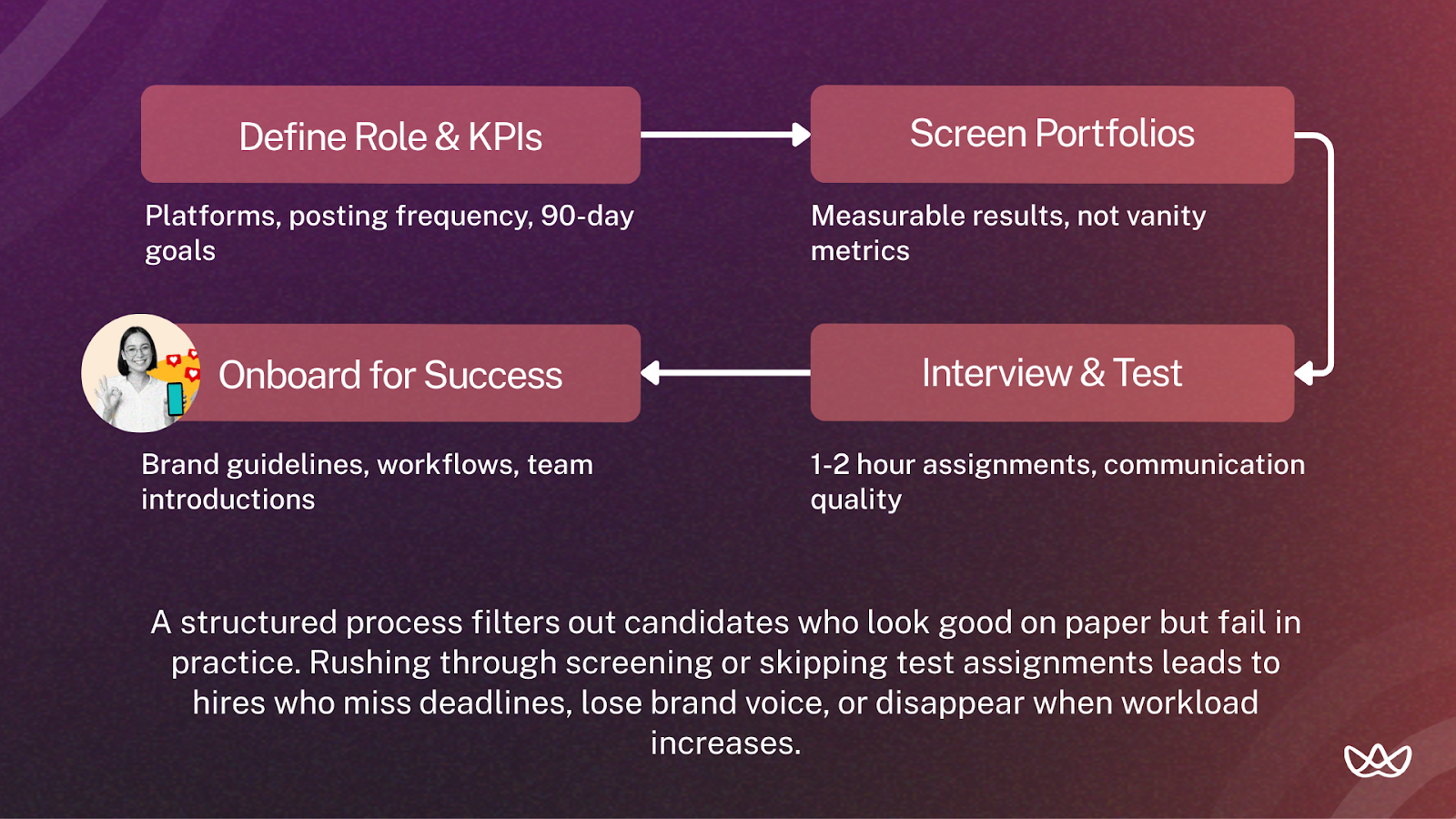
Stage 1 - Define the Role & KPIs
Start by outlining exactly what the social media manager will handle. List the platforms they’ll manage, set expectations for posting frequency, and define reporting cadence and format.
Clarify collaboration requirements, including meetings and async communication. Finally, set measurable KPIs for the first 90 days so both sides know what success looks like.
Stage 2 - Sourcing & Screening (What to Look For)
Focus on portfolio quality first. Look for work that shows an understanding of different brand voices and measurable results, not just likes or followers.
Verify experience with the platforms you need. Eliminate candidates who can’t provide clear examples of past performance.
Stage 3 - Interviewing & Test Assignments
Interviews help assess communication skills and cultural fit, while test assignments show real work quality. Use both methods. Keep test assignments under two hours to respect candidate time but still gather meaningful insights.
Examples of Test Assignment Formats (Short vs Long)
- Short format (1 hour): Write five captions for a sample brand or create a one-week content calendar outline.
- Long format (2 hours): Audit an existing social presence and provide improvement recommendations with specific examples.
Stage 4 - Offer, Contract & Onboarding for Long-Term Success
A clear contract avoids misunderstandings. Include work hours, communication expectations, tool access, and a performance review schedule. Onboarding should cover brand guidelines, approval workflows, escalation procedures, and introductions to the team. Investing time upfront helps prevent problems later.
Top Interview Questions to Ask When You Hire a Social Media Manager
Asking the right questions helps you understand not just skills, but how a candidate thinks, solves problems, and adapts to client and remote work situations.
Evaluate Campaign Walkthroughs & Problem-Solving Prompts
- Walk me through a campaign you managed from planning to results. What worked and what would you change?
- Tell me about a time content underperformed. How did you diagnose the problem and what did you do?
- How do you decide which metrics matter for a specific campaign?
Assess Behavioral Questions for Client & Remote Work
- How do you handle a client who disagrees with your content recommendations?
- Describe your daily workflow when managing multiple accounts remotely.
- How do you stay organized when priorities change frequently?
Verify Practical Tests & Portfolio Review Checklist
- Does the portfolio show work across multiple platforms?
- Are results presented with specific metrics rather than vague claims?
- Can they explain the strategy behind content decisions?
- Is there evidence of adapting content for different audiences?
Assess AI-Related Interview Questions (How Candidates Use AI Tools)
- Which AI tools do you use regularly and for what tasks?
- How do you ensure AI-generated content matches brand voice?
- What tasks should AI handle versus human judgment?
Mistakes to Avoid When Hiring a Social Media Manager
Red Flags
- Portfolio shows follower counts but no engagement or business metrics.
- Cannot explain strategy behind past content decisions.
- Slow or unclear communication during interview process.
- No experience with your required platforms.
- Unwilling to complete test assignments.
Relying on Vanity Metrics
Follower counts alone don’t tell you much. A candidate who grew an account from 1,000 to 5,000 engaged followers provides more value than someone with 50,000 followers who never interact. Ask about engagement rates, click-throughs, and how social media contributed to business results.
Ignoring Community Management & Async Communication Skills
Content creation is important, but managing the community often drives success. Ask about handling comments, DM response protocols, and crisis management. For remote roles, test async communication by observing email quality, response speed, and clarity during the hiring process.
Under-Scoping Test Assignments
Assignments that are too short don’t show skill, and overly long tasks waste candidate time. Aim for 1-2 hour assignments that show real capability. Use clear criteria to evaluate, not just gut feeling.
Not Testing Async Communication Skills
Remote work relies on strong async communication. Pay attention to how candidates ask questions, respond to messages, and explain their ideas. This often predicts how effectively they’ll collaborate once hired.
When You Should Partner with a Recruiting or Operations Partner
Partnering with a recruiting or operations partner becomes a strategic necessity when your business faces specific challenges related to capacity, specialized expertise, and the need for objective, high-level strategy.
Signs You Need Expert Help
- Past hires have not worked out and you are not sure why.
- You need to hire quickly but lack internal recruiting bandwidth.
- You are expanding into new markets or regions.
- Screening volume overwhelms your team.
How Partners Reduce Risk & Speed Up Hiring
Good recruiting partners handle the early stages of hiring so you don’t have to. They pre-screen candidates for skills, experience, and cultural fit, conduct initial interviews, and verify references. Instead of reviewing dozens of applications, you get a shortlist of qualified candidates ready for final interviews.
What to Expect from a Good Partner (Vetting, Onboarding, Retention)
Quality partners provide thorough vetting, including skills assessments and English proficiency checks. They also support onboarding with documentation, introductions, and guidance on workflows.
Some offer replacement guarantees if a hire doesn’t work out within a set period. Confirm these services before engaging a partner.
How LATAM Recruiting Partners Reduce Time-to-Hire From 45 to 10 Days
DIY hiring usually takes 30-45 days, including sourcing, screening, interviewing, and negotiating. Specialized LATAM partners maintain pre-vetted talent pools and established processes that can cut this to 10–15 days. The time savings alone often justify the cost of partnering.
Your Next Step
Hiring a social media manager works best when you have a clear process:
- Define platforms, posting frequency, and reporting expectations.
- Set measurable 90-day KPIs.
- Screen portfolios for results, not vanity metrics.
- Use 1-2 hour test assignments to evaluate capabilities.
- Observe communication quality during the process.
- Prepare onboarding materials before the hire starts.
Choosing the right approach depends on your needs. DIY works if you have time and recruiting capacity, partners speed up vetting, and LATAM full-time talent provides cost efficiency, focus, and collaboration.
Start building your team with vetted offshore Social Media Managers in LATAM with Floowi. Access bilingual, high-performing talent within 15 days and streamline hiring from screening to onboarding.
Frequently Asked Questions
How Do I Hire a Social Media Manager the Right Way?
Define clear responsibilities and KPIs first. Source candidates through appropriate channels. Screen portfolios for measurable results. Use interviews and test assignments to evaluate fit. Invest in proper onboarding.
What's the Cost Difference Between LATAM Full-Time Hires & Offshore Agencies?
LATAM full-time hires cost $18,000-60,000 annually depending on seniority. Offshore agencies charge similar rates but often provide shared resources rather than dedicated focus. Full-time hires deliver more consistent quality and availability.
What Risks Do Founders Face When Managing Social Media Themselves?
Burnout from constant platform demands, inconsistent posting that hurts algorithm performance, slow response times that damage brand perception, and significant opportunity cost from time diverted from strategic work.
When Is Offshore LATAM Talent the Best Fit?
LATAM talent works well when you need full-time focus, overlap with US time zones, and experience with US market expectations. Many have worked with US clients for years and understand how to balance creativity, analytics, and community management.
What Essential Skills Should Agencies Look For?
Look for analytics skills, scheduling tool proficiency, content creation across formats, community management experience, and clear writing. Familiarity with AI tools helps with efficiency, but human judgment and brand alignment remain critical.
How Do You Test for Essential Soft Skills in Interviews?
Ask behavioral questions about client handling and shifting priorities. Notice how candidates ask questions, take feedback, and communicate. Clear, timely, proactive communication during hiring predicts remote and multi-account performance.
When Should Agencies Choose a Recruiting Partner Over DIY Sourcing?
Use a partner when speed matters, internal resources are limited, past DIY hires didn’t work, or you’re hiring multiple managers. Partners pre-screen, vet, and sometimes guarantee replacements, saving time and reducing risk.
How Do Agencies Onboard Social Media Managers for Long-Term Success?
Agencies ensure the long-term success of social media managers through a structured, multi-phase onboarding program that prioritizes clarity of expectations, immersion into agency culture and client specifics, and continuous development.
Provide brand guidelines, approval workflows, and team introductions. Set 30/60/90 day goals and schedule early check-ins. Clear onboarding ensures alignment and faster results.
What Red Flags Should Agencies Watch For in Interviews?
Look for vague answers about results, inability to explain strategy, slow communication, focus on vanity metrics, or reluctance to do test assignments. These issues often indicate trouble in multi-account or remote work.




