

.png)
.png)



Agencies rely on remote social media managers to keep daily content work moving across multiple client accounts. The role now includes scheduling, community replies, client edits, and using AI tools to streamline reporting and content drafts.
Hiring the right person takes more than a simple job post. You need someone who stays organized across brand voices, handles async communication, and moves tasks forward without constant supervision.
Many agencies choose to hire vetted LATAM remote social media managers because the time zone overlap makes collaboration smoother and ensures faster turnaround on client projects.
This guide explains how to hire a remote social media manager in 2026, evaluate skills, compare costs, and choose the right hiring path.
Why Hiring a Remote Social Media Manager Is a Competitive Advantage
Hiring a remote social media manager offers a competitive advantage through enhanced flexibility, specialized talent acquisition, and significant cost efficiencies.
The benefits you get from hiring a remote social media manager:
- Access global specialists across platforms and industries.
- Save on office, equipment, and benefits costs.
- Provide 24/7 coverage across time zones.
- Hire targeted expertise without training full-time staff.
- Focus on measurable results, not hours worked.
- Scale teams quickly to match campaign needs.
- Bring diverse perspectives that boost creativity.
Assess What a Remote Social Media Manager Actually Handles
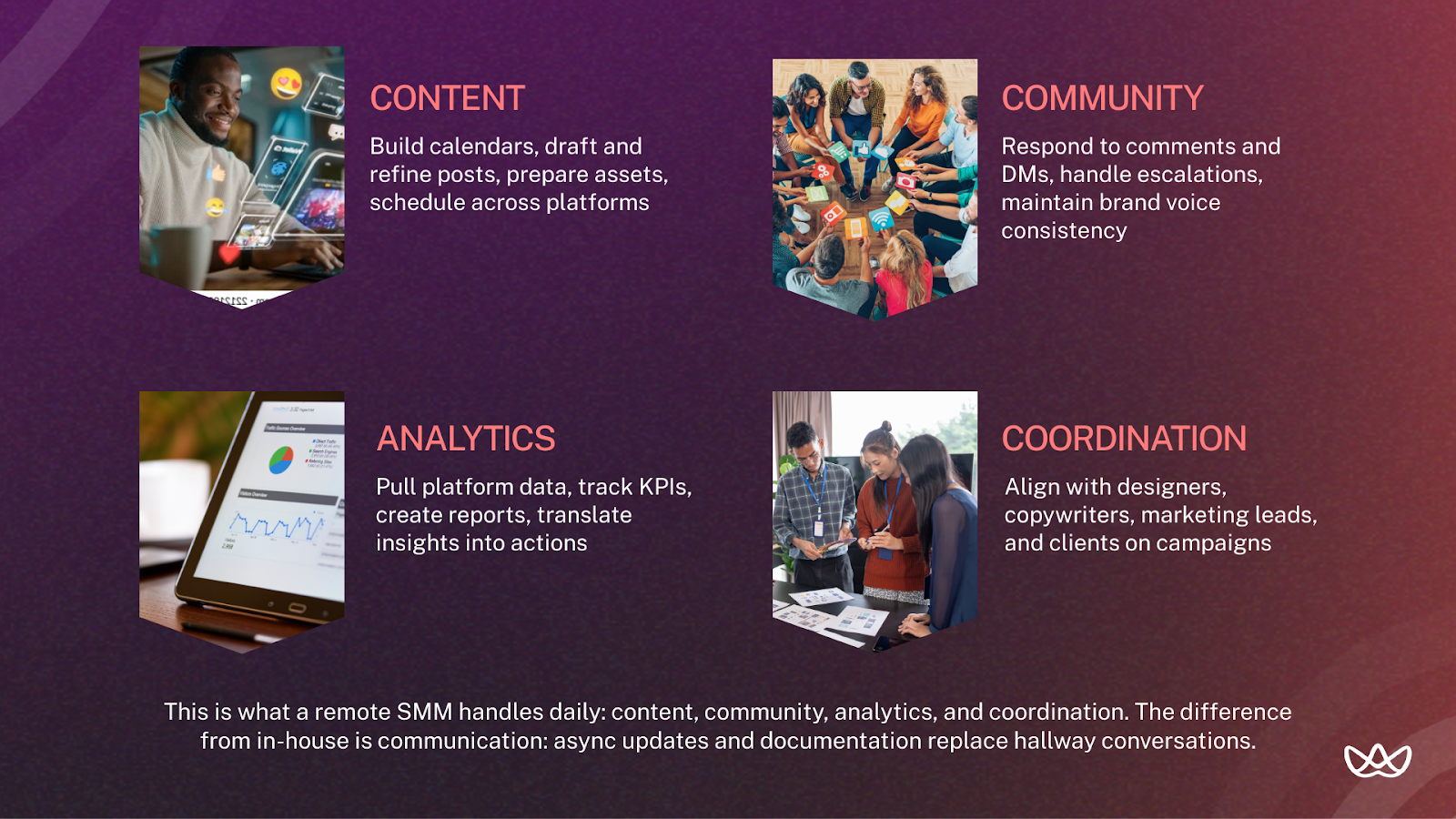
A remote social media manager owns the daily execution of brand presence across platforms. This includes content planning, scheduling, community engagement, analytics reporting, and cross-team coordination. The remote aspect adds requirements around async communication, self-management, and proactive updates without in-person check-ins.
Core responsibilities include:
- Building and maintaining content calendars across platforms.
- Drafting, editing, and scheduling posts.
- Managing comments, DMs, and community interactions.
- Pulling analytics and creating performance reports.
- Coordinating with designers, copywriters, and marketing leads.
- Handling escalations and crisis response during working hours.
- Using AI tools for content drafts and research.
Evaluate Benefits for Agencies: Cost Efficiency, Flexibility & Faster Execution
Remote hiring expands your talent pool beyond local markets. You can access experienced professionals at competitive rates while maintaining quality. Agencies report 30-50% cost savings when hiring remote talent from regions like Latin America compared to US-based equivalents.
Flexibility matters too. Remote SMMs can cover different time zones, handle weekend monitoring, or scale up during campaign launches without office logistics. Execution speeds up when you hire dedicated talent rather than splitting responsibilities across overloaded team members.
Why LATAM Remote Talent Has Become a Top Choice in 2026
LATAM remote talent is a top choice for global companies in 2026 due to time zone alignment, a growing pool of skilled professionals, cost efficiency, and cultural fit with North American teams. Agencies hire social media managers in LATAM because overlapping work hours reduce delays in approvals, client communication, and cross-team coordination.
Many bring agency experience and practical knowledge of US social media trends, while bilingual skills allow teams to manage English and Spanish content. Familiarity with multi-brand workflows and tight deadlines also reduces onboarding friction, letting LATAM remote SMMs contribute effectively from day one.
Assess the Difference Between Remote vs Hybrid vs Nearshore Social Media Managers
For most agencies, nearshore remote offers the best combination. You get cost savings, dedicated focus, and real-time collaboration during business hours.
Fully Remote: Works from anywhere, communicates entirely through digital channels. Requires strong async skills and self-management.
Hybrid: Combines remote work with occasional in-office time. Works when you need periodic face-to-face collaboration but have local candidates.
Nearshore Remote: Works remotely from a nearby region (like LATAM for US companies). Provides time zone overlap without relocation costs.
Define the Role and Goals Before Hiring
1. Audit Your Current Social Media Gaps
Before hiring, identify what is actually missing. Ask these questions:
- Which platforms are underperforming or neglected?
- Where does content quality drop due to bandwidth issues?
- How fast do you respond to comments and DMs currently?
- Who handles analytics, and is reporting consistent?
- Are campaigns delayed because nobody owns execution?
The gaps reveal whether you need an executor, a strategist, or someone who can do both.
2. Set Clear Objectives, KPIs & Platform Priorities
Define success before you start interviewing. Vague goals like "improve social presence" lead to misaligned expectations. Set specific targets:
- Engagement rate targets by platform (e.g., 3%+ on Instagram).
- Posting frequency (e.g., 5 posts per week per platform).
- Response time standards (e.g., all DMs answered within 4 hours).
- Reporting cadence (e.g., weekly metrics summary, monthly deep-dive).
- Content production volume (e.g., 20 posts per week across 3 brands).
3. Determine the Required Scope: Daily Tasks, Deliverables & Ownership Level
Remote-Readiness Checklist:
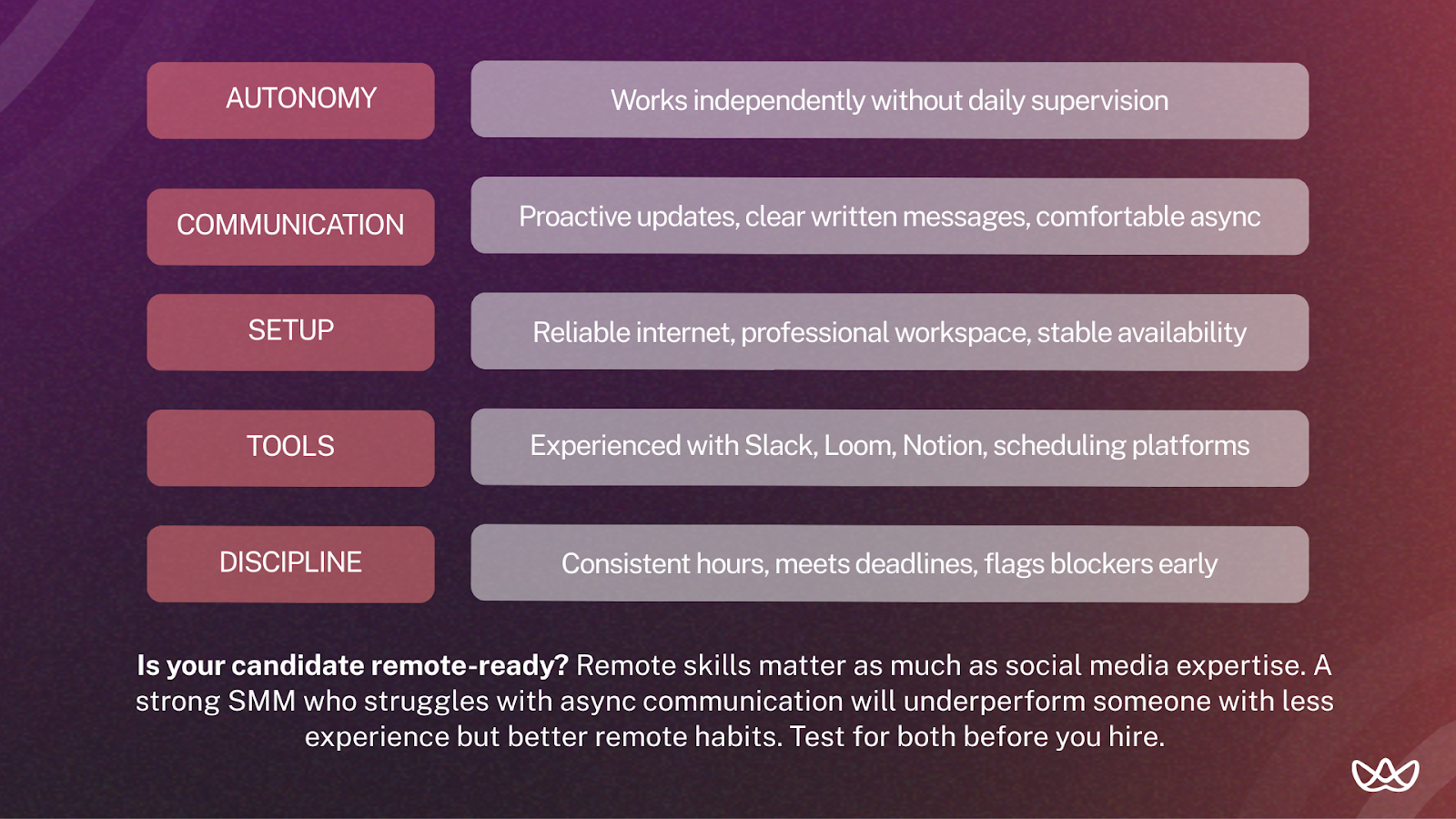
- Can work independently without daily supervision
- Comfortable with async communication tools (Slack, Loom, Notion)
- Proactive in sharing updates without being asked
- Maintains consistent availability during agreed hours
- Has reliable internet and a professional home setup
- Experienced with remote collaboration across time zones
KPIs Remote SMMs Should Own:
- Engagement rate (likes, comments, shares, saves)
- Follower growth rate
- Response time to comments and DMs
- Content production volume and quality
- Click-through rates on link posts
- Reporting accuracy and timeliness
- Brand voice consistency across platforms
Create a High-Converting Remote Social Media Manager Job Description
A high-converting remote social media manager job description should emphasize performance, autonomy, and the unique advantages of remote work, such as flexibility and global collaboration opportunities.
1. Role Summary & Primary Responsibilities
A strong job description attracts qualified candidates and filters out poor fits. Include:
- Platforms they will manage (Instagram, TikTok, LinkedIn, etc.)
- Number of brands or accounts
- Posting frequency expectations
- Community management scope
- Reporting requirements
- Tools they should know
- Time zone and availability requirements
2. Assess Required Skills, Experience & Portfolio Expectations
Specify what candidates must demonstrate:
- 2+ years managing social media for brands or agencies
- Portfolio showing measurable results (not just pretty posts)
- Platform-specific experience matching your needs
- Familiarity with scheduling tools (Hootsuite, Later, Metricool)
- Basic design skills (Canva proficiency minimum)
- Strong written English communication
3. Verify Remote Work Requirements: Tools, Availability & Communication Standards
Remote-specific requirements to include:
- Required working hours and time zone overlap
- Communication tools (Slack, Zoom, Asana, etc.)
- Response time expectations for messages
- Weekly check-in format (video call, async update)
- Equipment requirements (reliable internet, webcam, quiet workspace)
Examples of High-Performing Job Descriptions
Example 1 - Agency Role: "We need a remote social media manager to handle 4 client accounts across Instagram and TikTok. You will create content calendars, schedule posts, manage comments, and deliver weekly reports. Must be available 9am-5pm EST and comfortable with async communication via Slack."
Example 2 - Startup Role: "Looking for a remote SMM to own our LinkedIn and Twitter presence. Responsibilities include content strategy, daily posting, engagement, and monthly analytics. Must have B2B experience and strong copywriting skills. Flexible hours but expect 4-hour daily overlap with PST."
Choose the Best Hiring Path: In-House, Freelance, or Offshore Remote
Choosing the best hiring path - in-house, freelance, or offshore remote - depends entirely on your business needs, budget, desired control level, and long-term goals. Each path offers distinct advantages suited to different situations.
When to Hire an In-House Social Media Manager
In-house makes sense when:
- Social media is core to your business model.
- You need someone in strategy meetings daily.
- Budget allows for full US salary plus benefits.
- Confidential work requires on-site presence.
For most agencies managing client accounts, in-house is not the most efficient path.
Why Nearshore LATAM Talent Outperforms Offshore or Freelancers
LATAM remote hires offer specific advantages:
- Time zone alignment with US markets (same-day collaboration).
- Lower cost than US equivalents (40-60% savings).
- Full-time dedication versus freelancer split attention.
- Bilingual capabilities for Hispanic markets.
- Agency backgrounds with multi-client experience.
- Cultural familiarity with American brands.
Offshore talent from distant time zones creates async-only workflows that slow feedback cycles. Freelancers split attention across clients and may disappear during critical periods.
Assess Pros & Cons of Hybrid Approaches
Hybrid pros:
- Some face-to-face time for relationship building.
- Easier onboarding with in-person training.
- Works for local candidates who want flexibility.
Hybrid cons:
- Limits talent pool to commutable distance.
- Still requires office space and overhead.
- Does not capture full cost savings of remote.
Remote SMM Hiring Models
Each option - In-House, Freelance, Offshore Remote, or LATAM Nearshore - varies in cost, required autonomy, communication style, time zone alignment, and the type of work it’s best suited for.
Best Channels to Hire Remote Talent
To find qualified remote talent, it's best to use a mix of large professional networks, specialized remote job boards, and dedicated recruitment services, depending on your needs for speed, cost, and specialization.
Job Boards & Freelance Platforms
Platforms like Upwork, Fiverr, and general job boards provide quick access to large candidate pools. However, quality varies significantly and screening takes considerable time. Best for short-term projects rather than ongoing roles.
Talent Marketplaces & Specialized Staffing Partners
Specialized platforms focus on specific skill sets or regions. They typically pre-screen candidates, reducing your workload.
Full-Time LATAM Talent Platforms (e.g., Floowi)
For hiring full-time, long-term talent from Latin America, specialized recruitment agencies and platforms are the most effective channels, as they often manage vetting, payroll, and compliance.
Floowi's full-time nearshore SMM hiring process provides vetted professionals who work dedicated hours during US time zones. Unlike freelance marketplaces, these platforms focus on long-term placements with accountability structures.
Professional Referrals & Industry Communities
Referrals from trusted contacts often produce strong candidates. Industry communities like social media marketing groups, Slack channels, and professional associations can surface experienced talent actively looking for remote opportunities.
Why Vetted Talent Platforms Outperform Freelance Marketplaces
Freelance marketplaces create risks:
- No vetting beyond self-reported skills.
- Freelancers juggle multiple clients.
- High turnover and availability issues.
- Limited accountability when things go wrong.
- You handle all screening and management.
Vetted platforms provide:
- Pre-screened candidates for skills and English proficiency.
- Dedicated full-time focus on your accounts.
- Replacement guarantees if hires do not work out.
- Ongoing support for retention and performance.
- Reduced time-to-hire (days instead of weeks).
Assess & Verify Remote Candidates Effectively
Evaluating remote candidates isn’t just about interviews. You also need to confirm their qualifications and check the soft skills that make them effective at working independently.
Portfolio & Resume Review Checklist:
- Shows work across multiple platforms.
- Includes specific metrics (engagement rates, growth numbers).
- Demonstrates understanding of different brand voices.
- Contains examples of community management.
- Shows campaign work from planning to results.
Video Interview Best Practices:
- Test video and audio quality (shows remote setup).
- Ask candidates to share screen and walk through past work.
- Evaluate communication clarity and response speed.
- Present a scenario and assess problem-solving approach.
- Note how they handle unexpected questions.
Remote-Readiness Assessment:
- Ask about their home office setup and internet reliability.
- Discuss how they structure their workday remotely.
- Explore their experience with async communication.
- Ask how they handle isolation and stay motivated.
- Verify availability during required hours.
Remote Work Red Flags:
- Vague about working hours or availability.
- Cannot demonstrate remote work experience.
- Poor video call setup (bad audio, distracting background).
- Slow email responses during hiring process.
- Unwilling to do video interviews.
- No questions about tools or communication expectations.
Identify Must-Have Skills for a High-Performing Remote Manager
High-performing remote managers require a combination of strong technical competencies and critical "power skills" (soft skills) to navigate the unique challenges of leading a distributed workforce. The must-have skills include:
Technical, Platform & Analytics Skills:
- Platform-native analytics (Instagram Insights, TikTok Analytics, LinkedIn Analytics).
- Scheduling tools (Hootsuite, Later, Buffer, Metricool).
- Design basics (Canva, basic Figma or Photoshop).
- Reporting tools (Google Sheets, Looker, platform exports).
- AI tools for content assistance (ChatGPT, Jasper).
- Basic understanding of paid social integration.
Soft Skills Required for All-Remote Teams:
- Clear written communication (most interaction happens in text).
- Proactive updates without prompting.
- Problem-solving without immediate access to colleagues.
- Time management and self-discipline.
- Adaptability when priorities shift.
- Comfort with feedback delivered asynchronously.
Assess Remote-Specific Skills: Async Communication, Time-Zone Alignment, Autonomy
Remote work demands specific capabilities:
- Async communication: Can write clear updates that don't require follow-up questions. Uses Loom or recorded explanations when helpful.
- Time zone discipline: Maintains consistent availability during agreed hours. Communicates schedule changes proactively.
- Autonomy: Makes reasonable decisions without waiting for approval on everything. Knows when to escalate versus handle independently.
Bonus Skills: AI Tools, Cross-Platform Strategy & Paid Ads
These differentiate strong candidates:
- Video editing for short-form content (Reels, TikTok).
- Experience with AI content tools and prompt engineering.
- Cross-platform content adaptation (repurposing for different formats).
- Basic paid advertising knowledge (boosting, audience targeting).
- Trend identification and rapid creative response.
Evaluate Portfolios and Case Studies With a Proven Framework
Evaluating portfolios and case studies with a structured framework ensures you move past surface-level aesthetics and focus on measurable results, strategic thinking, and the specific impact the candidate made.
Assess High-Impact Work (Beyond Aesthetics)
Pretty posts mean nothing without results. Look for:
- Engagement metrics attached to content examples.
- Before/after comparisons showing improvement.
- Explanation of strategy behind content decisions.
- Evidence of audience growth during their tenure.
- Examples of content that drove business outcomes.
Evaluate Strong Strategy, Execution & Results in a Portfolio
Strong portfolios showcase:
- Clear connection between content and business goals.
- Variety of content types (static, video, stories, carousels).
- Consistent brand voice across different formats.
- Adaptations for platform-specific best practices.
- Analytics screenshots showing actual performance.
Assess Weak Portfolios & What They Reveal
Warning signs in portfolios:
- Only shows follower counts, no engagement data.
- All content looks the same (no range or experimentation).
- Cannot explain why specific content performed well.
- No examples of handling negative feedback or crises.
- Focuses on personal accounts rather than brand work.
Run Effective Interviews for Remote Candidates
Running interviews for remote candidates works best when you follow a clear structure, focus on skills needed for remote work, and use tools that reflect how the team actually collaborates.
Questions That Reveal Strategic Thinking
- How do you decide what content to post versus what to skip?
- Walk me through how you would approach a new client account in the first 30 days.
- Tell me about a time you changed strategy based on analytics. What did you see and what did you do?
- How do you balance trend participation with brand consistency?
- What metrics do you prioritize and why?
- How do you handle a client who wants to post content you think will perform poorly?
Assess Problem-Solving, Speed & Communication
Present scenarios and evaluate responses:
- A negative comment is going viral. What do you do in the first hour?
- You realize a scheduled post has a typo after it went live. Walk me through your response.
- A client wants daily posting but only provides content for twice weekly. How do you handle this?
Listen for structured thinking, practical solutions, and clear communication.
Optional Skill Tests to Validate Expertise
Short assignments (1–2 hours) help show what candidates can actually do.
- Write 5 captions for a sample brand with different tones.
- Create a one-week content calendar for a specified account.
- Audit an existing social presence and provide 3 improvement recommendations.
- Analyze a provided analytics report and identify key insights.
AI-Related Interview Questions:
When interviewing a social media manager, it is essential to ask AI-related questions to assess their practical skills, ethical awareness, and ability to leverage modern technology for better results. For instance:
- Which AI tools do you use and for what specific tasks?
- How do you ensure AI-generated content matches brand voice?
- What should AI handle versus human judgment in social media work?
- Show me an example of how you refined an AI-generated caption.
Onboard Your Remote Social Media Manager for Fast Results
Onboarding a remote social media manager works best with a structured approach focused on communication, helping them understand company culture and performance expectations so they can start contributing quickly.
How to Communicate Goals, Brand Voice & Non-Negotiables
Provide clear documentation:
- Brand guidelines with voice examples.
- Content do's and don'ts.
- Approval workflows and escalation procedures.
- Response templates for common situations.
- Examples of past content that performed well.
Provide Tools & Access Needed for Remote Execution
Remote tech stack typically includes:
- Social media management platform (Hootsuite, Sprout, Later).
- Communication tools (Slack, Microsoft Teams).
- Project management (Asana, Monday, Notion).
- Design tools (Canva, Figma access).
- Analytics dashboards.
- Password manager for account access.
- Video meeting software (Zoom, Google Meet).
Set Performance Expectations & Feedback Loops
Establish clear cadence:
- Daily: Async updates on completed work and blockers.
- Weekly: Video check-in to discuss performance and priorities.
- Monthly: Formal review of KPIs against targets.
- Quarterly: Bigger picture assessment and goal adjustment.
Remote Onboarding Checklist
- Grant access to all required tools and platforms.
- Share brand guidelines and content examples.
- Introduce to team members via video calls.
- Explain approval workflows and escalation procedures.
- Set up communication channels and response expectations.
- Define 30/60/90 day goals.
- Schedule regular check-ins.
- Provide feedback on first week deliverables.
Common Mistakes to Avoid When Hiring Remotely
Hiring remote talent effectively means avoiding common mistakes that can hurt team cohesion, productivity, and retention. Many of these errors come from treating a distributed team like an in-office one.
Here are the most common mistakes to watch for when hiring remotely:
1. Prioritizing Aesthetics Over Strategy
A portfolio full of beautiful posts means nothing if they did not generate engagement or support business goals. Always ask for metrics behind the visuals.
2. Skipping Remote-Fit Evaluation
Someone who performed well in an office may struggle remotely. Test for self-management, async communication skills, and proactive updates before hiring.
3. Not Clarifying Availability, Ownership & Communication Cadence
Ambiguous expectations create problems. Be specific about working hours, response times, and who owns what decisions. Document everything in the contract.
4. Ignoring Async Communication Processes
Remote teams live and die by written communication quality. If a candidate writes unclear emails or requires multiple follow-ups to understand simple requests, they will create friction in a remote environment.
Your Next Step
Hiring a remote social media manager works best when you start with a clear role definition and a thorough skills assessment. Once you know exactly what you need, you can plan onboarding that sets expectations, outlines workflows, and covers remote-specific requirements.
Next, consider the logistics of where to source talent. LATAM professionals work US hours, communicate in English, and provide predictable costs. This alignment addresses many of the coordination challenges teams often face with offshore hires.
Start scaling your social media operations by hiring vetted LATAM remote Social Media Managers through Floowi, who work US hours and integrate quickly into your team. Book your free consultation today.
Frequently Asked Questions
How Do Agencies Measure the ROI of Hiring Remote Talent?
Agencies measure ROI by comparing the reduction in overhead costs (office space, benefits, equipment) against the increase in productivity and project completion rates. They track key performance indicators (KPIs) like project margins, talent retention rates, and the speed of scaling teams up or down to quantify the financial benefit.
Why Is LATAM Talent Becoming a Preferred Choice in 2026?
LATAM talent is a top choice due to time zone compatibility with U.S. businesses, significant cost efficiencies without compromising quality, a rapidly growing pool of skilled professionals (especially in tech and marketing), and strong cultural alignment that fosters seamless collaboration.
How Do Agencies Audit Social Media Gaps Before Hiring?
Agencies audit social media gaps by conducting a thorough analysis of current performance data (engagement, reach, lead generation), competitor activity, and internal resource constraints. This identifies specific needs - like expertise in a new platform (e.g., TikTok) or data analytics - before a job description is even written.
What Elements Make a Job Description High-Converting for Remote Talent?
High-converting job descriptions prioritize transparency, flexibility, and outcomes. Must-have elements include: clear KPIs for the role, mention of specific tools used, a focus on autonomy and results over hours logged, and a clear description of the company culture and benefits specific to remote workers.
Should I hire an offshore agency or a direct hire?
Offshore agencies can be a good fit if you need to start projects quickly and want managed compliance, payroll, and easy scalability. The downside is less direct control over the team and possible markups. Direct hires work better for long-term integration, deep brand alignment, and full control, but you’ll handle recruitment, payroll, and legal compliance yourself.
How Do Agencies Screen Portfolios for Real Impact?
Agencies use a structured approach, often leveraging a version of the STAR framework (Situation, Task, Action, Result). They look past appealing visuals to identify hard data points: specific metrics achieved, the strategy behind the work, and the clear ROI the candidate delivered for past clients.
What Technical Skills Are Non-Negotiable for Remote Managers?
Non-negotiable skills include strong digital literacy (proficiency in project management tools like Asana/Jira and communication tools like Slack/Teams), data fluency, and comfort with video conferencing technology. Exceptional written communication is vital as most interaction is asynchronous.
How Do Agencies Identify High-Impact Work Beyond Aesthetics?
Agencies look for the "why" behind the design or content. They evaluate the strategic thinking process, the documented problem the work solved, A/B testing results, and the quantitative data (conversions, lead generation, revenue impact) that proves the work didn't just look good but achieved specific business goals.




