


.png)



According to Auxis research, 90% of U.S. organizations considering new outsourcing destinations in 2026 are evaluating Latin America. The shift is happening because 29% of companies still struggle coordinating with offshore teams due to time zone gaps and cultural differences, and access to skilled talent now surpasses cost savings as the primary driver for outsourcing decisions.
But here's what most provider lists won't tell you: the companies ranking highest for engineering talent aren't the same ones excelling at marketing and creative placements. EOR platforms don't source candidates. Freelance marketplaces don't handle compliance.
Let’s break down the 10 Best Nearshore Outsourcing Companies for U.S. Teams, what each provider actually does, what they charge, and which type of company they serve best.
What Is a Nearshore Outsourcing Company?
A nearshore outsourcing company provides access to professionals located in countries close to your own, typically within a few time zones. For U.S. companies, this means Latin America. The company handles some combination of sourcing, vetting, compliance, payroll, and ongoing management depending on its model.

Nearshore outsourcing companies differ from freelance marketplaces, where you post jobs and sort through applications yourself. They also differ from pure EOR (Employer of Record) platforms that handle employment logistics but don't source candidates. Most nearshore providers sit somewhere between, offering both talent access and operational support.
How Nearshore Differs From Offshore and Onshore Models
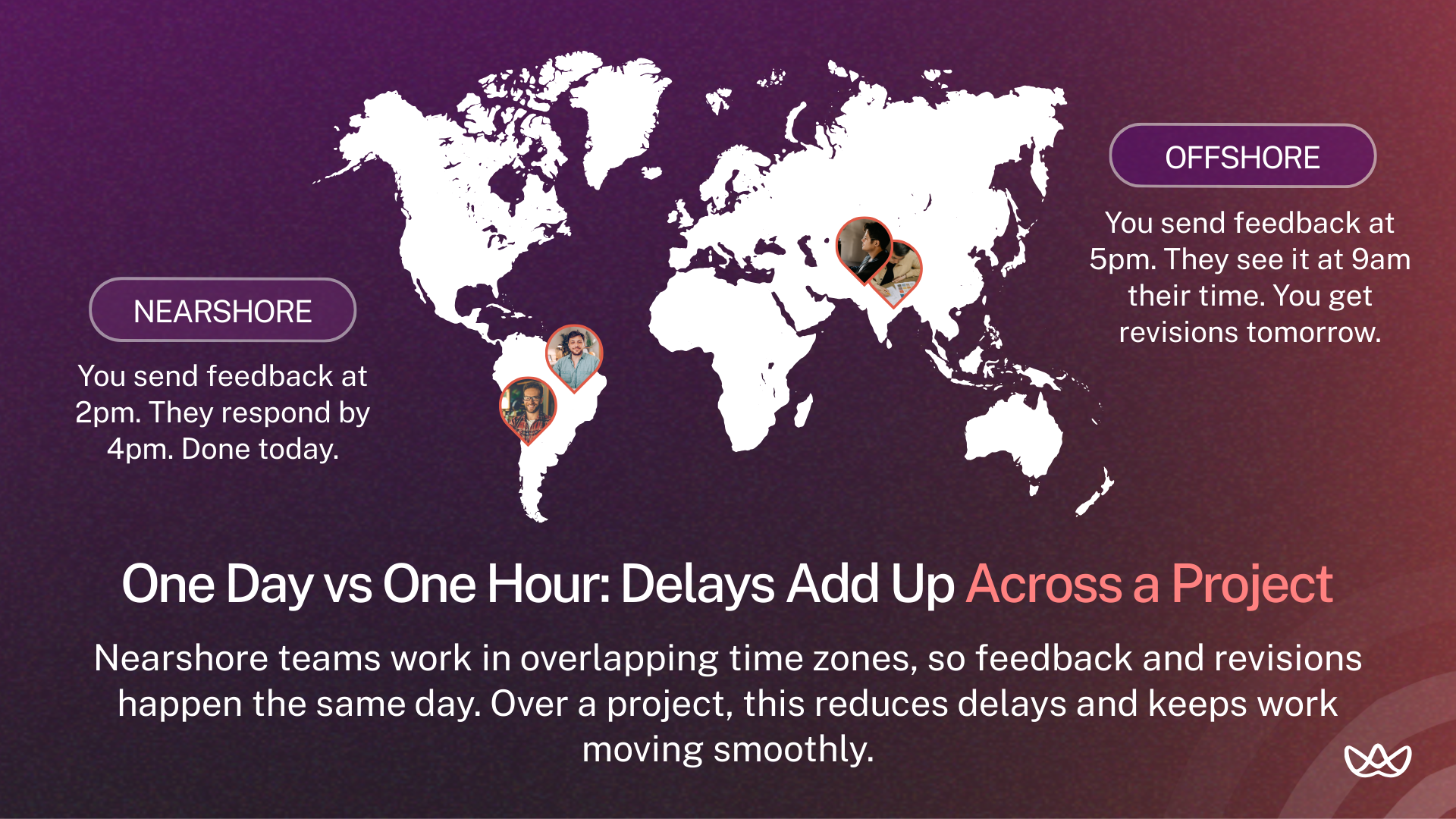
Nearshore provides lower costs than onshore while keeping time zones close enough for real-time collaboration with U.S. teams.
- Onshore: Hiring within the U.S. Highest cost, simplest logistics, no time zone issues. Best for leadership roles and positions requiring physical presence.
- Offshore: Hiring in distant regions like Asia or Eastern Europe. Lowest cost but 10-13 hour time differences force async communication. Best for independent work with minimal collaboration needs.
- Nearshore: Hiring in Latin America. Moderate cost (40-60% below U.S. rates), 1-4 hour time difference, real-time collaboration possible. Best for roles requiring daily interaction.
The nearshore hiring benefits compound over time. Faster feedback loops, fewer miscommunications, and stronger team integration lead to better output quality.
When U.S. Teams Should Consider a Nearshore Outsourcing Company
These situations make nearshore a strong option:
- You need to scale a marketing or creative team quickly without domestic hiring timelines.
- Budget constraints prevent U.S.-rate hires but you need real-time collaboration.
- You want to build a dedicated team rather than manage individual freelancers.
- Compliance complexity in international hiring exceeds your internal capacity.
- Previous offshore experiences created communication or quality issues.
Agencies expanding capacity, startups building core teams, and enterprises adding specialized functions all fit the nearshore model well.
Key Benefits of Nearshore Outsourcing
Nearshore outsourcing helps U.S. teams hire faster, collaborate in real time, and maintain control over quality - advantages that offshore or fully remote models often struggle to deliver.
Time-Zone and Language Alignment for Real-Time Collaboration
A designer in Mexico City joins your 9 AM standup without adjusting their schedule. A developer in Colombia responds to Slack messages within minutes, not hours. This alignment enables the kind of iterative work that marketing and creative projects require.
English proficiency varies by country but trends strong across LATAM tech hubs. Argentina consistently ranks highest in the region. Major cities in Mexico, Colombia, and Brazil produce professionals with business-level English developed through education and prior client work.
Cultural Compatibility and Easier Team Integration
Latin American professionals share cultural touchstones with American colleagues. Exposure to U.S. media, business practices, and communication styles creates natural alignment. Teams gel faster than with offshore counterparts where cultural gaps require more bridging.
Work style expectations also align. Deadlines, accountability, and direct communication match what U.S. managers expect without extensive cultural training.
Cost-Efficiency With Higher Control Over Quality
Nearshore hiring saves 40-60% compared with U.S. salaries while keeping quality under observation.
Faster Time-to-Market and Scalable Hiring
Nearshore teams speed up hiring and scaling:
- Traditional U.S. hiring: 30-90 days
- Nearshore providers: 10-21 days, sometimes under a week for common roles
You can scale teams quickly for campaigns or peak seasons, adding multiple roles in weeks rather than months.
Major Nearshore Destinations & Market Overview
Nearshore destinations for US hiring are almost exclusively concentrated within Latin America and focus heavily on aligning with North American business hours, culture, and operational standards
- Mexico: Largest talent pool in LATAM, aligned with Central U.S. time zones. Strong in marketing, creative, and operations roles.
- Colombia: Growing hub for marketing and creative talent. Central time zone alignment. Government initiatives boosting English proficiency and workforce development.
- Brazil: Major economy with a broad range of marketing and enterprise capabilities. Portuguese-speaking, with English common in business and tech sectors..
- Argentina: Highest English proficiency in LATAM. Known for engineering excellence and creative talent. Economic volatility creates cost advantages for foreign employers.
- Chile: Stable economy with strong fintech and analytics talent. Higher costs than other LATAM countries but excellent infrastructure.
Nearshore-Like Options in Europe & Emerging Regions
Eastern Europe (Poland, Ukraine, Romania) offers strong technical talent but 6-8 hour time differences from U.S. East Coast. This creates partial overlap rather than true nearshore alignment.
Canada provides true nearshore proximity but costs approach U.S. rates, limiting the financial advantage.
For U.S. companies prioritizing collaboration, LATAM remains the practical nearshore choice.
Comparative Strengths by Country (Talent Depth, English Level, Cost)
LATAM countries vary in cost, English proficiency, talent availability, and hiring speed, helping U.S. teams identify the best fit for marketing, creative, and operational roles.
How to Evaluate a Nearshore Outsourcing Company
When evaluating a nearshore partner, focus on talent quality and cultural fit over cost. Make sure candidates are properly vetted, English proficiency is solid, and security standards are in place. Also check retention and time-zone alignment so the team works seamlessly with yours.
1. Define Project Scope, KPIs and SLA Expectations
Before evaluating vendors, document what you actually need. Vague requirements lead to mismatched partnerships.
Define role responsibilities, required skills, expected output, and success metrics. Specify working hours, communication expectations, and reporting cadence. The clearer your requirements, the better vendors can assess fit.
2. Portfolio, Case Studies & Client References
Request examples of similar placements. A provider strong in engineering may struggle with marketing roles. Look for case studies in your specific function and company stage.
Red flags include vague client descriptions, unwillingness to provide references, and case studies that don't match their stated specialization.
3. Vetting Process for Talent and Onboarding Speed
Understand how providers screen candidates.
- What technical assessments do they use?
- How do they evaluate English proficiency?
- What percentage of applicants pass their vetting?
Ask about typical time-to-hire for roles like yours. Providers with maintained talent pools move faster than those who source from scratch.
4. Compliance, Security and IP Protection
International employment creates legal obligations. Confirm how the provider handles employment contracts, tax withholding, and labor law compliance.
For IP protection, verify that contracts include clear assignment clauses. Ask about NDA enforcement and data security practices. Providers should explain their approach to protecting client information.
Pricing Models: Hourly, Project, Retainer and Dedicated Staff
Pricing models range from flexible hourly and project rates to predictable retainer and dedicated staff arrangements for ongoing work.
Communication Protocols and Project Management Practices
Check which communication tools, meeting schedules, and reporting formats the provider uses. They should have clear processes in place, not improvise as they go. Make sure you know who’s handling your account, how to reach them, and what to do if issues come up.
Top 10 Nearshore Outsourcing Companies for U.S. Teams in 2026
These providers are evaluated on speed, cost, quality, and specialization. Each caters to different functions, so the best fit depends on your team’s specific goals and priorities.
1. Floowi - Best for Nearshore Marketing & Creative Talent in LATAM
Floowi specializes in placing full-time marketing, creative, and operations professionals from Latin America with U.S. companies. The service handles sourcing, vetting, payroll, and compliance.
Why It Stands Out (Pre-Vetted Full-Time Talent, Payroll & Compliance Handled)
Candidates are screened for technical skills, English proficiency, and cultural fit before presentation. Floowi manages employment logistics including payroll processing, tax compliance, and benefits administration. This removes the operational complexity of international hiring.
The focus on marketing and creative roles means deeper talent pools in these specific functions compared to generalist providers.
Pricing Model & Ideal Use Cases
Floowi uses a dedicated staff model with monthly fees covering talent cost plus service fees. Ideal for agencies scaling capacity, startups building marketing teams, and companies adding creative functions without domestic hiring overhead.
2. Toptal - Best for Premium Engineering & Design Talent
Toptal is a talent marketplace positioning itself as access to the "top 3%" of freelancers in engineering, design, and finance.
Why It Stands Out
Rigorous screening process with low acceptance rates. Strong for senior technical roles and specialized expertise. Two-week trial period on engagements.
Pricing Model & Ideal Use Cases
Toptal charges $60-150+ per hour depending on role and seniority, with a $500 refundable deposit and $79 monthly subscription. Best for short-term projects requiring elite specialists. Less suited for long-term team building due to premium pricing.
3. Deel - Best for Global Payroll & EOR at Scale
Deel provides Employer of Record services, contractor management, and global payroll across 150+ countries.
Why It Stands Out
Broad country coverage and compliance infrastructure. Handles legal employment, payroll, benefits, and tax filings. Strong for companies managing distributed teams across multiple regions.
Pricing Model & Ideal Use Cases
Deel EOR starts at $599 per employee per month. Contractor management runs $49 per contractor monthly. Global payroll for companies with existing entities costs $29 per employee. Best for companies that already have candidates and need employment infrastructure rather than sourcing.
4. Andela - Best for Distributed Engineering Teams
Andela helps companies build distributed engineering teams by sourcing and placing software developers globally. Originally focused on Africa, it now provides access to engineers worldwide.
Why It Stands Out
Strong vetting for engineering talent. Experience building distributed development teams. Focus on long-term placements rather than short-term projects.
Pricing Model & Ideal Use Cases
Andela uses markup-based pricing on engineer salaries. Best for companies building engineering capacity over time. Less relevant for marketing or creative hiring.
5. Remote.com - Best for Benefits & Compliance Management
Remote.com is an EOR platform supporting employment in over 60 countries. They handle payroll, benefits, taxes, and compliance, letting U.S. companies hire abroad without local entities.
Why It Stands Out
Strong benefits infrastructure including health insurance, retirement plans, and equity compensation support. Handles complex benefits scenarios that other EORs struggle with.
Pricing Model & Ideal Use Cases
Remote.com is an EOR platform supporting employment in over 60 countries. They handle payroll, benefits, taxes, and compliance, letting U.S. companies hire abroad without local entities.
6. Tecla - Best for LATAM Technical Recruiting
Tecla focuses exclusively on Latin American engineering talent for U.S. companies. They offer a pipeline of vetted developers ready for remote integration.
Why It Stands Out
They have a deep LATAM network for technical roles and understand U.S. company expectations. Their vetting focuses specifically on engineering skills, making them a strong partner for multi-role developer hiring.
Pricing Model & Ideal Use Cases
Placement fees or ongoing service arrangements. Best for companies hiring multiple developers from LATAM. Tecla focuses on technical talent rather than marketing or creative positions.
7. X-Team/Arc - Best for Developer Networks
X-Team and Arc operate community-driven networks of developers, connecting companies with vetted talent across Latin America and Eastern Europe.
Why It Stands Out
The community-driven approach ensures engaged developers, with options ranging from full-time to part-time arrangements.
Pricing Model & Ideal Use Cases
Varies by engagement type. Ideal for companies looking for access to active developer networks rather than traditional staffing relationships.
8. BairesDev - Best for End-to-End Software Delivery
BairesDev provides full-service software development outsourcing, assembling dedicated teams to deliver complete projects for U.S. clients.
Why It Stands Out
Unlike providers focused on staff augmentation, BairesDev manages full project lifecycles, including planning, development, QA, and deployment. This makes it easier for companies to outsource entire workflows instead of juggling multiple individual contributor.
Pricing Model & Ideal Use Cases
Project-based or dedicated team pricing. Best for companies outsourcing entire development workstreams rather than augmenting existing teams.
9. Regional Nearshore Agencies
Regional nearshore agencies are boutique firms that operate in specific LATAM countries. They offer strong local insight and a more hands-on approach, often building deep talent networks in one or two markets rather than spreading across the entire region.
Why Choose Boutique vs. Marketplace
Boutique agencies work well when you value close collaboration and direct account support. You typically get more context on the local hiring market and tighter coordination during onboarding. The trade-off is scale. Talent pools are smaller, and rapid multi-role expansion can be harder to support.
10. Hybrid Marketplace & Staffing Providers
Hybrid providers blend marketplace-style browsing with staffing support. You can review candidate profiles directly while still receiving help with screening, contracts, and hiring decisions.
Ideal Use Cases
This model fits teams that want visibility and control over candidate selection but don’t want to manage the full hiring process alone. It works well for companies comfortable with a more hands-on, self-service approach while still needing guidance where it counts.
How to Read Provider Comparisons (Sample Evaluation Fields)
When comparing providers, weight factors based on your priorities:
- Speed matters most when you have immediate hiring needs or project deadlines
- Cost matters most when budget comes first and flexibility is acceptable.
- Quality matters most when role criticality justifies premium pricing
- Specialization matters most when your function requires specific expertise
Best Fit for Startups, Agencies and Enterprise Teams
Which provider works best depends on your team size, how quickly you need to hire, and how complex your operations are.
- Startups: Go for speed and cost. Providers that place talent quickly and offer flexible arrangements are usually the easiest fit. Floowi, Tecla, and regional boutiques work well for early-stage teams.
- Agencies: Look for scalability and specialization. You need partners who get client work and can flex capacity as projects change. Floowi fits marketing and creative needs, while Toptal or Andela handle technical roles.
- Enterprise: Focus on compliance and scale. Larger teams need providers with solid legal support and the ability to manage high headcounts. Deel, Remote.com, or BairesDev are suited for long-term, big-team hiring.
Is Nearshore Outsourcing Right for Your Business?
Nearshore outsourcing works best when you need fast, hands-on collaboration, high-quality hires, and support with compliance - especially if previous offshore experiences caused headaches.
When Nearshore Delivers the Best ROI
Nearshore outsourcing delivers strongest returns when:
- Roles require daily collaboration and real-time communication
- Budget constraints prevent domestic hiring but quality cannot suffer
- You need to scale faster than internal recruiting allows
- International employment compliance exceeds your internal expertise
- Previous offshore experiences created friction you want to avoid
Risks and Mitigation Strategies
Most challenges in nearshore outsourcing fall into four areas: maintaining consistent quality, keeping communication clear, ensuring legal compliance, and minimizing turnover.
How to Pilot a Nearshore Outsourcing Engagement
Begin with a small pilot - one or two roles for a defined period - track key metrics like output, communication, and integration, and use the insights to expand confidently into a long-term nearshore partnership.
Start Small: Pilot Projects and Trial Teams
Don't commit to large-scale nearshore hiring before testing the model. Start with one or two roles for a defined period. Evaluate results before expanding.
Pilots work best with roles that have clear deliverables and measurable outcomes. Avoid piloting with ambiguous or strategic positions where assessment is difficult.
KPIs to Track During the Pilot Phase
- Time to productivity (days from start to meaningful contribution)
- Output quality compared to domestic equivalents
- Communication effectiveness (response times, clarity, initiative)
- Integration with existing team (participation, collaboration quality)
- Manager satisfaction ratings
How to Scale From Pilot to Long-Term Partnership
Successful pilots lead to expanded engagements. Document what worked and what needed adjustment. Apply learnings to subsequent hires.
Build institutional knowledge about working with nearshore teams. Create onboarding materials specific to remote international employees. Develop management practices suited to distributed work.
Frequently Asked Questions
What Exactly Is a Nearshore Outsourcing Company?
A nearshore outsourcing company connects you with skilled professionals in nearby countries with overlapping time zones. Depending on the provider, they may handle sourcing, vetting, compliance, payroll, or a mix of these services.
How Does Nearshore Differ From Offshore and Onshore Models?
Nearshore combines benefits of both worlds: you get time zone alignment that offshore often lacks and cost savings that onshore cannot offer. LATAM professionals work U.S. hours at 40-60% lower cost than equivalent domestic hires.
How Does Time-Zone Alignment Improve Collaboration?
Working overlapping hours lets teams communicate in real time, get same-day feedback, and participate in live meetings. This keeps projects moving faster and reduces delays that happen when work is handed off asynchronously.
How Does Nearshore Outsourcing Reduce Costs Compared to U.S. Hiring?
The lower cost of living in LATAM countries means salaries are significantly lower than in the U.S. A role paying $100,000 in the U.S. might cost $40,000-60,000 nearshore, while maintaining comparable skills and output.
What Makes Mexico, Colombia, and Brazil Strong Nearshore Destinations?
Mexico has the largest talent pool and aligns with U.S. time zones. Colombia offers growing marketing and creative capabilities at competitive rates. Brazil brings strong data science and enterprise software talent to the table.
How Do Companies Evaluate Onboarding Speed and SLA Expectations?
Ask providers how long they typically take to fill similar roles, review case studies for real timelines, and clarify SLA terms for replacements if initial placements don’t meet expectations.
How Do Providers Vet Talent to Ensure Quality Assurance?
Top providers use multi-stage screening: skills assessments, English proficiency tests, and cultural fit interviews. Look for transparency in acceptance rates and screening methods to ensure consistent quality.
Why Is Floowi Ideal for Nearshore Marketing and Creative Talent?
Floowi focuses specifically on marketing, creative, and operations roles. This specialization gives access to deeper talent pools and better role matches. Handling payroll and compliance end-to-end also removes operational headaches for U.S. teams.
Your Next Steps
Start by shortlisting 2-3 providers matching your criteria. Request proposals with specific pricing for your roles. Run parallel pilots if feasible to compare directly.
Plan integration with your existing tools and workflows before candidates start. Document onboarding processes so they can be repeated.
The nearshore model works when executed intentionally. Companies that invest in proper evaluation and structured pilots build teams that perform at or above domestic standards at significantly lower cost.
Key Takeaways:
- Nearshore companies provide LATAM talent with U.S. time zone alignment.
- Costs are 40-60% below U.S. rates while enabling real-time collaboration.
- Choose providers specialized in your function for better matches.
- Start with pilot projects to reduce risk and build experience before scaling.
Build your nearshore team with Floowi using vetted LATAM talent. Book your free consultation today.




