






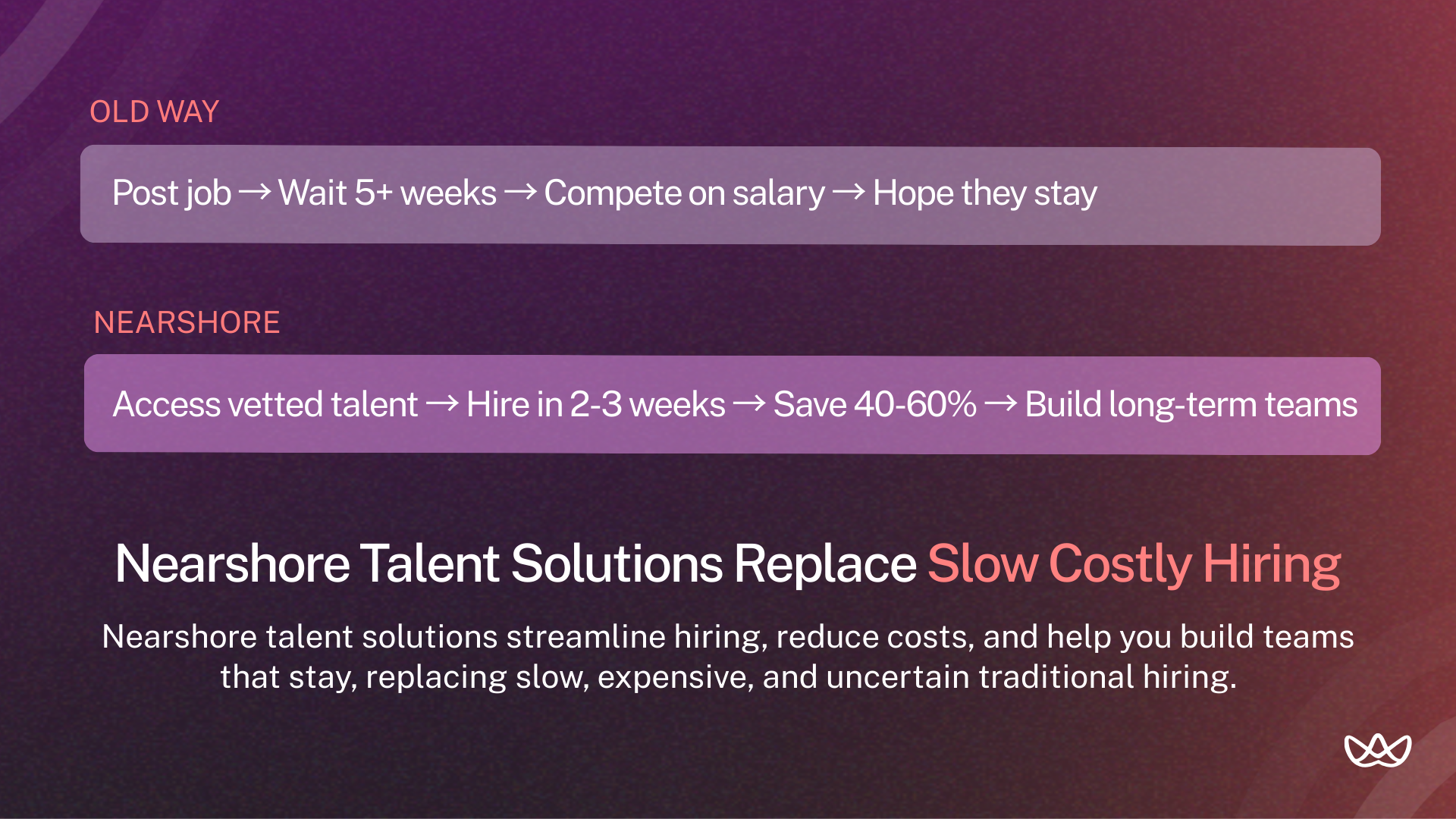
Robert Half's 2025 research found that 93% of marketing and creative leaders say it's challenging to find professionals with the right mix of skills. Hiring takes an average of 5 weeks for permanent roles, and 56% of leaders report skills gaps within their departments.
Nearshore talent solutions provide an effective way to scale teams. U.S. agencies and companies are building marketing, creative, and operations teams in Latin America where professionals work the same hours, understand American business culture, and cost 40% to 60% less than domestic hires.
Let’s explore what nearshore talent solutions are, why LATAM has become the go-to region for marketing and creative staffing, and how to build a hiring strategy that delivers.
What Are Nearshore Talent Solutions?
Nearshore talent solutions allow U.S. companies to hire full-time professionals in nearby regions like LATAM, combining cost efficiency with real-time collaboration. Unlike offshore hiring where teams work opposite hours, nearshore arrangements enable real-time collaboration during standard business hours.
The core principles include:
- Geographic proximity for overlapping work schedules
- Cultural alignment with American business practices
- Full-time dedicated roles rather than project-based gigs
- Compliant employment through local structures or partners
- Scalable team growth without domestic hiring constraints
For U.S. companies, nearshore typically means Latin America. The region spans time zones from UTC-3 to UTC-6, providing 6 to 10 hours of daily overlap with American teams.
Nearshore vs. Offshore vs. Onshore: What U.S. Companies Need to Know
Each approach balances cost, availability, and collaboration differently, so the right choice depends on your team’s priorities.
Onshore (U.S.-based hiring):
- Highest cost, typically $80,000 to $150,000+ for mid-level roles
- Simplest compliance and communication
- Limited talent availability in competitive markets
- Best for leadership and client-facing positions
Offshore (Asia, Eastern Europe):
- Lowest cost, often 60% to 70% below U.S. rates
- Significant time zone gaps (10 to 13 hours)
- Async communication by necessity
- Best for independent work requiring minimal collaboration
Nearshore (Latin America):
- Moderate cost, 40% to 60% below U.S. rates
- Strong time zone alignment (1 to 4 hours difference)
- Real-time collaboration possible
- Best for roles requiring daily interaction
The nearshore hiring benefits become clear when collaboration matters. A developer in Colombia can attend your 9 AM standup, respond to Slack messages before lunch, and participate in afternoon code reviews. That same workflow with an offshore team requires either awkward scheduling or 24-hour feedback cycles.
Why U.S. Companies Are Turning to Nearshore Talent
Nearshore hiring gives U.S. teams the speed, talent access, and cost structure they struggle to achieve with domestic or offshore models. Companies that rely on fast execution and close collaboration increasingly choose LATAM because it removes common friction points in hiring while keeping teams aligned day to day.
Real-Time Collaboration Through Time-Zone Alignment
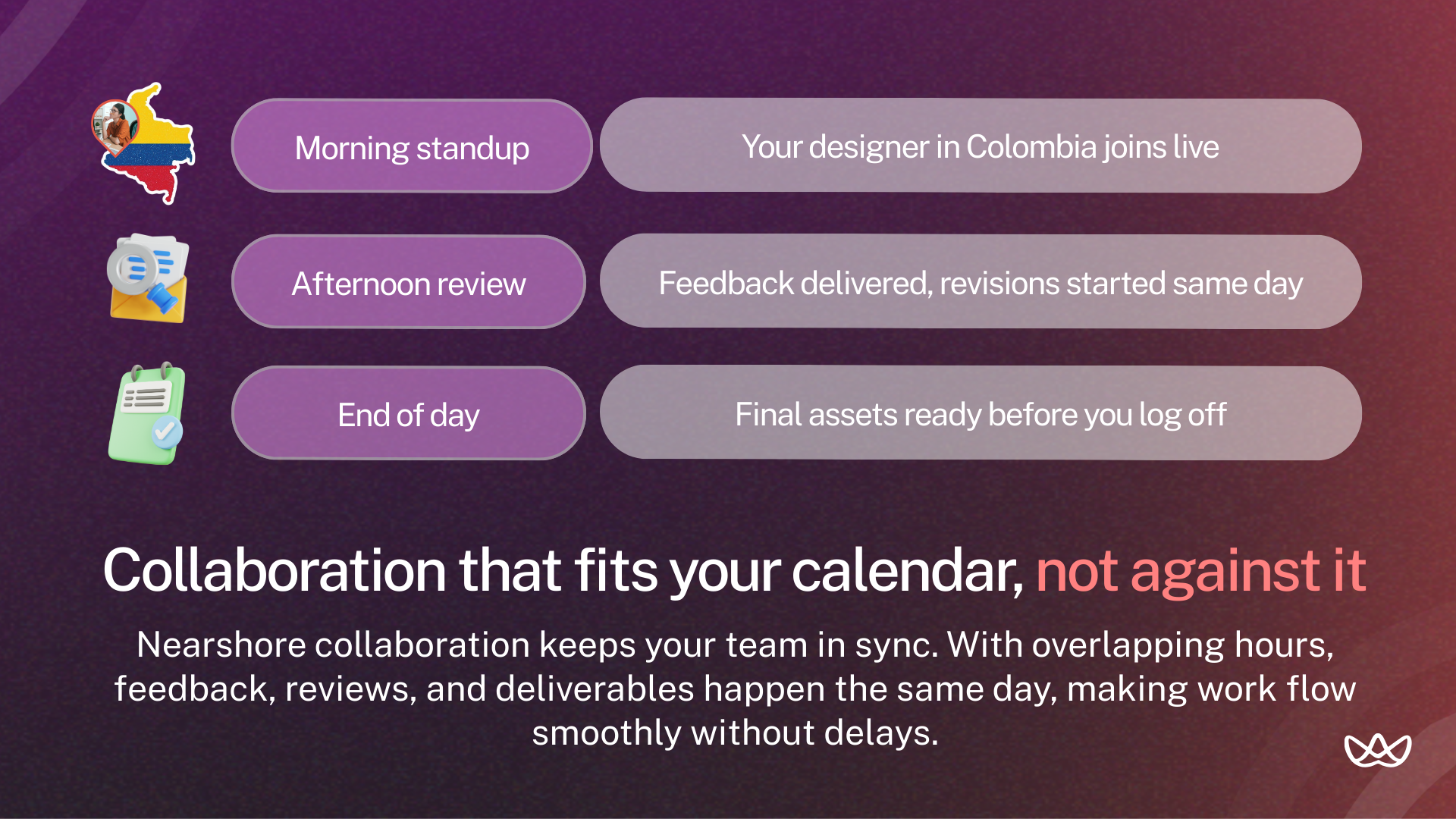
Time-zone alignment changes how distributed teams work. When nearshore team members share the U.S. workday, decisions move faster. Questions get answered the same morning, and blockers get resolved before they slow progress.
This matters most for:
- Agile product and engineering teams
- Marketing teams running live campaigns
- Customer-facing operations
A designer in Mexico City can revise assets during the same meeting where feedback comes up. An engineer in Argentina can push a fix before the end of the business day. Over time, this overlap improves delivery speed and reduces rework.
Access to Highly Skilled LATAM Talent in Marketing, Tech & Operations
Latin America has built deep talent pools across software development, digital marketing, data, and operations. Universities, technical programs, and private training institutions across the region continue to supply professionals with experience in modern frameworks and tools.
When you hire LATAM talent, you gain access to:
- Engineers with strong backgrounds in cloud, backend, and full-stack development
- Data and AI specialists supporting analytics and automation initiatives
- Marketers and designers experienced in performance marketing, content, and UX
Global technology companies operate engineering and delivery centers across LATAM, which has helped mature local talent markets and raise skill standards across the region.
Lower Costs Without Compromising on Quality
The U.S. vs LATAM cost comparison reflects differences in local labor markets and cost of living, not differences in capability.
In many LATAM markets, a $50k salary offers strong purchasing power and long-term stability. That stability supports retention and continuity for distributed teams.
Stronger Cultural and Communication Alignment
LATAM professionals often share U.S. business norms and communication styles, which reduces onboarding time and operational friction. English proficiency varies by country but remains strong in major hubs such as Mexico City, Bogotá, São Paulo, and Buenos Aires.
Bilingual team members also support Hispanic markets, localization needs, and regional expansion efforts.
Top Use Cases for Nearshore Talent Solutions
Some roles simply work better nearshore. These functions depend on daily collaboration, require specialized skills that are widely available across LATAM, and usually support ongoing work rather than short-term projects.
Software Development, Product & Engineering Roles
Engineering teams work more effectively with nearshore talent. Daily standups, code reviews, pair programming, and sprint planning all work better with time zone overlap.
Common roles include:
- Full-stack developers (React, Node.js, Python)
- Mobile engineers (iOS, Android, React Native)
- DevOps and cloud infrastructure specialists
- QA engineers and automation testers
- Product managers and technical leads
LATAM developers bring expertise in modern tech stacks. Over 50% of regional tech professionals are pursuing AI and ML training, creating a pipeline of specialists in high-demand areas.
Creative, Content & Digital Marketing Teams
Marketing requires iterative collaboration. Campaign adjustments, design revisions, and content approvals happen throughout the day. Nearshore creative teams keep pace with these demands.
Common roles include:
- Graphic designers and brand specialists
- Video editors and motion graphics artists
- Content writers and copywriters
- Social media managers
- Paid media specialists (Google, Meta, TikTok)
- SEO analysts and strategists
Colombia has become a strong center for creative and marketing talent, while Argentina and Mexico produce skilled designers and content creators.
AI Operations, Data Analytics & Automation Support
Data-focused teams often turn to nearshore staffing as analytics and automation needs grow. These roles work best when teams can collaborate closely and adjust models, pipelines, and reporting in real time.
Common roles include:
- Data analysts and business intelligence specialists
- Machine learning engineers
- Data engineers and pipeline architects
- Automation specialists
- AI operations support
Brazil stands out in the region for data science depth, with developers frequently ranking near the top globally in technical assessments.
Customer Support, Operations & RevOps Staffing
Customer-facing and operational roles require responsiveness during business hours, making nearshore placement ideal.
Common roles include:
- Customer support representatives
- Technical support specialists
- Operations coordinators
- Revenue operations analysts
- Account managers and success specialists
Bilingual capabilities add particular value for companies serving North American markets with significant Hispanic populations.
Key Benefits of Adopting Nearshore Talent
Nearshore hiring improves speed, communication, and team stability without adding operational complexity.
Faster Hiring and Scalable Team Growth
Traditional U.S. hiring takes 30 to 90 days from job posting to start date. Nearshore staffing partners compress this to 10 to 21 days for most roles.
The speed comes from maintained talent pools. Partners continuously source and vet candidates, so qualified professionals are available when you need them. You skip weeks of posting jobs, screening resumes, and coordinating initial interviews.
Scalability follows naturally. Need to add three developers before a product launch? A nearshore partner can deliver within two to three weeks. Need to scale back after a project? Staffing arrangements typically offer more flexibility than domestic employment.
Better Communication, Oversight & Workflow Integration
Synchronous work changes how teams operate. With overlapping hours, you see progress as it happens and can give feedback in real time instead of reacting a day later.
Collaboration tools work as intended:
- Slack conversations happen live
- Zoom meetings fit normal work hours
- Jira tickets update during the same day
This level of visibility does not require micromanagement. It allows you to spot issues early and adjust before small problems grow.
Improved Quality, Continuity & Long-Term Retention
Nearshore professionals often stay longer than offshore contractors. Cultural alignment, shared work hours, and competitive local compensation support more stable working relationships.
Lower turnover preserves institutional knowledge. A developer who has worked with your team for two years understands your codebase, customers, and internal processes. That continuity leads to better outcomes than constantly onboarding new talent.
Retention also lowers recruiting costs over time. Teams that stay in place deliver compounding value as they gain deeper context and experience.
Challenges of Nearshore Hiring and How to Overcome Them
Each LATAM country has unique employment laws covering contracts, benefits, taxes, and termination. Missteps can create legal exposure and damage employee trust.
Compliance, Contracts & Cross-Border Regulations
Each LATAM country has distinct employment laws covering contracts, benefits, termination, and taxes. Getting compliance wrong creates legal exposure and damages employee relationships.
Solutions:
- Use an Employer of Record (EOR) to handle local employment
- Work with staffing partners experienced in specific countries
- Ensure contracts comply with local labor law requirements
- Budget for mandatory benefits and social contributions
Compliance complexity is manageable with the right partners. EORs and specialized staffing agencies handle the details so you focus on the work.
Managing Remote Teams and Performance Standards
Distance requires intentional management practices. You cannot rely on hallway conversations or physical presence to gauge performance.
Solutions:
- Set clear KPIs and deliverables for every role
- Establish regular check-in cadences (daily standups, weekly 1:1s)
- Use project management tools consistently
- Document processes and expectations explicitly
- Provide regular feedback rather than annual reviews
Remote management skills transfer to any distributed team. The practices that make nearshore work successful improve your overall management capability.
Ensuring Consistent Quality Delivery Across Markets
Quality standards must be explicit and measurable. Assumptions that work domestically may not translate across cultural contexts.
Solutions:
- Define quality criteria clearly in onboarding
- Implement QA processes and review cycles
- Conduct weekly progress reviews during initial period
- Provide examples of expected output
- Address issues promptly rather than letting them compound
Early investment in alignment pays dividends. Teams that understand expectations from day one deliver more consistent results.
Why LATAM Is Leading the Nearshore Talent Revolution
Latin America has become a strong nearshore option for marketing, creative, and operational roles. Professionals work in real time with U.S. teams, and hubs in Argentina, Colombia, Mexico, and Brazil handle content and workflows efficiently.
This approach lets U.S. companies scale teams at a lower cost with smoother day-to-day collaboration.
Top Countries Driving the Nearshore Market
LATAM countries offer distinct strengths: Mexico and Peru for support, Colombia and Argentina for marketing and engineering, Brazil and Chile for data and fintech. Most time zones align with the U.S., and English skills are strong in key hubs.
Technical, Economic & Cultural Advantages of LATAM
LATAM offers a mix of advantages that offshore alternatives often can’t match.
- Technical depth: LATAM developers work with modern frameworks and methodologies. Major tech companies have validated regional talent by establishing engineering centers. The startup ecosystem includes 9,000+ funded companies and 60+ unicorns built entirely with local talent.
- Economic value: Salary savings of 40% to 60% compared to U.S. rates allow companies to hire more capacity or reinvest in growth. Even as LATAM salaries rise 10% to 15% annually, the cost advantage remains substantial.
- Cultural alignment: Business practices, communication styles, and work values align closely with American expectations. Integration feels natural rather than forced. Teams gel faster than with offshore counterparts.
- Bilingual workforce: Spanish and Portuguese speakers expand your reach into Latin American markets. Many professionals are fully bilingual in English, enabling seamless client communication.
How to Build a Nearshore Talent Strategy
A strong nearshore strategy focuses on four things: pick the right partner or EOR for compliance, target talent hubs that fit your needs, optimize workflows for real-time collaboration, and ensure cultural and language alignment so new hires integrate smoothly.
Choosing the Right Nearshore Staffing Partner
Not all partners deliver equal value. Evaluate providers based on criteria that matter for your specific needs.
Key evaluation criteria:
- Specialization in your required roles (marketing, tech, operations)
- Vetting process quality and acceptance rates
- Compliance and payroll capabilities
- Country coverage matching your preferences
- Speed to present qualified candidates
- Support during onboarding and ongoing employment
- Pricing transparency and total cost clarity
Ask for references from companies similar to yours. Start with a trial hire to evaluate quality before committing to volume.
You can explore Floowi’s vetted LATAM talent roles to see candidates who are ready to join your team.
Creating a Smooth Hiring, Onboarding & Integration Process
Remote hires need clear instructions and guidance since they don’t have the benefit of seeing how things are done in the office.
Pre-start checklist:
- Equipment shipped or stipend provided
- All accounts and access credentials created
- Manager briefed on start date and first-week plan
- Onboarding documentation prepared
- Team introductions scheduled
First week activities:
- Welcome call with manager and team
- Company and role overview
- Tools and systems training
- Initial task assignment (low-stakes to build confidence)
- Daily check-ins to answer questions
First 30 days:
- Weekly 1:1s with manager
- Gradual responsibility increase
- Cross-functional introductions
- Feedback on early work
- Process adjustment based on learnings
Document everything. Written expectations, recorded training sessions, and explicit guidelines help remote employees succeed without constant hand-holding.
Floowi: The Easiest Nearshore Talent Solution for U.S. Companies
Floowi makes nearshore hiring simple, connecting U.S. companies with vetted creative, marketing, and operational talent in Latin America. It handles sourcing, compliance, and payroll, so teams integrate smoothly, work in the same time zone, and deliver quality at up to 70% lower cost.
Full-Time, Pre-Vetted LATAM Talent Ready to Integrate Into U.S. Teams
Floowi connects U.S. companies with professionals across Latin America who have been screened for technical skills, English proficiency, and remote work readiness. Candidates are vetted before presentation, reducing your evaluation time and improving match quality.
The focus on full-time dedicated roles means employees work exclusively for your company. They learn your systems, understand your customers, and build institutional knowledge over time.
Compliance, Payroll & Onboarding Managed End-To-End
Floowi handles the operational complexity of international employment. Payroll processing, tax compliance, benefits administration, and local labor law requirements are managed so you focus on the work rather than paperwork.
This removes the need to establish foreign entities, navigate unfamiliar regulations, or manage multi-country payroll systems yourself.
Ideal for Marketing, Creative, Tech & RevOps Roles
The service specializes in roles that U.S. agencies, startups, and scaling companies need most. Marketing managers, designers, developers, and operations specialists comprise the core talent pool.
Specialization enables deeper candidate networks in these functions. Rather than offering shallow coverage across every possible role, Floowi maintains concentrated pools where quality can be assured.
Frequently Asked Questions
How Do Nearshore Talent Solutions Differ From Offshore and Onshore Hiring?
Nearshore talent solutions provide professionals in nearby time zones (LATAM for U.S. companies), enabling real-time collaboration at costs 40% to 60% below domestic rates. Offshore involves distant regions like Asia with 10+ hour time differences and lower costs but async-only workflows. Onshore means domestic hiring with highest costs and simplest logistics.
How Does Time-Zone Alignment Improve Collaboration With Global Teams?
Time zone alignment enables synchronous communication during standard business hours. Teams can hold live meetings, respond to messages in real time, and iterate on work throughout the day. This accelerates decision-making and reduces the delays inherent in async-only workflows.
Why Is LATAM Talent Particularly Strong in Marketing, Tech and Operations Roles?
LATAM talent performs strongly in marketing, tech, and operations thanks to a mix of cultural understanding and specialized training for the North American market. Marketers bring language skills and insights into consumer behavior, while tech and operations professionals leverage STEM and AI expertise to deliver precise workflows. Working in overlapping hours supports collaboration, letting these teams contribute as strategic partners instead of just back-office support.
How Do Nearshore Teams Reduce Costs Compared to U.S. Hiring?
Lower cost of living in LATAM countries means competitive local salaries translate to 40% to 60% savings versus U.S. rates. A developer earning $50,000 in Colombia has strong purchasing power locally while costing significantly less than the $130,000+ required for equivalent U.S. talent.
How Do Companies Use Nearshore Talent for Software Development, Product and Engineering?
Engineering teams hire nearshore developers for full-stack development, mobile engineering, DevOps, QA, and technical leadership roles. Time zone overlap enables daily standups, real-time code reviews, and collaborative problem-solving that offshore arrangements cannot support.
How Do Creative and Marketing Teams Benefit From Nearshore Hiring?
Marketing requires rapid iteration on campaigns, designs, and content. Nearshore creative teams can receive feedback and deliver revisions within the same workday. This speed advantage accelerates campaign launches, improves design quality through more iteration cycles, and enables responsive social media management.
How Does Nearshore Hiring Accelerate Recruitment Timelines and Scalability?
Nearshore staffing partners maintain pre-vetted candidate pools, enabling hiring in 10 to 21 days versus 30 to 90 days for traditional domestic recruitment. This speed allows rapid scaling for project demands, seasonal needs, or growth phases without the delays of building internal recruiting capacity.
How Do Companies Choose the Right Nearshore Partner When Building a Global Hiring Strategy?
Evaluate partners based on role specialization, vetting quality, compliance capabilities, country coverage, pricing transparency, and client references. Start with trial hires to assess quality before committing to volume. Prioritize partners with deep expertise in your specific functional needs rather than generalists.
How do nearshore talent solutions differ from offshore and onshore hiring models?
Nearshore talent solutions hire professionals in nearby regions, typically in similar time zones, which makes real-time collaboration easier and improves communication. Offshore hiring focuses on distant regions with lower costs but often creates challenges around time zones, language, and coordination. Onshore hiring uses domestic talent, offering the closest alignment but at significantly higher cost and with more limited talent availability.
Your Next Step
Nearshore talent solutions are quickly becoming the norm, with many U.S. companies expanding into LATAM through 2026. The combination of lower costs, shared time zones, and skilled talent makes it a smart choice.
On top of that, faster hiring, smoother collaboration, and better retention give teams a real advantage, especially as LATAM continues building tech skills, English proficiency, and digital infrastructure.
Key Takeaways:
- Nearshore talent cuts hiring to 10–21 days and enables real-time collaboration.
- LATAM offers 40–60% cost savings with comparable skills.
- Cultural fit and English proficiency make integration smoother than offshore.
- Supports scalable, long-term growth in marketing, tech, and operations.
Build your nearshore team with Floowi’s vetted LATAM talent. Book your free consultation today.




