

.png)




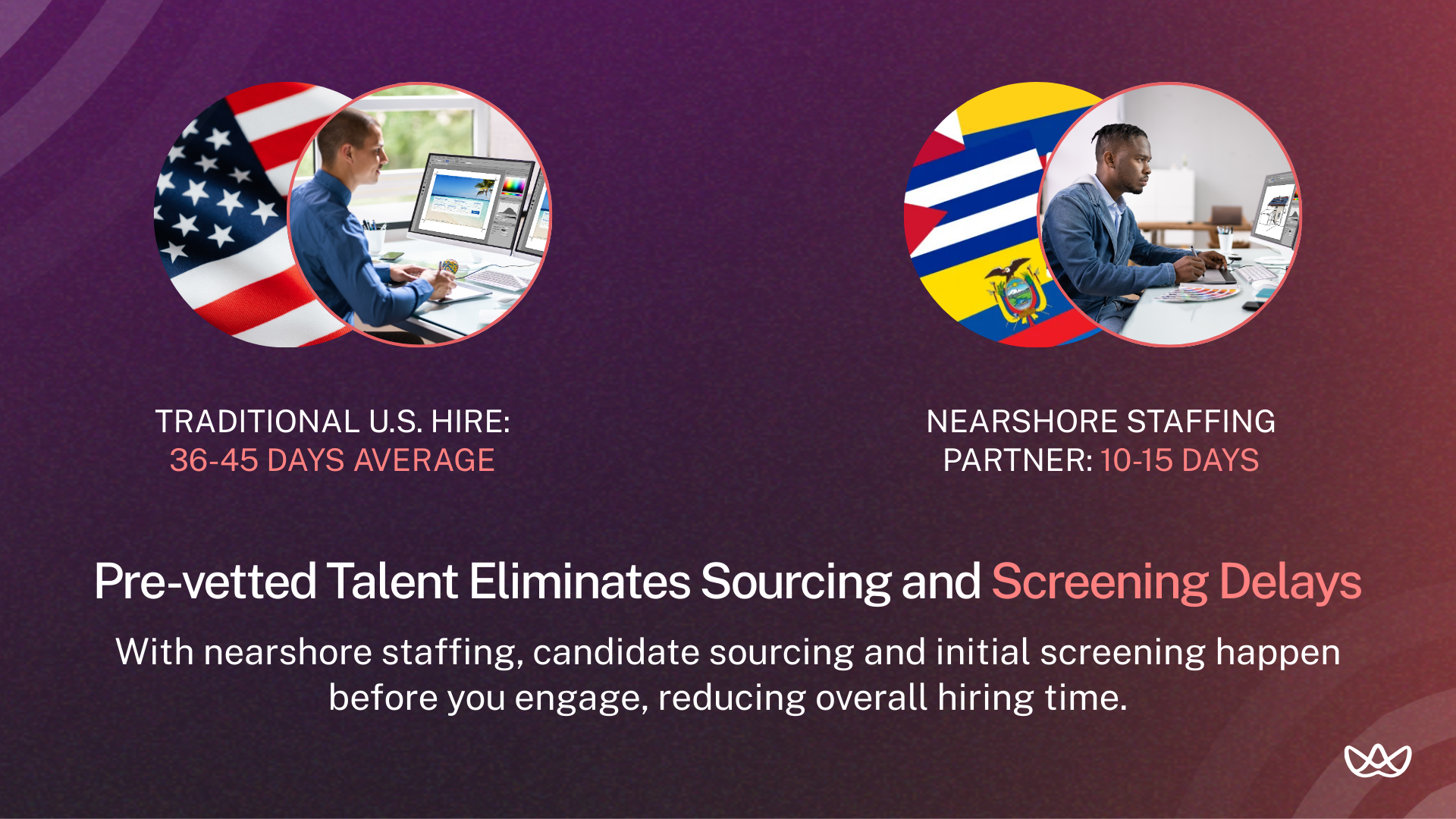
The average U.S. hire takes 36 days to close, and that timeline stretches longer for specialized marketing and creative roles. Each open position costs companies roughly $4,700 in direct recruiting expenses before accounting for the revenue impact of understaffed teams missing deadlines.
Latin America has grown as the primary solution for U.S. agencies and startups that need to move faster. Professionals in Mexico, Colombia, and Argentina work within 0-3 hours of U.S. time zones, maintain strong English proficiency, and command 30-50% lower compensation than equivalent domestic hires. Real-time collaboration stays intact. Communication friction disappears.
Let’s look at how a nearshore staff augmentation company works and the 9 best providers in 2026 for scaling your marketing, creative, or operations team with vetted LATAM talent.
What Is a Nearshore Staff Augmentation Company?
A nearshore staff augmentation company provides external professionals who integrate directly into your existing team on a temporary or ongoing basis. Unlike traditional outsourcing where you hand off an entire project, staff augmentation means the hired talent works under your management, follows your workflows, and operates as a natural extension of your internal team.
These companies handle the sourcing, vetting, payroll, compliance, and HR administration. You focus on directing the work. The "nearshore" element specifically refers to hiring from geographically close regions, typically within a few time zones of your headquarters. For U.S. companies, this means primarily Latin America.
Why Nearshore Staff Augmentation Is Replacing Traditional Outsourcing
The shift away from classic outsourcing models comes down to control, flexibility, and integration quality. Traditional outsourcing typically means:
- Handing off entire projects to external teams
- Limited visibility into day-to-day work
- Communication filtered through project managers
- Long feedback loops that slow iteration
Staff augmentation flips this model. You retain full control over the work while gaining access to specialized talent you couldn't hire fast enough locally. The professionals become part of your team rather than operating as a separate vendor. They attend your standups, use your tools, and follow your processes.
Companies increasingly prefer this approach because it combines the cost benefits of global hiring with the operational control of internal teams.
Nearshore vs. Onshore vs. Offshore
Each option has its pros and cons, so it comes down to what matters most for your team - cost, speed, or how closely you need to work together.
Onshore: Local Talent With the Highest Cost
Onshore hiring means recruiting within your own country. For U.S. companies, this approach guarantees same time zone overlap and cultural alignment but comes with significant drawbacks.
The average time to fill a technical role in the U.S. exceeds 30 days. Salary expectations run high, and competition for skilled professionals remains intense in cities like San Francisco, New York, and Austin.
Onshore works when budget isn't a constraint and you need someone physically present. For most growing companies, it's the most expensive and slowest path to building capacity.
Nearshore: Best Balance of Skill, Speed & Cost
Nearshore hiring, particularly from LATAM, offers what many consider the optimal balance. Professionals in Mexico, Colombia, Argentina, and Brazil work within 0-3 hours of U.S. time zones. English proficiency is strong across the region. Cultural compatibility with U.S. business practices makes collaboration feel natural.
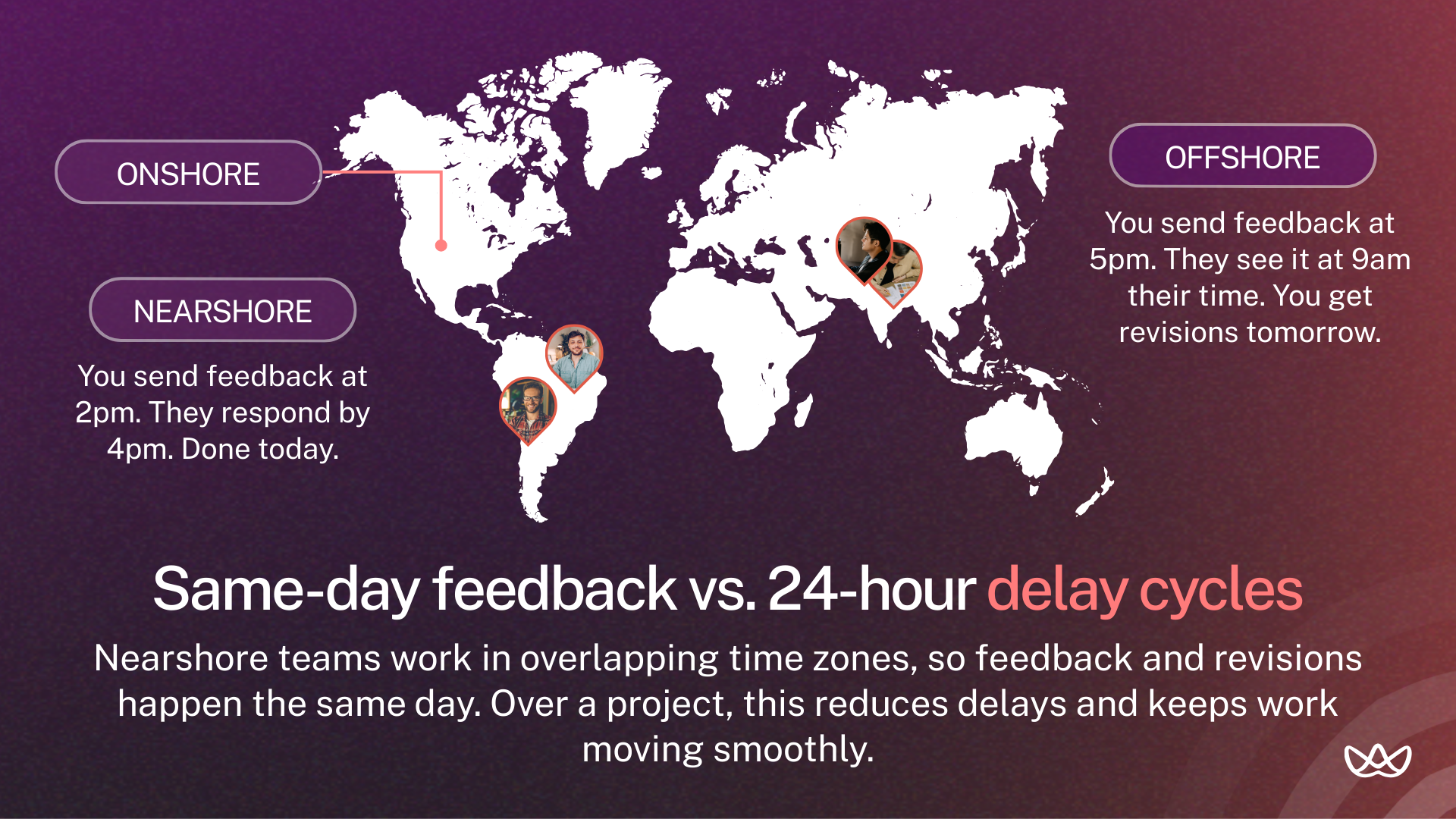
Cost savings typically range from 30% to 50% compared to U.S. salaries for equivalent skill levels. Time-to-hire drops significantly because nearshore partners maintain pre-vetted talent networks.
Offshore: Lowest Cost With Limited Collaboration Overlap
Offshore hiring from regions like India, Pakistan, the Philippines, or Eastern Europe offers the lowest rates but introduces significant collaboration challenges.
Time zone differences of 10-13 hours mean limited or no overlap during your working day. Communication happens asynchronously, which can slow down iteration cycles and create misunderstandings.
Offshore models work for projects that don't require real-time collaboration or when cost is the overwhelming priority. For client-facing work, agile development, or roles requiring frequent communication, the collaboration friction often outweighs the cost savings.
Top Benefits of Nearshore Staff Augmentation
For U.S. teams seeking to scale without the delays and costs of domestic hiring, nearshore staff augmentation delivers specific advantages that directly impact business outcomes.
1. Real-Time Collaboration Through Shared Time Zones
When your team in New York starts at 9 AM, your nearshore talent in Colombia or Mexico is already online or just starting their day. This overlap enables daily standups, immediate Slack responses, and same-day feedback cycles. You can have a morning meeting, get work delivered by afternoon, review it together, and ship by end of day.
This simply isn't possible with offshore teams operating on opposite schedules. Real-time collaboration matters most for roles involving client communication, agile sprints, or creative work that requires rapid iteration.
2. Cultural Alignment With U.S. Teams
Latin American professionals often share similar work styles, communication approaches, and business expectations with their U.S. counterparts. Many have worked with American companies before, understand startup culture, and adapt quickly to direct communication styles.
This cultural alignment shows up in practical ways: how people handle feedback, their approach to deadlines, their comfort with autonomous work, and their willingness to flag problems early.
3. Access to Vetted, Specialized Talent (Marketing, Tech, Design)
LATAM has strong talent pipelines in software development, digital marketing, UX/UI design, data analysis, and creative roles. Top nearshore partners maintain networks of pre-screened candidates who have passed technical assessments and English fluency evaluations.
This means you can find a senior React developer, a performance marketing specialist, or a product designer without running months of recruiting efforts.
4. Cost Savings vs. U.S. Hiring Without Sacrificing Quality
Cost differences come from local living expenses, not skill. A senior developer in Buenos Aires earns a competitive salary by local standards but costs less than an equivalent hire in San Francisco.
You’re not hiring lower-quality talent - these are equally skilled professionals at rates aligned with their local economy. Many companies see 30-50% savings on total compensation while maintaining or improving work quality.
5. Faster, More Flexible Team Scaling
When you need additional designers, content strategists, or marketing specialists, a nearshore partner can provide vetted candidates within days and onboard them in a few weeks. This also allows you to adjust team size if a project ends or priorities change, without the delays of traditional hiring.
When You Should Choose a Nearshore Staff Augmentation Company
Choose a nearshore staff augmentation company when you need to fill skill gaps quickly, handle temporary workload spikes, or scale your team without long-term local hires. Proximity and cultural alignment reduce communication delays, while costs remain lower than onshore hiring.
When Projects Require Niche Expertise
Sometimes you need a specialist for a specific technology, platform, or discipline that nobody on your team knows well. Maybe it's a DevOps engineer with Kubernetes experience, a data scientist comfortable with ML pipelines, or a paid media specialist for TikTok advertising.
Hiring full-time for niche skills often doesn't make sense, especially if the need is project-based. Nearshore augmentation lets you bring in expertise exactly when you need it, without the commitment of a permanent hire.
When Internal Hiring Becomes Too Slow
If your projects are stalling because you can't fill roles fast enough, that's a clear signal to consider augmentation. The opportunity cost of empty seats often exceeds the premium of working with a staffing partner.
When you calculate what delayed product launches or missed client deadlines actually cost, faster hiring through nearshore channels typically represents a net positive investment.
When You Want Time-Zone Overlap for Faster Iteration
Some projects simply require synchronous collaboration. Building a customer-facing product, running an agency with client calls, or developing software in an agile environment all benefit from having everyone available at the same time.
If you've tried offshore models and found the communication lag frustrating, nearshore provides the cost savings of global hiring without the collaboration penalties.
How to Choose the Right Nearshore Staff Augmentation Partner
To pick the right nearshore partner, focus on agencies with cultural fluency and a portfolio that matches your brand. Ensure they support real-time collaboration, are proficient with AI-driven creative tools and marketing platforms, and use a vetting process like live design challenges - to confirm their talent can represent your brand effectively.
1. Match Their Talent Network to Your Required Roles
Not all nearshore providers specialize in the same roles. Some focus exclusively on software development. Others cover marketing, creative, and operations roles. Before engaging, confirm that the partner has actual depth in the positions you need to fill.
Ask for examples of similar placements they've made. Request to see candidate profiles (anonymized if needed) to understand the caliber of talent in their network.
2. Evaluate Communication, Reporting & Agile Practices
The best partners establish clear communication cadences, integrate with your existing tools (Slack, Jira, Notion, etc.), and have experience operating in agile environments.
Ask about their onboarding process, how they handle performance issues, and what visibility you'll have into day-to-day work.
3. Ensure Cultural and Work-Style Compatibility
Beyond technical skills, cultural fit determines long-term success. How does the partner assess candidates for soft skills, communication style, and cultural alignment? Do they screen for English fluency? Do they evaluate work style preferences?
Partners who invest in cultural matching tend to have higher retention and smoother integrations than those who focus only on technical screening.
4. Review Compliance, Contracts & Long-Term Scalability
When you hire internationally, worker classification, IP protection, and local labor laws become your concern, or your partner's. The best nearshore companies handle compliance, contracts, payroll, and benefits administration so you don't have to navigate unfamiliar legal terrain.
Understand what happens if you want to scale up rapidly or transition someone to a different arrangement. Flexibility in the contractual relationship matters as your needs evolve.
The 9 Best Nearshore Staff Augmentation Companies for 2026
The following companies have been selected based on cost structure, hiring speed, talent quality, and specialization. Each serves somewhat different needs, so the right choice depends on your specific situation.
1. Floowi (Best for U.S. Agencies & Startups Hiring LATAM Talent)
Floowi is a nearshore talent partner specializing in connecting U.S. marketing agencies and startups with vetted professionals from Latin America. The company focuses specifically on marketing, creative, design, and operations roles rather than general software development.
Why It Stands Out (Pre-Vetted LATAM Talent, Full Compliance, High Cultural Alignment)
Floowi focuses on speed and cultural fit. Their 15-day hiring process includes technical vetting, English proficiency checks, and cultural compatibility screening. They manage compliance, payroll, and onboarding, allowing you to concentrate on integrating new team members into your workflows.
The company's specialization in agency and marketing roles means their recruiters understand the actual work your hires will be doing. They know the difference between hiring a social media manager versus a paid media specialist and screen accordingly.
Ideal Roles & Use Cases
Floowi works best for U.S. agencies and startups needing AI talent and roles like graphic designers, SEO specialists, account managers, project managers, digital marketing specialists, and creative professionals. If you're scaling a marketing team or agency operations, this is a strong fit.
2. Toptal
Toptal operates as a global freelance network connecting businesses with professionals across software development, design, finance, and project management. They claim to accept only the top 3% of applicants through a rigorous screening process.
Why It Stands Out
The emphasis on elite talent makes Toptal attractive for companies seeking highly experienced individual contributors for complex projects. Their vetting process is genuinely selective, and the talent network includes professionals who have worked at major tech companies and startups.
Ideal Use Cases
Toptal fits best when you need senior-level freelancers for demanding technical projects. The pricing reflects the premium positioning, so it works better for companies with budget flexibility who prioritize quality over cost savings.
3. Andela
Andela is a global talent marketplace that began by training developers in Africa and has expanded to cover over 135 countries. The company uses an AI-powered platform to match clients with technical talent and offers both individual placements and managed teams.
Why It Stands Out
Andela's scale is impressive, with a talent network spanning developers, cloud engineers, data specialists, and more. They focus heavily on long-term engagements and digital transformation projects. Major clients include GitHub, Mastercard, and Goldman Sachs.
Their AI-matching system accelerates hiring, with the platform able to complete placements up to 66% faster than traditional recruitment.
Ideal Use Cases
Andela works well for mid-size to large companies seeking technical talent for ongoing projects. Their strength is engineering roles, particularly in areas like cloud, DevOps, and data engineering.
4. Tecla
Tecla is a nearshore talent acquisition platform connecting U.S. and Canadian companies specifically with Latin American professionals. They focus on software development roles and offer staff augmentation, dedicated teams, and full-cycle software development options.
Why It Stands Out
Tecla's exclusive focus on LATAM means deep regional expertise. They operate across 18 countries in the region and handle legal, compliance, and payments entirely. Their vetting process assesses technical skills, English fluency, and soft skills.
Ideal Use Cases
Tech companies needing to scale engineering teams with LATAM talent find Tecla well-suited to their needs. The company is particularly strong for roles like frontend, backend, and full-stack developers.
5. BairesDev
BairesDev is a nearshore software development company headquartered in Mountain View with a team of over 4,000 engineers across Latin America. They offer staff augmentation, dedicated development teams, and end-to-end software outsourcing.
Why It Stands Out
BairesDev's scale and track record are notable. They serve over 500 clients, including Fortune 500 companies like Google, Pinterest, and Johnson & Johnson. Their hiring process claims to select the top 1% of tech talent in LATAM, supported by AI-driven screening.
The company received the 2024 Staff Augmentation Solutions Provider of the Year award and has appeared on the Inc. 5000 list for six consecutive years.
Ideal Use Cases
BairesDev works well for companies needing to scale engineering capacity significantly or requiring end-to-end project management. They're a strong choice for enterprises seeking a proven nearshore partner with extensive technical depth.
6. Arc.dev / X-Team
Arc.dev is a talent marketplace connecting companies with freelance and full-time remote developers, designers, and marketers. They claim to provide access to the top 2% of talent through AI-powered vetting. X-Team is a staff augmentation company that embeds long-term engineers directly into client teams with a focus on culture and retention.
Why They Stand Out
Arc.dev's speed and scale make it attractive for rapid hiring. Their network includes over 450,000 professionals across 190 countries. X-Team differentiates through their emphasis on developer engagement and long-term placements, with a 97% retention rate.
Both companies handle the operational aspects of international hiring, including compliance and payroll.
Ideal Use Cases
Arc.dev fits companies needing quick access to freelance or full-time technical talent at various seniority levels. X-Team is better suited for companies seeking embedded engineers who function as true team members for extended engagements.
7. Remote.com
Remote.com is a global employment platform that provides Employer of Record (EOR) services, global payroll, and contractor management across 180+ countries. They own their legal entities in each country rather than using third-party partners.
Why It Stands Out
Remote's owned-entity model gives them direct control over compliance and employment processes. Their transparent pricing structure ($599-$699 per employee monthly for EOR services) and ISO27001 certification appeal to companies prioritizing compliance and data security.
Ideal Use Cases
Remote.com fits companies that want to hire employees directly in other countries without establishing local entities. It's more of an infrastructure play than a recruiting service, so you'll typically source candidates yourself or use it alongside a recruiting partner.
8. Deel
Deel is a comprehensive global workforce platform offering EOR services, contractor management, global payroll, HR tools, and compliance support in 150+ countries. The company has grown rapidly since its 2018 founding and now serves over 35,000 companies.
Why It Stands Out
Deel's all-in-one approach consolidates multiple services into a single platform. They handle everything from hiring and onboarding to payroll, benefits, and compliance. Their 24/7 customer support and integration with popular HR and accounting tools make operations smoother.
The company surpassed $1 billion in annual recurring revenue in 2025, indicating significant market adoption.
Ideal Use Cases
Deel works well as infrastructure for companies building globally distributed teams. It handles the administrative complexity of international employment. Like Remote.com, it's primarily an operational platform rather than a recruiting service.
9. Oyster HR
Oyster HR is a global employment platform focused on helping companies hire, pay, and manage international employees. They operate as an EOR in 180+ countries and emphasize employee experience and ethical employment practices.
Why It Stands Out
Oyster positions itself around the remote-first employee experience, offering features like continuous learning programs, localized benefits packages, and tools designed to support distributed team culture. They're the only B Corp-certified EOR in the space.
Their platform handles onboarding, payroll, compliance, and benefits administration with a user-friendly interface.
Ideal Use Cases
Oyster fits companies that prioritize employee experience and ethical employment standards alongside operational efficiency. Mid-market to enterprise companies with strong remote culture tend to be their target customer.
Challenges & How to Mitigate Them
Nearshore staff augmentation can bring challenges, but clear processes help teams stay aligned and productive.
Managing Compliance & Worker Classification
International hiring introduces legal complexity around worker classification, tax obligations, and labor law compliance. Misclassifying an employee as a contractor can result in penalties and back taxes.
Mitigation: Work with partners who handle compliance in-house or use EOR services that legally employ workers on your behalf. Don't try to navigate foreign labor law yourself.
Ensuring Cultural and Communication Alignment
Even with nearshore talent, cultural differences exist. Communication styles, expectations around feedback, and approaches to problem-solving can vary.
Mitigation: Invest in onboarding that goes beyond technical setup. Establish clear communication norms, create opportunities for relationship building, and address misunderstandings quickly when they arise.
Maintaining High Performance in Remote Environments
Remote work requires intentional management practices. Without in-person interaction, it's easier for team members to feel disconnected or for performance issues to go unnoticed.
Mitigation: Set clear expectations upfront, maintain regular check-ins, and create visibility into work progress. Use project management tools to track deliverables and establish feedback rhythms.
Establishing Clear Goals, KPIs & Delivery Processes
Augmented team members need the same clarity on priorities and success metrics as internal employees. Ambiguity about what "good" looks like leads to misaligned work.
Mitigation: Define specific deliverables, timelines, and quality standards before engagement begins. Review and adjust as the relationship matures.
Nearshore Staff Augmentation in LATAM: Why It Dominates 2026
LATAM combines a highly skilled, bilingual workforce with competitive compensation and well-established pipelines across marketing, design, engineering, and data, making it a top choice for nearshore staff augmentation in 2026.
1. Highly Skilled, Bilingual Workforce
Latin America produces a steady stream of skilled professionals from strong university systems and growing tech ecosystems. Argentina leads the region in English proficiency. Mexico's tech hubs in Mexico City, Guadalajara, and Monterrey are producing hundreds of thousands of skilled workers annually.
Brazil and Colombia have rapidly maturing tech scenes.
English fluency across the region has improved dramatically, making collaboration with U.S. teams increasingly seamless.
2. Competitive Compensation Aligned With U.S. Expectations
LATAM professionals earn competitive salaries by local standards while representing 30-50% cost savings for U.S. companies. This creates a sustainable model where talent receives good compensation and employers achieve efficiency.
Wage competition within LATAM is increasing as demand grows, but the fundamental cost advantage remains strong.
3. Strong Talent Pipelines in Marketing, Design, Engineering & Data
The depth of LATAM talent now extends well beyond software development. Marketing specialists, UX/UI designers, data analysts, and operations professionals are all available through nearshore channels. This breadth allows companies to build complete distributed teams rather than just augmenting engineering capacity.
Frequently Asked Questions
Why Is Nearshore Augmentation Replacing Traditional Outsourcing Models?
Nearshore staff augmentation keeps management in-house while adding capacity, maintaining direct control over tasks and quality. Traditional outsourcing hands project responsibility entirely to external vendors, creating distance between your team and the work.
How Do Costs Compare Between Onshore, Nearshore and Offshore Models?
Nearshore hiring generally reduces costs by 30–50% compared to U.S. onshore salaries. Offshore can be cheaper, sometimes 50–70% lower, but often brings collaboration and time-zone challenges. The best choice depends on how critical real-time communication is for your projects.
How Does Time-Zone Overlap Improve Real-Time Collaboration?
Nearshore teams within 0–3 hours of your time zone allow synchronous communication - same-day feedback, live meetings, and quicker responses—making iteration faster than working with distant, asynchronous offshore teams.
Why Is Cultural Alignment Critical for U.S. Teams?
Teams that share work styles, communication norms, and problem-solving approaches integrate more smoothly. This reduces friction, speeds onboarding, and helps performance ramp faster.
How Do Vetted Talent Networks Reduce Hiring Risk?
Pre-screening ensures candidates meet technical and communication standards before you see them. Assessments, English tests, and background checks reduce interview load and improve the likelihood of a strong match.
What Projects Require Niche Expertise Best Filled by Nearshore Talent?
Projects needing specialized skills - like DevOps, data engineering, machine learning, platform-specific marketing (e.g., TikTok, programmatic), or design disciplines (UX research, motion graphics) - benefit from nearshore augmentation because local talent is often scarce.
How Do Companies Match Talent Networks to Required Roles?
Strong partners align their candidate pipelines with your specific needs. Reviewing case studies, sample profiles, and role-specific experience ensures the talent network can reliably fill the positions you require.
Why Is Floowi Ideal for U.S. Agencies and Startups?
Floowi focuses on marketing, creative, and operations roles for agencies and startups. Their 15-day process, LATAM talent focus, and industry-specific expertise make them well-suited for scaling non-engineering teams efficiently.
Your Next Step
Use nearshore augmentation when hiring internally is slow, you need specific skills, or you want cost-efficient, real-time collaboration. Teams comfortable with remote work and proper onboarding get the most value.
Latin America offers aligned time zones, cultural fit, strong English, and growing talent across technical and non-technical roles, giving U.S. companies faster access to experienced professionals.
Key Takeaways:
- Nearshore speeds hiring and enables real-time collaboration.
- LATAM offers bilingual, skilled talent in engineering, marketing, design, and operations.
- Staff augmentation provides lower risk and flexible scaling.
- Floowi fits marketing, creative, and tech teams at U.S. agencies and startups.
Build your nearshore team with vetted LATAM talent through Floowi. Book your free consultation today.




