


.png)



Remote staffing services let U.S. companies build distributed teams without opening local entities in other countries. You access vetted talent in regions like Latin America, while a third party handles compliance, payroll, and HR.
The provider acts as the legal employer, and you manage the day-to-day work. This approach is faster than opening an entity, often more cost-effective than U.S. hiring, and easier to scale as needs change.
U.S. companies adopt this approach for three reasons: speed to market, access to skilled bilingual professionals in aligned time zones, and tighter cost control. According to Floowi's 2025 LATAM Hiring Benchmarks, LATAM hiring can reduce total employment costs by 40–60 percent compared to U.S. roles, with similar productivity.
Let’s break down how remote staffing works today, the main models companies use, what pricing looks like, and where teams see consistent results.
What Are Remote Staffing Services?
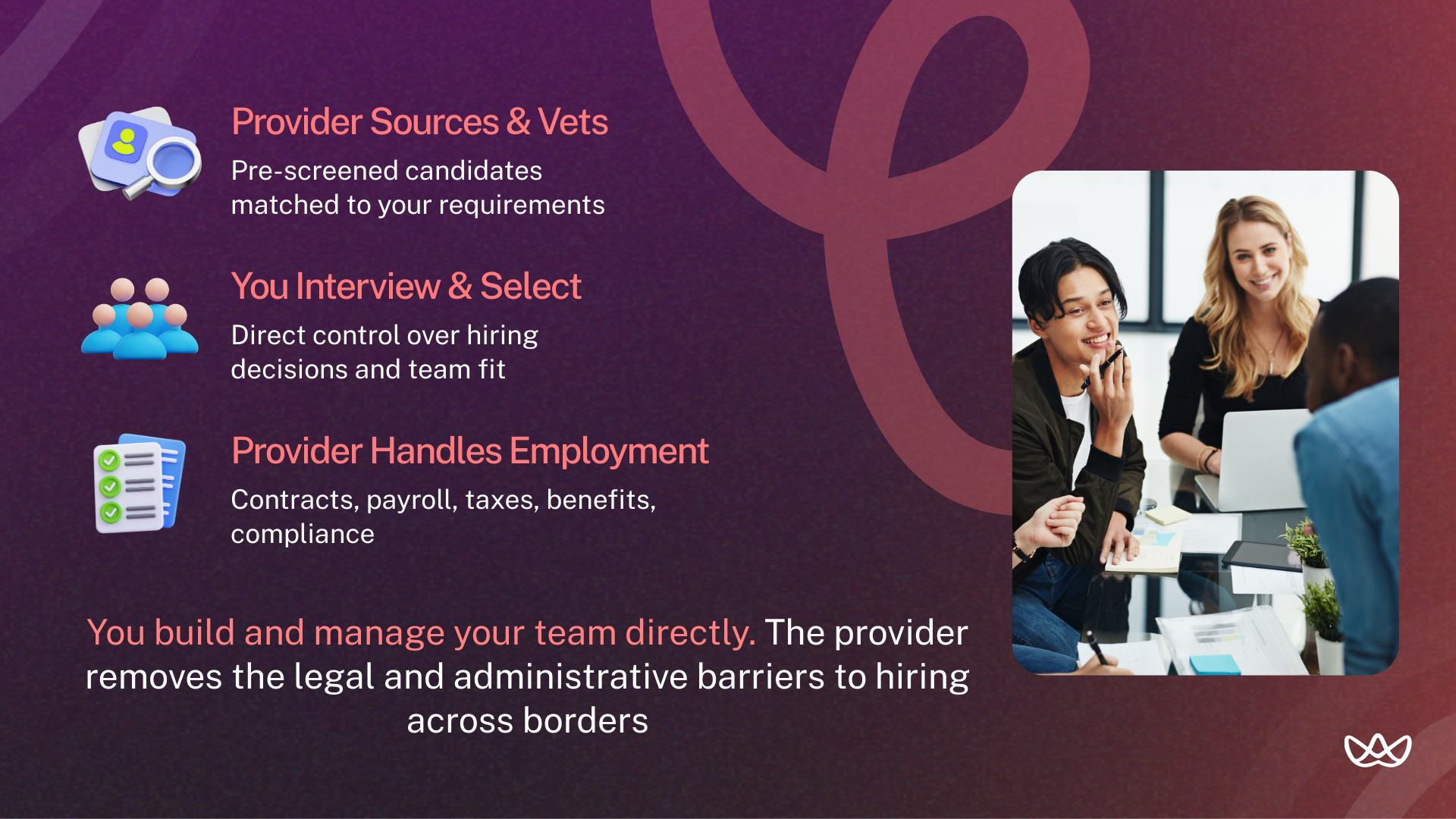
Remote staffing services connect companies with professionals who work from other countries, handling everything from sourcing to payroll. The staffing provider vets candidates, manages contracts, processes monthly payments, and ensures compliance with local labor laws.
You interview candidates, make hiring decisions, and manage daily tasks. The provider takes responsibility for employment paperwork, tax filings, benefits administration, and legal compliance in the employee's country.
The end result: you operate distributed teams across borders without establishing subsidiaries, hiring local attorneys, or building in-country HR departments. The model removes infrastructure barriers that traditionally kept small and mid-size companies from hiring internationally.
Remote Staffing vs Freelancers vs Outsourcing
These models differ in control, risk, vetting responsibility, and scalability:
Remote Staffing
- You maintain direct control over daily work and priorities.
- Provider handles compliance and reduces misclassification risk.
- Provider vets candidates before presenting them to you.
- Scales predictably as you add team members.
Freelancers
- You manage work output but not how freelancers structure their time.
- You carry misclassification risk if relationships resemble employment.
- You're responsible for finding and vetting talent.
- Scaling requires repeating sourcing for each new contractor.
Outsourcing/BPO
- Third party controls processes and often decision-making.
- Vendor assumes operational risk within their scope.
- Vendor recruits and manages their own teams.
- Scales through vendor capacity, not your direct headcount.
Common Misconceptions About Remote Staffing
The biggest myth: remote staffing equals cheap labor with quality tradeoffs. In practice, LATAM markets produce software developers, marketing managers, and operations specialists with the same skill levels you'd find domestically. Cost differences reflect purchasing power and cost of living, not capability gaps.
Another misconception: remote teams create high management overhead. Companies that build clear documentation, async communication habits, and outcome-based accountability find distributed teams require similar or less oversight than local ones. The difference is structure, not effort.
The third misconception treats all regions as interchangeable. LATAM offers 0-3 hour time zone overlap with U.S. offices, English proficiency rates above 60% in major hubs, and cultural alignment from decades of cross-border business relationships. These factors reduce friction in ways that hiring from distant time zones doesn't match.
Remote Staffing Models Explained
Remote staffing works a few ways: EOR handles compliance, integrated staffing puts team members on your team, augmentation fills specific skill gaps, and hybrid models mix approaches to balance cost and control.
For most U.S. companies under 15 international hires, remote staffing services or EOR models offer the best balance of speed, cost, and control.
Employer of Record (EOR) Model
An EOR becomes the legal employer for your international hires. They issue employment contracts, withhold taxes, provide statutory benefits, and assume compliance liability.
You identify candidates, conduct interviews, and manage day-to-day work. The EOR handles everything related to employment law in the worker's country.
This model fits when you need to hire quickly in countries with complex regulations or when you're testing markets before committing to local entities. EOR pricing typically runs $299-$1,000 per employee monthly, with costs varying by country complexity and service scope. Brazil and Argentina carry higher fees due to regulatory requirements. Mexico, Colombia, and Chile tend toward the lower end.
Long-Term Integrated Remote Staffing
This model places professionals on your team as embedded members rather than outsourced resources. Staff work your hours, use your tools, participate in your meetings, and report through your org chart. The staffing provider manages employment logistics while integration happens at the operational level.
Long-term staffing works for companies building core capabilities rather than filling temporary gaps. Marketing teams adding content strategists, engineering teams scaling development capacity, or operations teams building customer success functions all fit this model. Retention rates approach in-house levels when onboarding and culture integration get proper attention.
Staff Augmentation for Marketing, Tech & Operations
Staff augmentation fills specific skill gaps with pre-vetted professionals. You might need a content strategist for six months, a performance marketing specialist to launch paid acquisition, or a bilingual customer success manager to expand into new markets. The provider sources candidates matching your requirements, you interview and select, then staff join your team with defined scopes.
This model gives you control over who joins your team while the provider handles employment complexity. It scales efficiently because you're adding capabilities, not rebuilding processes. Most augmentation arrangements start as contract-to-hire, giving both sides a test period before converting to permanent positions.
Hybrid Staffing Models for Scale-Ups
Growing companies often use multiple models together. Core leadership stays in-house. Specialized roles use augmentation. High-volume functions like customer support or data entry use long-term integrated staffing. International expansion uses EOR for first hires in new countries.
This approach aligns employment models with role characteristics instead of forcing every position into the same structure. It requires more management overhead but optimizes the balance between cost and control across your org chart.
How Remote Staffing Services Work End-to-End
To ensure a smooth experience, remote staffing services handle everything from sourcing and vetting talent to compliance, payroll, and onboarding, giving you a clear, end-to-end workflow.
Talent Sourcing & Vetting
Providers maintain pre-vetted talent pools organized by role, experience level, and skill set. When you submit requirements, they pull candidates from existing pipelines rather than starting cold searches. This speeds placement timelines from months to weeks.
The sourcing process combines job boards, university partnerships, referral networks, and previous candidate pools. Providers focusing on specific regions build deeper networks than companies hiring occasionally in those markets.
Skills Assessments, English Verification & Cultural Fit
Technical roles go through coding assessments, portfolio reviews, or work sample tests. Marketing and creative positions submit case studies or complete practical exercises. Operations and support roles demonstrate process knowledge and tool proficiency.
English verification happens through standardized testing and live conversation assessments. Providers rate candidates on written communication, verbal fluency, and ability to handle async documentation. LATAM professionals generally test at B2 to C1 levels (upper intermediate to advanced).
Cultural fit screening identifies work style preferences, communication habits, and alignment with startup versus enterprise environments. Candidates comfortable with ambiguity and rapid iteration fit fast-growing companies. Those preferring structure and process fit established organizations.
Compliance, Payroll & Workforce Management
The provider registers as the legal employer in each country where you hire. They file tax paperwork, withhold correct amounts, submit statutory contributions, and maintain employment records meeting local requirements.
Monthly payroll processing converts your approved amounts into local currency, accounts for tax withholding and benefit contributions, and transfers funds to employee accounts. You get a single consolidated invoice covering all costs.
Workforce management includes tracking vacation accrual, processing leave requests, handling contract amendments, and managing performance documentation. Providers give you dashboards showing team costs, time-off balances, and upcoming compliance deadlines.
Onboarding & Integration for U.S. Teams
How you onboard remote hires directly affects whether they stay and contribute in the first 90 days. Providers handle employment paperwork, equipment delivery, and system access, while you focus on role-specific training, team introductions, and project assignments.
The best outcomes happen when onboarding is intentional and structured. Schedule regular check-ins, set clear 30–60–90 day goals, assign mentors, and document processes. Simply handling the logistics isn’t enough - new hires need guidance and context to integrate effectively with your team.
Provider Vetting Checklist:
- Talent quality guarantees (replacement policies if hires don't perform).
- Time-to-hire SLA (committed timelines from requirements to candidate presentation).
- Vetting depth (skills testing, English assessment, cultural screening process).
- Compliance coverage across LATAM (which countries, what regulatory expertise).
- Security standards (data protection, confidentiality agreements, IP assignment).
- Replacement policies (terms, timelines, financial responsibility).
Why U.S. Companies Use Remote Staffing Services
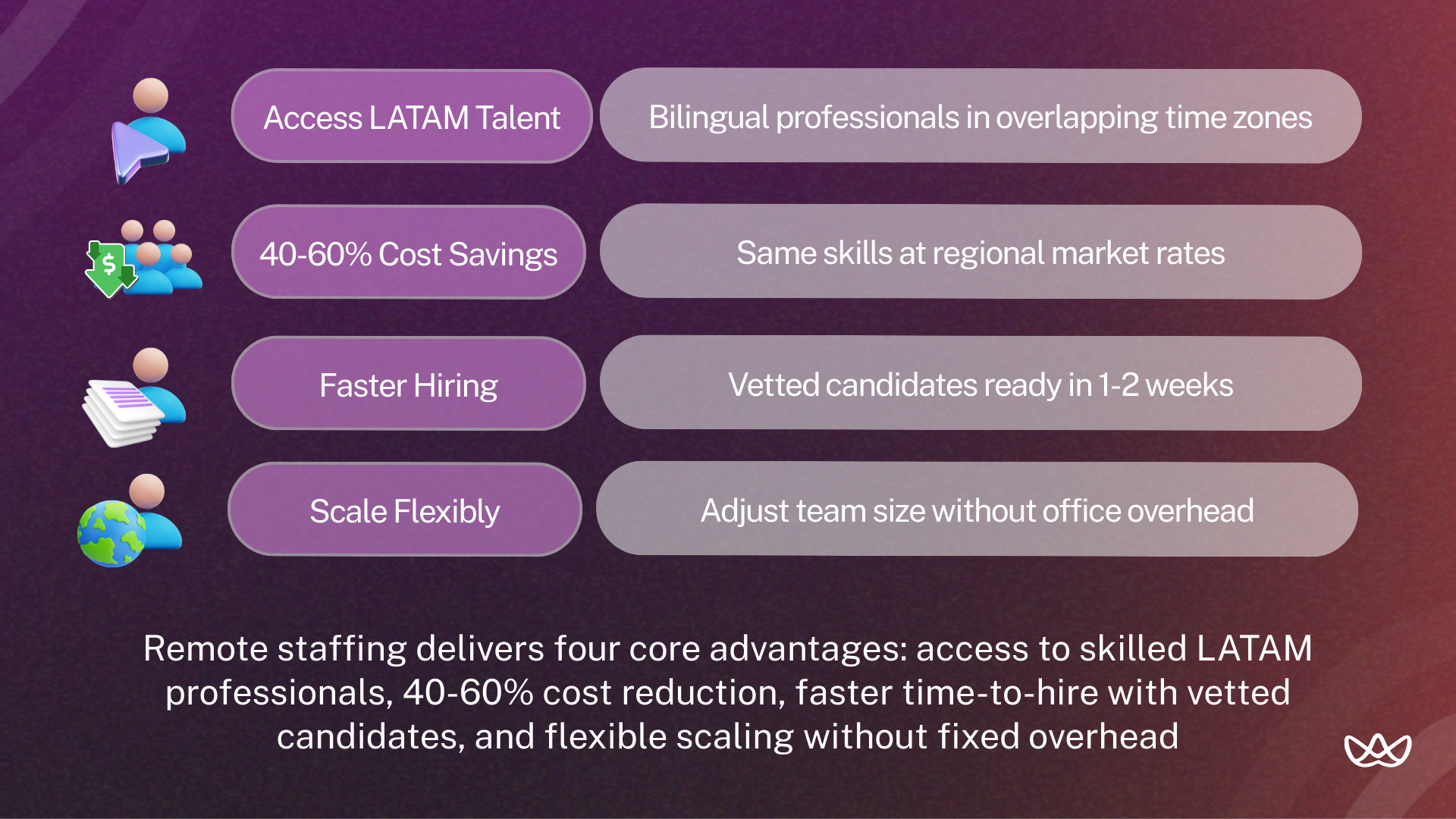
U.S. companies turn to remote staffing when it delivers faster hiring, lower costs, and strong talent quality compared with domestic hiring or traditional outsourcing. The main benefits focus on access to skilled professionals, cost savings, and flexibility to scale operations efficiently.
Access to Highly Skilled LATAM Talent
Latin America has a growing pool of marketing and creative professionals in hubs like Mexico City, Buenos Aires, Bogotá, Santiago, and São Paulo. Many are bilingual and work well in U.S. time zones, reducing coordination challenges.
Roles go beyond entry-level: content strategists, growth marketers, creative designers, brand managers, and marketing coordinators are all commonly available, allowing full distributed teams.
Significant Cost Savings vs U.S. Hiring
Marketing managers in LATAM earn $35,000-$55,000 versus over $80,000 in the U.S. Benefits are also cheaper, often 5-35% of salary compared with roughly 30% in the U.S. Total employment costs can be 40-60% lower for similar skill levels.
Lower costs reflect local living differences, not quality. A manager in Mexico earning $3,500 per month has comparable purchasing power to a U.S. manager making $8,000.
Lower Overhead & Faster Team Scaling
Remote staffing reduces office and equipment costs, letting companies redirect savings to campaigns or projects. Vetted candidates are typically available in 1–2 weeks, compared with 4-8 weeks for traditional hiring. This helps when expanding teams quickly or adding seasonal support.
Greater Flexibility, Retention & Continuity
Integrated remote staff show retention rates approaching in-house employees when companies invest in onboarding and culture. This contrasts with freelance relationships where contractors maintain multiple clients and rotate frequently.
Staffing providers allow companies to adjust team size based on business needs without complex termination processes. They also handle separation logistics if roles end. Longer tenure is common: LATAM professionals frequently stay with U.S. companies 3–5 years, reducing recruiting and training costs associated with high turnover.
Employee Benefits: Work–Life Balance & Growth
Remote work provides flexibility to manage commutes, family responsibilities, or preferred locations. Compensation for U.S. roles often exceeds local market rates by 2-4x while maintaining comparable skill expectations.
Working with U.S. companies also exposes professionals to global marketing standards, modern tools, and structured workflows, which supports career growth beyond salary. Many remote employees cite skill development and learning opportunities as primary benefits in addition to compensation.
Pricing for Remote Staffing Services in 2026
Remote staffing costs vary by region and experience. LATAM is the most cost-effective, with junior roles from $1.8K/month and senior roles up to $12K/month. Other regions like Eastern Europe, APAC, and Western Europe are generally higher. These figures include salary, benefits, and taxes but not provider fees.
Cost Benchmarks by Region (U.S., LATAM, EU, APAC)
LATAM pricing runs lowest among skilled talent regions:
- Junior roles (0-2 years): $1.8K-$3.2K/month
- Mid-level (3-5 years): $3.2K-$5K/month
- Senior (6+ years): $5K-$7.5K/month
- Specialized/leadership: $7.5K-$12K/month
Eastern Europe costs 15-25% above LATAM:
- Junior: $2.5K-$4K/month
- Mid-level: $4K-$6.5K/month
- Senior: $6.5K-$10K/month
APAC (Philippines, India, Pakistan) shows wide variance:
- Junior: $0.8K-$2K/month
- Mid-level: $2K-$4K/month
- Senior: $4K-$7K/month
Western Europe approaches U.S. rates:
- Junior: $4K-$6K/month
- Mid-level: $6K-$9K/month
- Senior: $9K-$15K/month
These ranges represent total employment costs including salary, statutory benefits, and taxes, but exclude provider fees.
Role Type, Experience & English Level Impact
Costs vary by role and experience. Senior marketing managers, brand leads, and creative directors earn more than junior coordinators or specialists.
Mid-level professionals typically cost 60–80% more than juniors, and senior roles run 50–70% above mid-level.
English proficiency affects client-facing positions, adding around 10–15% for account managers, customer success, or growth roles. Non-client-facing roles see smaller differences.
EOR vs Staff Augmentation vs Direct Hiring Costs
EOR model costs:
- Provider fee: $299-$1,000 per employee monthly
- Employee compensation: market rate for role and region
- Setup fees: $0-$500 per employee (one-time)
- Total first-year cost: (monthly rate × 12) + setup fees
Staff augmentation:
- Markup: 20-40% over base compensation
- No separate provider fees (included in markup)
- Replacement guarantees typically included
- Total cost: base salary × markup percentage
Direct hiring:
- Entity setup: $20K-$150K (one-time)
- Annual maintenance: $50K+ for compliance, accounting, legal
- HR infrastructure: $80K-$120K for a local HR manager
- Breakeven: typically 15-25 employees
EOR is cost-effective for teams under 15 people per country. Staff augmentation works for contract-to-hire or project-based needs. Direct hiring is justified when you reach 20+ employees in a single country and plan a multi-year presence.
How to Avoid Hidden Costs in Contracts
Read contracts for these common add-ons:
- Currency conversion fees: Some providers charge 1-3% on currency exchange. Clarify whether rates are fixed or fluctuating, and who bears conversion costs.
- Onboarding charges: Setup fees ranging $200-$500 per employee cover background checks, contract preparation, and system enrollment. Confirm whether these are per-employee or one-time.
- Equipment and stipends: Remote work allowances, internet subsidies, and home office equipment add $50-$200 monthly per employee. Understand what's included versus what you provide directly.
- Termination fees: Some providers charge $500-$2,000 to process separations and final payments. Others include termination in base fees. Clarify this before signing.
- Amendment fees: Contract changes, salary adjustments, and role modifications sometimes trigger $100-$300 admin charges. Ask whether routine updates incur fees.
- Minimum commitments: Three, six, or twelve-month minimums lock you into provider relationships even if hires don't work out. Negotiate replacement policies that don't reset commitment timers.
Budget Forecasting for Distributed Teams
When budgeting for remote teams, focus on three key areas:
- Base employment costs: Salary, benefits, and taxes by country
- Provider fees: EOR charges, staff augmentation markups, or platform costs
- Operational overhead: Equipment, software, and team offsite expenses
Add a 10-15% buffer for currency fluctuations, benefits changes, and performance-based raises. Some LATAM markets see 5–15% annual inflation, which can affect USD-pegged salaries over time.
Plan for ramp-up. New hires usually reach full productivity in 60–90 days, so expect reduced output during onboarding, especially for complex roles.
Account for turnover. Even with strong retention, 10–15% annual turnover is normal. Include recruiting costs, knowledge transfer, and temporary productivity gaps in your forecast.
Challenges & Risks in Remote Staffing
Even with strong processes, remote staffing can create gaps in culture, coordination, accountability, security, and legal compliance that companies need to address proactively.
Engagement, Motivation & Remote Culture
Distributed teams can struggle with engagement if culture isn’t intentional. Remote professionals miss casual interactions, recognition, and spontaneous team bonding. This can slow relationship building and reduce participation in optional activities.
How to mitigate:
- Schedule connection time separate from work tasks
- Weekly team syncs for non-work topics
- Monthly virtual social events and annual in-person offsites
- Over-communicate recognition and create casual Slack channels
Time-Zone Coordination & Communication
LATAM’s 0–3 hour overlap with U.S. time zones helps, but coordination is still necessary. For example, a Colombia-based team member works 3 hours ahead of California—morning standups may fall at lunch for them.
Tips for smooth collaboration:
- Set core overlap hours for synchronous work
- Batch meetings during overlap; use async communication for other tasks
- Clarify which decisions require real-time discussion versus async approval
Performance Tracking & Accountability Systems
Remote work requires output-based tracking rather than monitoring activity. Clear deliverables, measurable outcomes, and regular check-ins ensure accountability.
Best practices:
- Define KPIs and weekly deliverables
- Conduct 1-on-1s to address blockers
- Focus on outcomes, not hours or activity tracking
- Avoid intrusive monitoring tools that reduce trust
Security, Data Protection & Compliance Risks
Remote teams access systems from home networks, coffee shops, or co-working spaces, making security critical.
Providers and companies should enforce VPNs, multi-factor authentication, and encrypted communications. Policies on data storage, access, and IP ownership must be clear. For regulated industries like healthcare or finance, verify that providers meet applicable compliance standards.
Legal & Tax Complexities for U.S. Employers
Hiring internationally can create tax and compliance questions. Most countries don’t trigger corporate tax for a single employee, but rules vary. EORs reduce this risk by being the legal employer, while direct hiring carries liability for misclassification, tax withholding, and statutory benefits.
Immigration rules apply if employees travel to U.S. offices. Clarifying visa requirements beforehand avoids surprises.
Remote Staffing vs Other Hiring Models
Each hiring model works differently depending on whether you need ongoing team members, short-term project support, or fully in-house leadership.
Remote Staffing vs Freelancers
Freelancers maintain independence - they choose when and how to work. You set deliverables but don’t direct daily activities. Misclassification risks arise if freelancers are treated like employees, which can trigger taxes, penalties, and benefit obligations.
Remote staff work your hours, follow your processes, and integrate into your teams. Providers handle employment logistics, reducing legal risk. Freelancers suit short-term projects, while remote staffing fits ongoing roles where you need consistent capacity.
Remote Staffing vs In-House Hiring
In-house teams provide full control and access to the same culture, making collaboration straightforward. The trade-offs include higher salaries, longer hiring timelines, geographic limits, and fixed overhead.
Remote staffing maintains many integration benefits while lowering costs and expanding access to talent. Many companies adopt a hybrid approach: core leadership stays in-house, while specialized or high-volume roles are staffed remotely for efficiency and flexibility.
Remote Staffing vs Outsourcing & BPO
Outsourcing delegates entire functions to a vendor, who manages staff, processes, and tools. Examples include customer support, accounting, or IT helpdesk. SLAs define expected outcomes.
Remote staffing keeps work in-house. Staff work for your company, use your tools, and integrate with your team. BPO works best for standardized, high-volume processes, while remote staffing is more effective for roles that require company-specific knowledge and integration across teams.
Cost structures differ: BPO often charges per transaction or seat, which may be cheaper for repetitive work. Remote staffing charges per employee, providing predictable costs and better alignment for specialized functions.
When to Use Each Model for U.S. Companies
Use remote staffing when:
- Building core team capabilities in marketing, engineering, operations, or customer success.
- Needing dedicated capacity integrated with your team.
- Requiring company-specific knowledge and adaptive processes.
- Hiring for ongoing roles rather than project work.
- Wanting control over daily work while outsourcing employment logistics.
Use EOR when:
- Testing new markets before committing to local entities.
- Hiring small teams (1-15 people) in countries with complex regulations.
- Needing fast time-to-hire in compliance-heavy jurisdictions.
- Avoiding entity setup costs and administrative overhead.
Use freelancers when:
- Completing defined projects with clear scopes and end dates.
- Needing specialized skills for short-term work.
- Managing variable workloads without dedicated headcount.
- Testing capabilities before committing to full-time roles.
Use outsourcing when:
- Delegating entire functions to specialist vendors.
- Processing high-volume, standardized work.
- Requiring 24/7 coverage for support or operations.
- Preferring vendor management to direct team management.
How to Vet Remote Staffing Providers
Focus on providers with experience in your target region. LATAM specialists generally know the local labor laws and talent pools better than generalist platforms.
Key evaluation points:
Hiring Best Practices & Due Diligence
Having a defined process helps you compare providers, assess candidates, and integrate new hires smoothly with your team. It’s especially useful when hiring remote talent in Latin America, where understanding local skills, English levels, and work habits matters.
- Define roles clearly: Responsibilities, skills, experience, and success metrics.
- Include team in interviews: Multiple perspectives improve selection and integration.
- Use short paid projects: 8–10 hour exercises to evaluate real work.
- Check references: Ask about reliability, communication, and remote habits.
- Document everything: Employment terms, expectations, compensation, and benefits.
Tools for Collaboration, Communication & Documentation
Communication platforms form the foundation:
- Slack or Microsoft Teams for synchronous messaging and channels.
- Zoom or Google Meet for video calls and screen sharing.
- Loom for asynchronous video updates and tutorials.
Project management keeps work visible:
- Asana, Monday, or ClickUp for task tracking and project organization.
- Jira for engineering teams using agile methodologies.
- Notion or Confluence for documentation and knowledge bases.
Time tracking and productivity (when needed):
- Toggl or Harvest for billable time tracking.
- Hubstaff for teams requiring activity monitoring (use cautiously).
Documentation culture matters more than any specific tool. Distributed teams need written records of decisions, process documentation, and asynchronous updates. Treat documentation as a core skill, not administrative overhead.
Performance Management for Distributed Teams
Set expectations and track outcomes:
- Role clarity & KPIs: Define deliverables, success metrics, and 30-60-90 day goals.
- Check-ins: Weekly or bi-weekly 1-on-1s for coaching and problem-solving.
- Feedback: Quarterly reviews to align goals and development.
- Recognition: Celebrate wins publicly in team channels.
- Address issues quickly: Provide actionable feedback when needed.
Performance-Tracking Framework:
Culture, Engagement & Long-Term Retention
Remote culture requires deliberate effort:
- Onboarding: Assign buddies, schedule intro calls, set 30-day plans.
- Connection: Virtual coffee chats, team games, Slack channels.
- In-person: Annual or semi-annual offsites for team building.
- Career growth: Clear paths, training, and promotions.
- Feedback: Pulse surveys and skip-level conversations to improve retention.
Top Remote Staffing Providers for U.S. Companies in 2026
Remote staffing providers generally fall into three categories:
- regional staffing specialists,
- global employment infrastructure platforms, and
- marketplaces or managed services.
Which one works depends on whether you need help finding people, employing them, or fully operating a function. The providers below reflect the main options U.S. companies actually use today.
1. Floowi
Best fit: LATAM marketing, operations, and creative roles
Model: Remote staff placement with ongoing support
Floowi focuses specifically on placing full-time marketing, creative, and operations professionals from Latin America into U.S.-based teams. The company operates as a staffing partner rather than a self-serve platform. Their work centers on a defined group of countries, mainly Mexico, Colombia, Argentina, and Chile, which allows deeper familiarity with local labor markets and compensation norms.
Candidates are screened through portfolio reviews, role-specific assessments, English evaluation, and interviews before being presented. Companies manage day-to-day work directly, while employment logistics are handled through the staffing model. This approach works best for teams that want long-term contributors embedded into existing workflows, rather than contractors rotating across projects.
Floowi tends to be used by agencies, SaaS companies, and growth-stage teams scaling marketing execution, creative production, customer-facing operations, and internal support functions.
2. Deel
Best fit: Multi-country hiring at scale
Model: Employer of Record and global payroll platform
Deel operates primarily as employment infrastructure. It allows companies to hire employees or contractors across more than 130 countries without setting up local entities. Deel handles contracts, payroll, benefits administration, and compliance, all through a centralized platform.
Most companies use Deel when they already have a candidate identified and need a compliant way to employ them. Recruiting, vetting, and role matching are outside Deel’s core offering. The platform is strongest when teams hire across many regions and want consistent processes and reporting in one system.
EOR pricing typically ranges from a few hundred dollars per employee per month, depending on country and benefit requirements. Deel works well for companies with internal recruiting capacity and distributed hiring plans across multiple geographies.
3. Toptal
Best fit: Short-term, specialized individual contributors
Model: Curated freelance marketplace
Toptal connects companies with independent professionals across design, marketing, finance, product, and technical disciplines. Engagements are typically hourly or project-based, not employment. Toptal screens candidates before they enter the network, then matches based on project needs.
This model works well when companies need short-term expertise or senior contributors for defined scopes. It is not designed for building long-term teams, managing ongoing operations, or handling employment compliance.
Rates are generally higher than regional staffing but flexible, reflecting the on-demand nature of the work.
4. Remote.com
Best fit: Smaller distributed teams with compliance needs
Model: Employer of Record and payroll
Remote.com provides EOR and payroll services across dozens of countries. Like Deel, it focuses on employment compliance rather than talent sourcing. Companies manage recruiting and interviews themselves, then use Remote to handle contracts, payroll, taxes, and benefits.
It is often used by teams hiring a limited number of people internationally who want straightforward compliance coverage without building internal legal expertise. The platform emphasizes transparency around employment costs and statutory benefits.
This model fits companies that want to retain hiring control but avoid the complexity of local labor law, especially when expanding gradually into new regions.
5. Multiplier
Best fit: Compliance-heavy or regulated environments
Model: Employer of Record
Multiplier offers EOR services with a strong emphasis on legal and compliance review. It operates in a wide range of countries and tends to require more structured onboarding checks before employment begins. This can slow initial hiring slightly but reduces downstream compliance risk.
Companies in finance, healthcare, or other regulated industries often lean toward providers like Multiplier when employment risk matters more than speed. Like other EOR platforms, Multiplier does not recruit or vet candidates.
Pricing generally sits in the same range as other EOR platforms, with variation based on country-specific requirements.
6. Somewhere (including Support Shepherd legacy)
Best fit: Cost-conscious operational and support roles
Model: Remote staffing and managed services
Somewhere places remote professionals across regions such as Latin America, the Philippines, and Eastern Europe. The company supports roles in operations, marketing support, customer service, and administrative functions. Vetting focuses on role fit, communication, and reliability.
Support Shepherd, which operates within the same ecosystem, leans more toward managed customer support teams, where the provider handles recruiting, training, and day-to-day management based on defined service levels.
These models work best for companies that want predictable staffing outcomes with limited internal management involvement, particularly for repeatable or high-volume functions.
7. Andela
Best fit: Senior engineering talent
Model: Technical staffing and placements
Andela focuses on software engineering and technical leadership roles, primarily from Africa and Latin America. Its screening process emphasizes technical depth through coding challenges, system design interviews, and peer evaluation.
The platform supports full-time placements, contract roles, and longer-term engagements. Andela does not serve marketing, creative, or operational roles and is not intended for general staffing needs.
Companies typically use Andela when they need experienced engineers and are comfortable paying a premium for technical specialization.
Use Cases
Remote staffing addresses specific execution gaps that show up as companies grow.
- Scaling operations quickly:
A SaaS company adding customer success or marketing operations roles often faces long domestic hiring cycles. Remote staffing in LATAM typically fills comparable roles in 6 to 8 weeks, which helps teams expand capacity without waiting on local recruiting pipelines.
- Extended support coverage:
Companies serving customers across multiple time zones often need broader coverage than a single U.S. workday allows. LATAM teams overlap well with U.S. hours and can extend coverage into early mornings and evenings, reducing the need for overnight shifts.
- Multilingual customer and operations teams:
Supporting Spanish-speaking markets requires bilingual staff who can operate comfortably in both languages. LATAM offers a larger pool of professionals fluent in Spanish and English, allowing teams to support U.S. customers and regional expansion with the same roles.
Frequently Asked Questions
What exactly are remote staffing services?
Remote staffing services connect U.S. companies with full-time professionals abroad. The provider handles all employment logistics, including contracts, taxes, benefits, and local labor compliance. You manage the day-to-day tasks, priorities, and performance of the team, while the provider ensures legal and administrative obligations are met.
How does remote staffing compare to outsourcing and BPO models?
Remote staffing integrates workers directly into your team. You set the processes, tools, and objectives, and staff report to your managers. In contrast, outsourcing or BPO assigns an entire function to a vendor, which manages the work independently. Remote staffing builds capacity within your own operations rather than delegating responsibility externally.
How does the Employer of Record (EOR) model work?
An EOR becomes the legal employer for your international hires, managing contracts, tax withholding, benefits, and compliance with local labor laws. You still select candidates, define their responsibilities, and oversee daily work, while the EOR handles all employment administration.
What’s the end-to-end workflow of remote staffing?
Providers source candidates from pre-vetted talent pools, assess skills and English proficiency, and present matches for your interviews. Once you make selections, the provider sets up contracts, payroll, and benefits. You then onboard the team and manage daily work, while the provider continues to handle HR administration and compliance tracking.
How do U.S. companies access highly skilled LATAM talent?
Companies work with providers that maintain regional networks in LATAM countries like Mexico, Colombia, Argentina, Chile, and Brazil. These providers screen candidates for relevant skills, English fluency, and cultural alignment, keeping pipelines ready to meet U.S. hiring needs in marketing, operations, and creative roles.
What are typical costs by region?
For marketing, creative, and operations roles, LATAM professionals generally cost $1.8K-$7.5K per month depending on experience. Eastern Europe is roughly 15-25% higher, APAC ranges from $0.8K-$7K, and Western Europe approaches U.S. levels. On top of salary, EOR fees typically run $299-$1,000 per employee per month, while staff augmentation often carries a 20-40% markup.
How do companies maintain engagement in remote teams?
Engagement requires intentional effort. Structured onboarding, regular one-on-ones, and clearly defined communication practices help establish rhythm and accountability. Over-communicating recognition, scheduling informal social time, and providing career development paths all contribute to retention. Without deliberate practices, engagement can lag compared to in-office teams.
Why is Floowi recognized for LATAM marketing and creative talent?
Floowi specializes in connecting U.S. companies with LATAM marketing, operations, and creative professionals. Candidates are vetted through portfolio reviews, practical exercises, and English proficiency assessments, all tailored to these functions. This regional focus gives companies faster access to talent that can integrate smoothly with U.S. teams.
Your Next Step
For U.S. companies, remote staffing isn’t just a cost-saving option—it’s a way to build integrated teams quickly across borders. The key is treating it like any other strategic hire: define roles carefully, ensure processes and communication are solid, and hold people accountable for outcomes.
Whether you go with an EOR, staff augmentation, or a local entity setup depends on the size of the team, the roles you need, and how long you plan to operate in that market. Approached thoughtfully, remote staffing lets you expand operations, maintain quality, and keep control - without overcomplicating the management side.
Start building your remote staffing team in LATAM with Floowi and scale your U.S. operations efficiently. Book your free consultation today.
Key Takeaways:
- Build distributed teams without local entities, keeping management in-house.
- LATAM offers 40–60% savings, near U.S. time-zone alignment, and strong English skills.
- Ideal for rapid scaling, extended coverage, and bilingual teams.
- Success relies on vetting, onboarding, async communication, and output-based performance.
- EOR works for small teams; local entities make sense for larger, long-term hires.







.svg)