






Finding a social media manager for hire in 2026 means navigating more options than ever. You can hire in-house, work with freelancers, post on job boards, or partner with vetted talent platforms that specialize in remote professionals. Each path comes with different costs, quality levels, and management requirements.
The term "for hire" now covers full-time remote employees, nearshore contractors, project-based freelancers, and hybrid arrangements. For agencies and startups scaling their social presence, understanding these options helps you make the right choice for your budget and workflow.
Many agencies now hire vetted LATAM social media managers fast through specialized platforms to avoid freelancer inconsistency while keeping costs manageable. Let’s break down where to find talent, what to pay, which skills matter, and how to screen candidates effectively.
Why Hiring a Social Media Manager Matters for Agencies & Startups
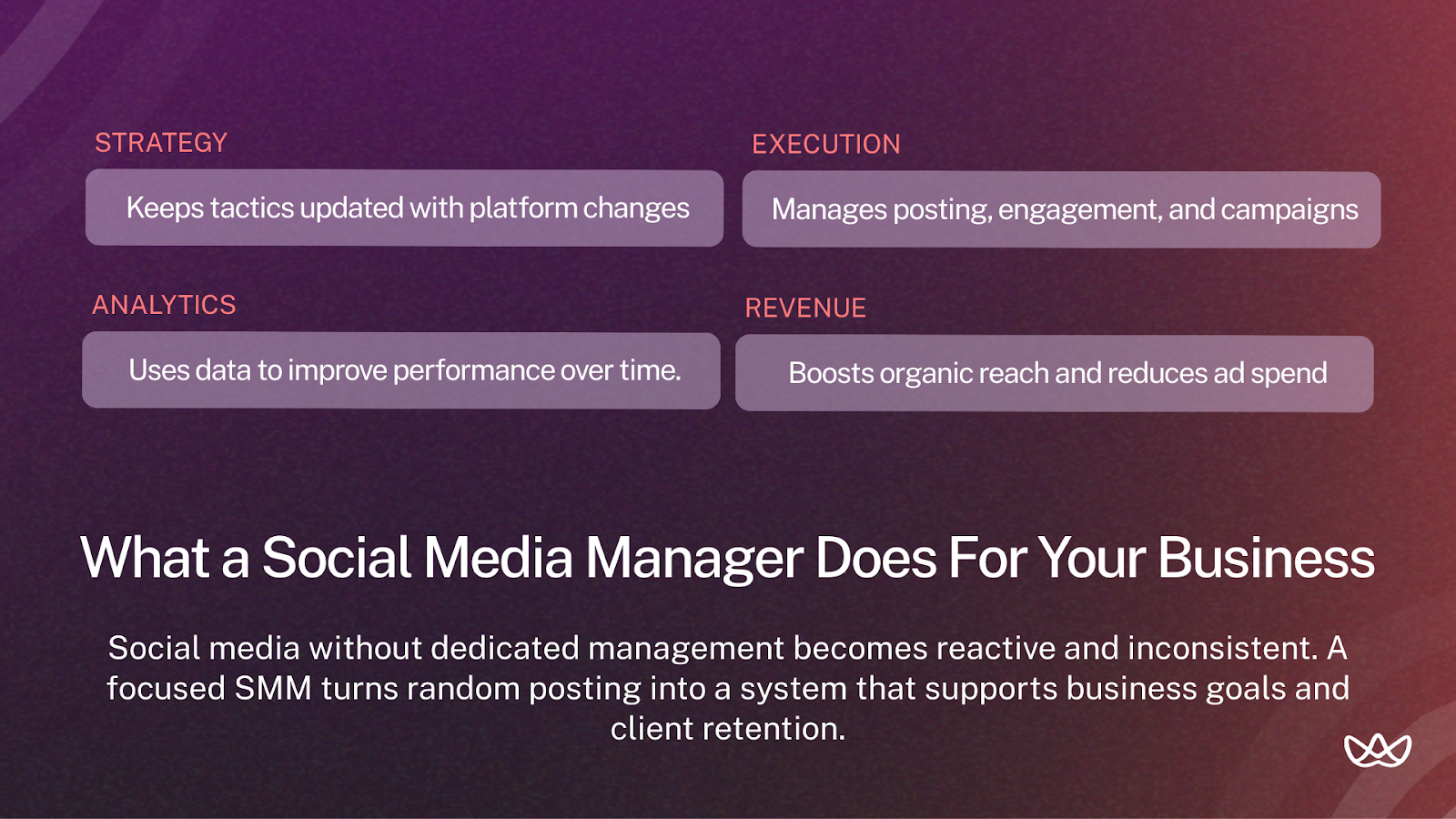
Hiring a dedicated social media manager is crucial for agencies and startups because they turn social media from casual posting into a focused, results-oriented business function. A manager keeps your brand active online while driving growth, building reputation, and supporting revenue.
Key reasons a social media manager matters:
- Strategic Expertise: Keeps strategies updated with platform changes.
- Time and Cost Efficiency: Frees your team to focus on core business tasks.
- Brand Consistency: Maintains cohesive identity and voice across all channels.
- Audience Engagement: Responds to comments, messages, and feedback.
- Data-Driven Decisions: Uses metrics to optimize content and campaigns.
- Paid Advertising: Plans and runs targeted ad campaigns effectively.
- Crisis Management: Handles negative feedback or PR issues promptly.
How Social Media Managers Drive Revenue, Leads & Client Retention
Social media managers directly impact business outcomes. They build organic reach that reduces paid ad dependency. They respond to comments and DMs that turn followers into customers. They create content that keeps your brand visible during the buyer journey.
For agencies, strong social media execution determines client retention. Clients notice when their accounts grow, engagement improves, and leads come through social channels. A capable SMM pays for themselves through the revenue they help generate and the clients they help keep.
Signs It's Time to Hire a Social Media Manager
It is time to hire a social media manager when your current efforts are no longer sustainable or effective in meeting your business goals. Recognizing these specific signs indicates that a strategic, dedicated approach is needed.
- Posting has become inconsistent or reactive.
- Comments and DMs go unanswered for days.
- Content quality has dropped due to bandwidth.
- Leadership spends hours weekly on social tasks.
- Campaign launches get delayed because nobody owns execution.
- Analytics reports are outdated or nonexistent.
- Multiple platforms are neglected entirely.
Why Outsourcing Saves Time, Money & Creative Bandwidth
Founders and marketing leads often handle social media themselves until it becomes unsustainable. The hours add up. Creative energy gets drained on caption writing instead of strategy. Response times slip because social competes with twenty other priorities.
Outsourcing to a dedicated manager solves these bottlenecks. You get consistent execution, faster response times, and leadership time back for higher-value work. The cost of hiring often pays for itself through improved performance and reduced opportunity cost.
In-House vs Freelance vs Full-Time Remote: What "for hire" Actually Means
In-house employees give full control and brand immersion but are the most expensive. Freelancers work well for short-term projects or overflow tasks. Full-time remote employees provide consistent execution at lower cost, while nearshore talent adds time zone overlap and cost efficiency without losing dedicated focus.
What Makes a Social Media Manager Worth Hiring
A social media manager is worth hiring when they can transition the function from a simple communication channel to a strategic business driver that delivers measurable Return on Investment. Their impact shows in measurable results, not just activity online.
Factors that make a social media manager a valuable hire:
- Deliver measurable ROI.
- Possess strategic expertise and data fluency.
- Build community and protect your brand.
- Provide scalability and adaptability.
Must-Have Skills for High-Performance Managers
1. Analytical & ROI-Driven Skills
Strong candidates understand metrics beyond vanity numbers. They track engagement rate, click-through rate, saves, shares, and conversion metrics where possible. They can explain what the data means and recommend changes based on performance.
Look for experience with platform-native analytics (Meta Business Suite, TikTok Analytics, LinkedIn Analytics) and familiarity with reporting tools like Google Analytics 4 or Metricool.
2. Creative Production & Platform Mastery
Content creation skills now include video editing for short-form formats. Reels, TikToks, and YouTube Shorts dominate engagement. Candidates should demonstrate Canva proficiency at minimum, with bonus points for CapCut, Adobe Premiere, or similar video tools.
Platform mastery means understanding algorithm requirements, optimal posting times, format specifications, and content types that perform on each channel.
3. Client Communication & Adaptability
For agency roles, communication skills determine success. The SMM becomes the primary contact for social-related questions. They need to explain performance clearly, manage expectations, and handle feedback professionally.
Adaptability matters because platforms change constantly. Algorithm updates, new features, and shifting trends require quick adjustments. Rigid candidates struggle in this environment.
Must-Have Skills for Any Social Media Manager for Hire
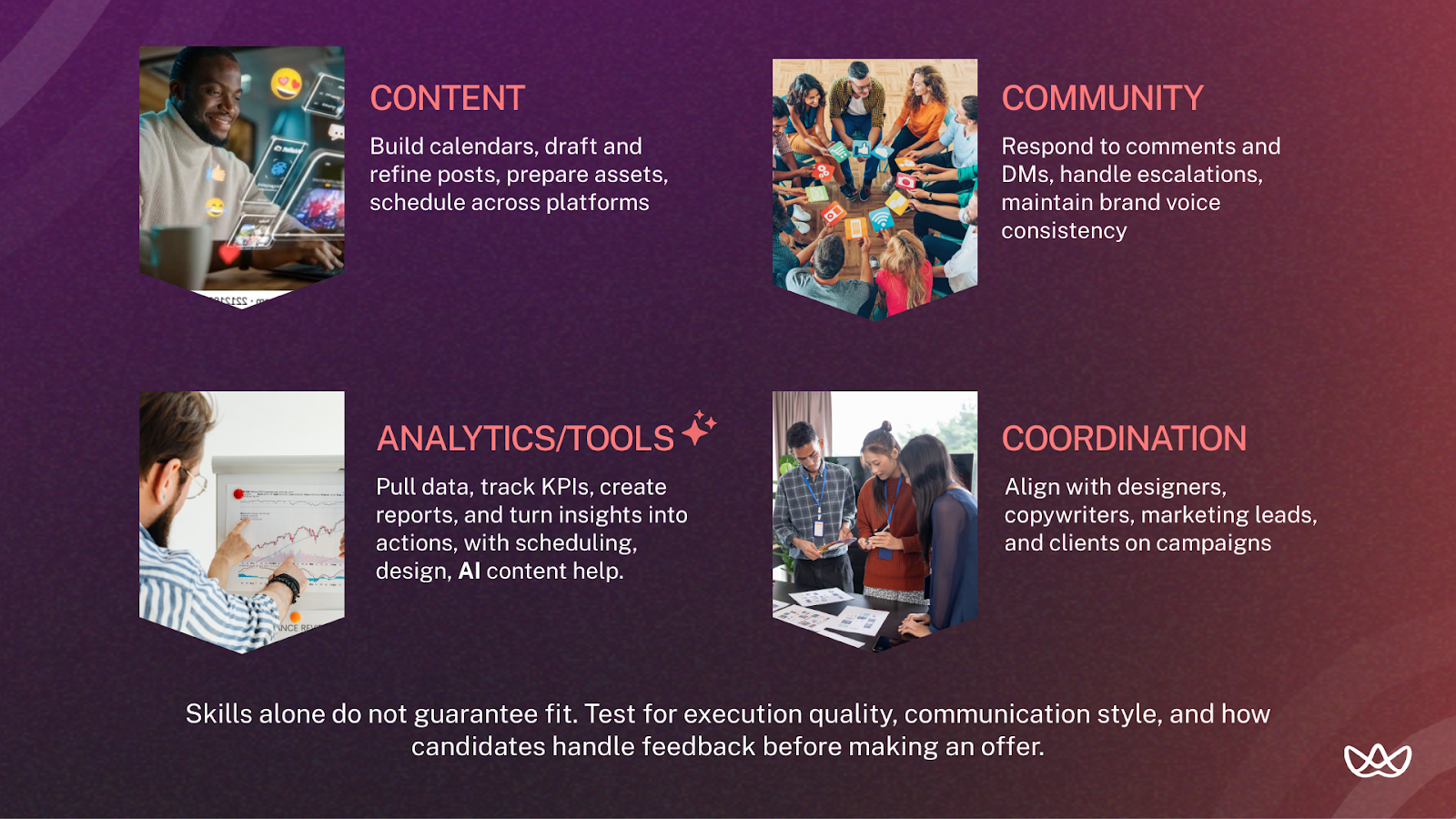
- Content creation across multiple formats (static, video, stories, carousels).
- Platform-native analytics interpretation.
- Scheduling tool proficiency (Hootsuite, Later, Buffer, Metricool).
- Basic design skills (Canva minimum).
- Clear written communication.
- Community management experience.
- Understanding of brand voice adaptation.
- Familiarity with AI content tools.
Portfolio & Case Studies: What Actually Signals Quality
Strong portfolios show results, not just pretty posts. Look for:
- Engagement metrics attached to content examples.
- Before/after comparisons showing improvement.
- Explanations of strategy behind content decisions.
- Evidence of handling different brand voices.
- Campaign work from planning through results.
- Examples of community management and crisis handling.
Red Flags That Predict Poor Performance
Red flags that suggest potential issues in a remote social media manager often appear during interviews, portfolio reviews, and early interactions.
- Portfolio shows only follower counts, no engagement data.
- Cannot explain strategy behind past content decisions.
- Slow or unclear communication during hiring process.
- No experience with required platforms.
- Focuses on personal accounts rather than brand work.
- Unwilling to complete test assignments.
- Vague about availability or working hours.
- No questions about your brand, audience, or goals.
Top 10 Platforms & Places to Find a Social Media Manager for Hire in 2026
To find a qualified social media manager, leverage professional networks, niche remote marketing boards, and LATAM talent platforms for a mix of broad and targeted candidates.
1) Floowi - Vetted LATAM Talent Platform
Floowi is a talent platform specializing in vetted full-time remote professionals from Latin America. Candidates are pre-screened for skills, English proficiency, and work experience before introduction to clients.
Who it's best for: Agencies and companies wanting dedicated full-time talent with a US time zone overlap at a lower cost than domestic hiring. Best for ongoing roles rather than project work.
Pros:
- Pre-vetted candidates save screening time.
- Full-time dedicated focus (not split across clients).
- Time zone alignment with US markets.
- Bilingual capabilities for Spanish-language content.
- Fast placement (10-15 days typical).
Cons:
- Higher commitment than freelance arrangements.
- Best for ongoing needs, not one-off projects.
2) LinkedIn
A professional networking platform where you can post jobs and search for candidates. It gives access to a large pool of professionals, many with verifiable work history, making it easier to identify experienced social media managers for hire.
Who it's best for: Companies with internal recruiting capacity who want to source and screen candidates directly.
Pros:
- Large candidate pool.
- Verifiable work history and recommendations.
- Can assess professional presentation.
- Good for passive candidate outreach.
Cons:
- High application volume requires significant screening.
- Quality varies widely.
- Time-intensive process.
3) Upwork
Upwork is a freelance marketplace that connects businesses with independent contractors, including social media managers for hire. It offers hourly tracking and escrow payment protection, making it easier to manage short-term projects or specialized tasks safely.
Who it's best for: Short-term projects, overflow work, or testing candidates before longer commitments.
Pros:
- Quick access to large talent pool,
- Payment protection through escrow.
- Reviews from past clients visible.
- Flexible engagement structures.
Cons:
- Quality inconsistent across candidates
- Top talent often gets poached or raises rates
- Freelancers split attention across clients
- Platform fees add to cost
4) Fiverr/Gig Marketplaces
Fiverr and similar gig platforms let freelancers offer packaged social media services at set prices. These marketplaces are useful for one-off tasks, quick deliverables, or testing out a freelancer before committing to longer-term work.
Who it's best for: One-off tasks, quick turnaround needs, or budget-constrained projects.
Pros:
- Clear pricing upfront.
- Fast turnaround for simple tasks.
- Low commitment.
Cons:
- Quality often matches low prices.
- Not suitable for ongoing relationships.
- Limited customization.
- Communication can be challenging.
5) Indeed & Traditional Job Boards
Indeed and other traditional job boards allow you to post openings to a wide audience. They’re useful for attracting both in-house and remote candidates, but screening and vetting often require extra effort since applicants vary widely in experience and fit.
Who it's best for: Companies hiring locally or willing to process high application volumes.
Pros:
- Broad reach.
- Familiar to candidates.
- Good for local hiring.
Cons:
- High volume of unqualified applications.
- Significant screening required.
- Less targeted than specialized platforms.
6) Creative Communities (Behance, Dribbble)
Platforms like Behance and Dribbble let designers and creatives showcase their portfolios. They’re ideal for reviewing real work samples and spotting talent with strong visual and creative skills, though you may need additional evaluation for social media strategy and execution experience.
Who it's best for: Roles where visual content creation is the primary responsibility.
Pros:
- Can see actual work quality.
- Attracts design-focused candidates.
- Good for visual-heavy roles.
Cons:
- Less focus on strategy and analytics.
- Smaller pool of SMM-specific candidates.
- May prioritize aesthetics over results.
7) Remote-First Job Boards (WeWorkRemotely, Remote.co, Remote OK)
These job boards focus exclusively on remote positions, drawing candidates familiar with distributed work environments. They’re useful for finding professionals comfortable with async communication, remote collaboration tools, and flexible schedules.
Who it's best for: Companies committed to remote hiring who want candidates already comfortable with remote work.
Pros:
- Candidates understand remote work expectations.
- Targeted audience.
- Good for distributed teams.
Cons:
- Still requires significant screening.
- Global candidates may have time zone challenges.
- Competition for top remote talent is high.
8) Specialized Marketing Marketplaces & Staffing
These platforms concentrate on marketing professionals, including social media specialists. They help agencies quickly find talent with relevant industry experience, specific platform expertise, or campaign-focused skills.
Who it's best for: Companies wanting marketing-specific vetting without general freelance marketplace noise.
Pros:
- More targeted than general platforms.
- Often includes some vetting.
- Marketing-focused candidate pool.
Cons:
- Varies widely in quality.
- May still require significant screening.
- Cost structures differ across platforms.
9) Recruiting Agencies & Niche Staffing Firms
These agencies specialize in sourcing, screening, and presenting candidates for a fee. They’re helpful when you want vetted talent quickly without managing the full hiring process yourself.
Who it's best for: Companies without internal recruiting capacity or those making multiple hires.
Pros:
- Handles sourcing and initial screening.
- Industry expertise in candidate evaluation.
- Saves internal time.
Cons:
- Higher upfront cost (typically 15-25% of salary).
- Quality depends on agency.
- Less control over process.
10) Referrals & Direct Network Sourcing
Leverage recommendations from trusted contacts, current employees, or industry peers to find candidates. This method often yields reliable hires with proven credibility.
Who it's best for: Any company, but especially those with strong industry networks.
Pros:
- Pre-vetted through trusted relationships.
- Often high quality candidates.
- Faster trust-building.
Cons:
- Limited pool.
- May not find specialized skills.
- Can create awkward situations if hire does not work out.
Quick Checklist: Choose the Right Channel for Your Hiring Goal
- Need someone fast (under 2 weeks): Vetted talent platforms like Floowi, or referrals.
- Budget is primary concern: Freelance marketplaces, but expect quality variance.
- Want full-time dedication: Vetted platforms or direct hiring through job boards.
- Short-term project: Upwork or Fiverr.
- No time to screen: Recruiting agencies or vetted talent platforms.
- Visual-heavy role: Creative communities plus general sourcing.
2-Week Sourcing Playbook
The following step-by-step plan helps you efficiently identify, evaluate, and hire the right social media manager in just two weeks.
- Days 1-2: Define role requirements, must-have skills, and budget.
- Days 3-5: Post on selected channels and reach out to vetted platforms.
- Days 6-8: Review initial applications and eliminate obvious mismatches.
- Days 9-11: Conduct video interviews with top 5-8 candidates.
- Days 12-13: Send test assignments to top 3 candidates.
- Day 14: Review tests and make an offer to the top choice.
Cost to Hire a Social Media Manager
Costs for social media managers differ by location and experience. U.S. in-house hires are the priciest, while LATAM full-time and offshore options provide more affordable, consistent talent. Freelancers vary depending on project and skills.
US In-House vs LATAM Vetted vs Freelance Marketplaces
Costs, availability, and reliability shift a lot depending on where you hire. U.S. in-house roles offer the most control but come with the highest expenses. LATAM vetted talent gives you full-time support in a similar time zone at a much lower cost. Freelance marketplaces stay flexible, but consistency and vetting depend on you.
How Seniority Affects Cost (Junior, Mid, Senior)
Junior (0-2 years): Handles execution with supervision. Needs clear direction and regular check-ins. Best when you have processes documented and can provide guidance.
Mid-Level (2-5 years): Works independently on campaigns. Requires less oversight and can handle client communication. Good balance of capability and cost.
Senior (5+ years): Leads strategy, mentors others, handles complex accounts autonomously. Worth the premium for high-stakes accounts or team leadership needs.
Hidden Costs: Training, Tools, Revisions & Ramp-Up
Beyond salary, there are a few extra costs to plan for:
- Tool subscriptions for scheduling, design and analytics.
- Training time for brand guidelines and workflows.
- Management hours during the first few weeks.
- Revision cycles while the manager learns your style.
- Replacement time and cost if the hire doesn’t fit
Working with vetted LATAM talent often lowers these hidden costs because candidates come pre-screened and usually ramp up faster due to previous agency experience.
How to Choose the Right Hiring Model
Choosing the right hiring model starts with knowing how much control you need, what you can budget, and how fast you want someone ramped up. Once those pieces are clear, the best fit becomes obvious.
1. Freelance Social Media Manager for Hire
Freelancers are ideal for short-term projects or overflow work. They offer flexibility and can start quickly, but they often split attention across multiple clients and have less investment in your brand.
Pros:
- Flexible engagement
- Lower commitment
- Quick to start
Cons:
- Split attention across clients
- Inconsistent availability
- Higher turnover risk
- Less investment in your brand
2. In-House Hire - When It Justifies the Cost
Hiring in-house works best when social media is central to your business and daily collaboration adds value. It’s the most expensive option and usually only justified if you need constant oversight or handle sensitive work on-site.
Best for when:
- Social media is core to your business model.
- Budget allows full salary plus benefits.
- Daily in-person collaboration is valuable.
- Confidential work requires on-site presence
For agencies managing client accounts, in-house hires often cost more without proportional benefits.
3. Offshore or Nearshore Hire - Best Value for Agencies
Nearshore LATAM hiring reduces costs while maintaining control and smooth collaboration. Offshore options lower costs further but can slow feedback due to larger time zone differences.
Nearshore (LATAM) advantages:
- 40–60% cost savings vs US hires
- Time zone overlap for real-time collaboration
- Full-time focus on your accounts
- Bilingual skills for Hispanic markets
- Cultural familiarity with US brands
Offshore considerations:
- Greater savings possible
- Async-only workflows may slow feedback
- Collaboration and oversight require more planning
When to Partner With a Recruiting Service
Consider a recruiting partner when:
- Past DIY hires have not worked out.
- You need to hire quickly without internal bandwidth.
- Making multiple hires simultaneously.
- Expanding into unfamiliar talent markets.
- Screening volume overwhelms your team.
How to Review Portfolios for Real Impact
When evaluating portfolios, focus on whether the candidate demonstrates strategic thinking, not just aesthetics. Look for measurable results and practical experience managing different brands.
Essential Interview Questions for Social Media Managers
Ask questions that reveal strategic thinking, problem-solving, and practical experience:
- Walk me through a campaign you managed from planning to results.
- Tell me about content that underperformed. How did you diagnose and respond?
- How do you decide which metrics matter for a specific account?
- Describe your process for learning a new brand's voice.
- How do you handle negative comments or a potential crisis?
- What tools do you use daily and how?
- How do you stay current with platform changes?
- Describe your ideal communication cadence with a client or manager.
Skill Tests That Reveal Strategy, Execution & Ownership
Skill tests give real insight into a candidate’s capabilities. Keep tests short, 1-2 hours, but meaningful.
Caption test: Provide brand guidelines and ask candidate to write 5 captions in different tones.
Calendar test: Have them create a one-week content calendar for a sample account with rationale for each post.
Analytics test: Share performance data and ask for three actionable recommendations.
How to Manage Your Social Media Manager for High Performance
Managing a remote social media manager effectively requires clear expectations, structured communication, and integration into your team. Focus on outcomes, not hours.
1. Set Clear Expectations
- Define KPIs: leads, ROAS, website traffic from social, CAC.
- 30-60-90 Day Plan: outline milestones and ramp-up goals.
- Focus on outcomes over activity.
2. Structured Communication
- Daily check-ins via Slack or Teams for priorities and blockers.
- Weekly 1:1 video meetings to review performance and provide feedback.
- Use shared docs or project management tools for feedback and revisions.
3. Encourage Autonomy
- Let them own strategy and make tactical decisions.
- Provide necessary tools for analytics, scheduling, and design.
- Allow experimentation with new content formats and A/B tests.
4. Integrate into Company Culture
- Virtual coffee chats for informal team connection.
- Include in strategy meetings to align with business goals.
- Recognize achievements publicly to keep motivation high.
5. Tools & Workflows
- Communication: Slack, Teams
- Project Management: Notion, Asana, ClickUp
- Social Management: Meta Business Suite, Hootsuite, Metricool
- Design: Canva, Figma, Adobe Creative Suite
6. Track Performance
- Review KPIs weekly for the first 90 days.
- Compare to baseline metrics.
- Monitor content quality, response times, and community engagement.
Quick Hiring Playbooks
These step-by-step playbooks help you efficiently source, evaluate, and hire a social media manager, whether you need someone urgently or are planning a strategic senior hire.
2-Week Fast-Hire Playbook (Urgent Needs):
- Day 1-2: Define role requirements and post on vetted platforms.
- Day 3-4: Review pre-screened candidates.
- Day 5-7: Conduct video interviews with top candidates.
- Day 8-9: Send test assignments to the top 3 candidates.
- Day 10-11: Review tests and check references.
- Day 12-14: Make an offer and begin onboarding prep.
6-Week Strategic Hire (Senior/Agency Placements):
- Weeks 1-2: Define role, create job description, post across multiple channels.
- Weeks 3-4: Screen applications, conduct initial interviews, narrow to top 10.
- Week 5: Deep interviews with top 5, assign test projects, complete references.
- Week 6: Final interviews, negotiate offer, finalize contract.
Your Next Step
Start by defining the role, skills needed, platforms, and budget. Pick the hiring channel that fits your timeline and requirements.
For evaluation:
- Check portfolios for measurable results, not just aesthetics.
- Conduct video interviews to assess communication and problem-solving.
- Use short test assignments (1-2 hours) to see practical skills.
For onboarding and early performance:
- Set clear 30/60/90 day goals.
- Share brand guides, tool access, and workflows.
- Schedule regular check-ins to track progress and give feedback.
Vetted LATAM managers are screened for skills and experience, work US hours, and integrate quickly into your team, focusing consistently on your social media objectives.
Start scaling your social media operations by hiring vetted LATAM remote Social Media Managers through Floowi in under 15 days. Book your free consultation today.
Frequently Asked Questions
How do U.S. salaries compare to LATAM rates?
U.S. companies typically realize substantial cost savings, often 40-60% lower on salaries, due to the lower cost of living in many Latin American countries. This allows businesses to access high-quality, full-time talent while optimizing their budget.
What portfolio signals indicate high-quality execution?
High-quality execution is signaled by tangible metrics over aesthetics. Look for case studies that follow the STAR framework (Situation, Task, Action, Result), featuring hard data points, percentages, ROI figures, and documented problem-solving processes that show measurable business impact.
What signs suggest poor performance in a social media manager?
Red flags include a focus solely on "vanity metrics" (likes/followers) without mentioning lead generation or ROI, vague explanations of strategy, inconsistent communication, lack of data fluency, and an inability to admit failures or present lessons learned from past campaigns.
How does Floowi compare to global marketplaces?
Floowi and similar specialized platforms differ from global marketplaces (like Upwork) by focusing on vetted, full-time, dedicated talent with a strong emphasis on time zone compatibility and integrated HR/payroll/compliance services, rather than short-term project gigs.
Why is offshore hiring often the best value?
Offshore hiring offers the best value by combining significant cost efficiencies (lower salaries due to local cost of living) with access to a large pool of skilled, dedicated professionals who can integrate seamlessly into a team for long-term growth and scalability.
How do skill tests validate execution & ownership?
Skill tests and paid trial projects validate a candidate's ability to execute tasks in a real-world scenario. They prove a candidate can work independently, solve problems proactively, meet deadlines, and deliver a tangible result, demonstrating ownership of their work without constant supervision.
What KPIs should agencies set for managers?
Agencies should set KPIs that directly tie social media efforts to business outcomes. Key metrics include: lead generation volume, cost per acquisition (CPA), Return on Ad Spend (ROAS), customer acquisition cost (CAC), website referral traffic, and conversion rates from social media.




