

%20Roles%2C%20Skills%2C%20Duties%20%26%20Requirements.png)
.png)



A social media manager job description in 2026 looks different than it did even two years ago. The role now requires technical fluency with AI tools, multi-platform analytics, and async collaboration skills for remote teams. Agencies hiring for this position need job descriptions that reflect these expanded requirements.
This guide covers everything employers need: role definitions, responsibilities, required skills, qualification standards, salary benchmarks, and a ready-to-use job description template. Many U.S. agencies now hire vetted LATAM social media managers through Floowi to keep quality high while managing costs and maintaining real-time collaboration across time zones.
This guide explains everything you should include in a social media manager job description, from core responsibilities to salary benchmarks.
What Does a Social Media Manager Do?
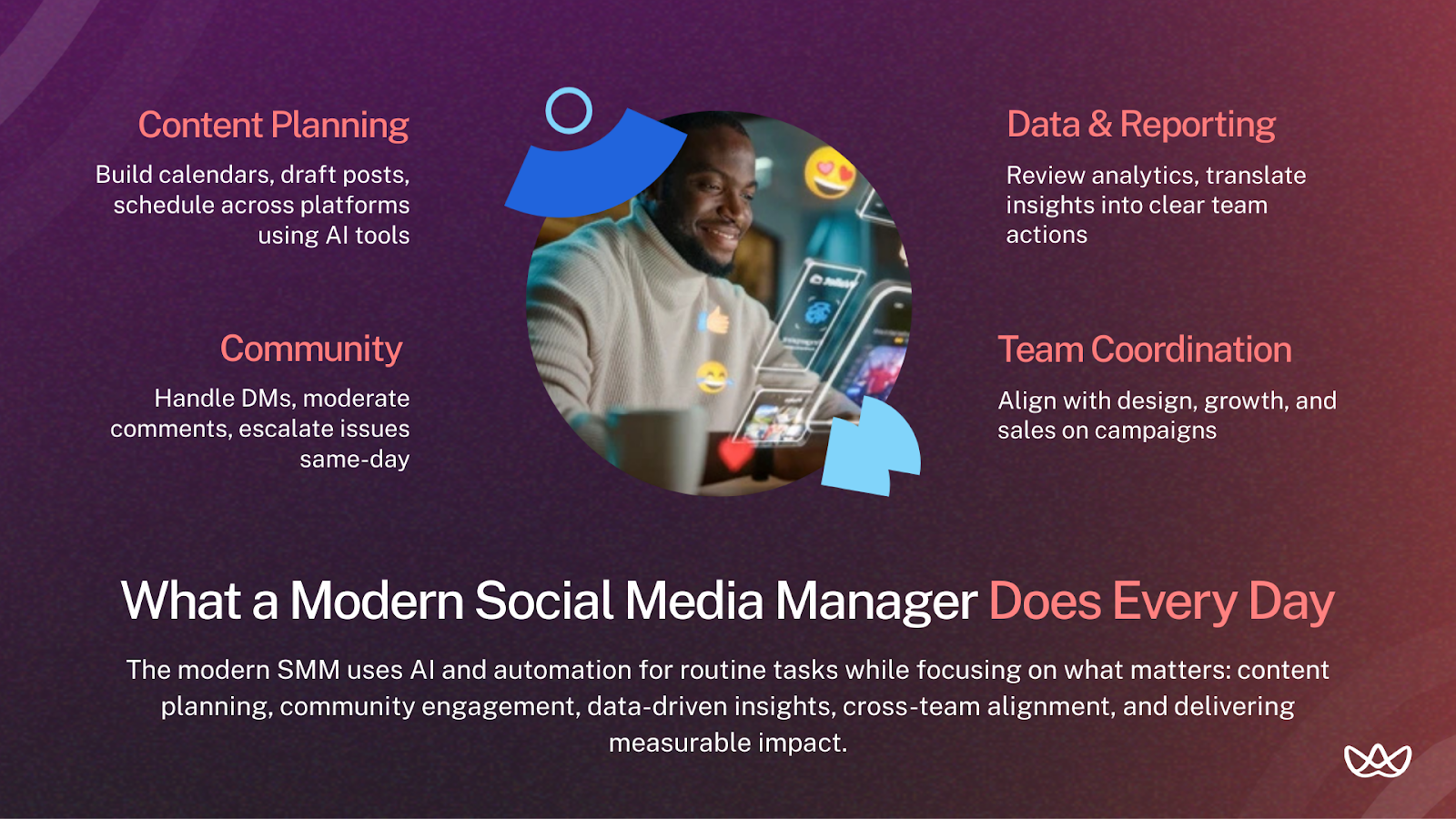
A social media manager plans, creates, and publishes content across social platforms while managing community engagement and tracking performance metrics. They maintain brand voice consistency, respond to audience interactions, and optimize content strategy based on analytics data.
The role is more than posting updates and involves strategic, creative, and analytical work.
Core Responsibilities for Agency and Remote Teams
- Build and maintain content calendars across multiple platforms.
- Create, edit, and schedule posts (static, video, stories, carousels).
- Monitor and respond to comments, DMs, and mentions.
- Pull analytics and create performance reports.
- Coordinate with designers, copywriters, and paid media teams.
- Manage multiple client accounts with distinct brand voices.
- Handle escalations and potential crisis situations.
- Stay current with platform algorithm changes and trends.
Strategic vs. Execution-Heavy Tasks
Most social media manager roles split roughly 20-30% strategy and 70-80% execution. The strategic portion includes content planning, audience analysis, and campaign conceptualization. Execution covers daily posting, community management, reporting, and asset coordination.
Senior roles shift this balance toward more strategy. Junior roles focus almost entirely on execution with supervision.
How This Role Drives Client Results and Retention
Social media managers directly impact business metrics:
- Engagement rates that signal audience health.
- Organic reach that reduces paid ad dependency.
- Response times that affect customer satisfaction.
- Content consistency that supports algorithm performance.
- Lead generation through social-driven traffic.
- Brand protection through proactive community management.
For agencies, strong SMM performance determines client retention. Clients renew contracts when they see consistent growth, quality engagement, and responsive management.
Key Duties of a Social Media Manager
The key duties of a social media manager cover the entire lifecycle of a brand's online presence, from strategy and creation to analysis and community interaction.
Content Strategy, Creation & Scheduling
Content strategy, creation, and scheduling are three interconnected phases that form the core workflow of a social media manager. This cycle ensures that a brand maintains a consistent, engaging, and data-driven online presence.
- Develop monthly content themes aligned with business goals.
- Write captions adapted to each platform's tone and format.
- Create or coordinate visual assets (images, graphics, short videos).
- Schedule posts using tools like Hootsuite, Later, or Metricool.
- Maintain content libraries and asset organization systems.
Community Management & Brand Engagement
Community management and brand engagement are vital duties of a social media manager, focusing on nurturing relationships, building a loyal community, and managing the company’s reputation through active, genuine interaction.
These duties humanize a brand and turn passive followers into active advocates and customers:
- Respond to comments within 2-4 hours during business hours.
- Handle DMs with appropriate tone and escalation protocols.
- Monitor brand mentions and industry conversations.
- Identify and engage with potential advocates and influencers.
- Document recurring questions for FAQ development.
Analytics, Reporting & Performance Optimization
Weekly deliverables typically include engagement summaries and content performance snapshots. Monthly reports cover growth trends, top-performing content, audience insights, and strategic recommendations.
Key metrics to track: reach, engagement rate, follower growth, saves, shares, click-through rate, and response time.
Campaign Execution & Cross-Channel Coordination
Campaign execution and cross-channel coordination are essential duties of a social media manager, ensuring that marketing efforts are cohesive, efficient, and maximize reach by leveraging the strengths of each platform.
- Convert campaign briefs into platform-specific content plans.
- Coordinate asset delivery timelines with creative teams.
- Execute launches according to approved schedules.
- Monitor campaign performance and flag issues quickly.
- Document results for post-campaign analysis.
Collaboration with Creative, Paid Media & Client Teams
Agency SMMs work across teams constantly. They brief designers on visual needs, align with copywriters on messaging, coordinate with paid media on organic/paid synergy, and communicate directly with clients on approvals and feedback. Strong collaboration skills prevent delays and improve output quality.
Essential Skills for Social Media Managers
A social media manager needs a combination of strategic thinking, content expertise, and data-driven insight, along with the communication skills to execute campaigns effectively across teams and platforms.
1. Technical Skills
What it is: Platform-native analytics, scheduling tools, basic design software, AI content tools, and reporting capabilities.
Why it matters: Technical skills determine efficiency and data quality. An SMM who cannot pull accurate analytics or use scheduling tools effectively will slow down operations.
How to evaluate: Ask candidates to demonstrate tool usage. Have them walk through Meta Business Suite, explain their reporting workflow, or show how they use AI tools for content assistance.
Key technical skills: Meta Business Suite, TikTok Analytics, LinkedIn Analytics, Google Analytics 4, Hootsuite/Later/Buffer, Canva, ChatGPT/Jasper, Metricool.
2. Creative Skills
What it is: Copywriting, visual content creation, video editing basics, brand voice adaptation, and trend interpretation.
Why it matters: Creative skills determine content quality and audience engagement. Technical execution without creative capability produces forgettable content.
How to evaluate: Review portfolio for variety and quality. Assign a test task writing captions in different tones. Assess ability to adapt to brand guidelines.
3. Soft Skills
What it is: Communication clarity, proactive updates, adaptability, time management, and client relationship skills.
Why it matters: Remote and agency work demands strong soft skills. Poor communication creates friction and errors. Lack of adaptability causes problems when priorities shift.
How to evaluate: Observe communication quality during hiring process. Ask behavioral questions about handling difficult feedback or changing deadlines. For LATAM talent, assess English proficiency through conversation and writing samples.
Social Media Management Skills
Evaluate candidates across four dimensions:
- Platform expertise: Deep knowledge of 2-3 platforms, working knowledge of others.
- Content production: Ability to create quality content consistently.
- Data interpretation: Can translate metrics into actionable insights.
- Stakeholder management: Handles feedback and competing priorities professionally.
Responsibilities and Required Skills
Connect skills directly to the work they support:
- Content creation: copywriting, basic design, adapting to brand voice.
- Community management: clear communication, sound judgment, quick response.
- Analytics: understanding data, using tools effectively, generating insights.
- Collaboration: managing projects, working asynchronously, staying flexible
Skills Needed for a Social Media Manager
To perform effectively, a social media manager needs a combination of technical, creative, and organizational skills:
- Creating platform-specific content.
- Using scheduling and social management tools efficiently.
- Interpreting basic analytics to inform decisions.
- Writing clearly and concisely.
- Maintaining a consistent brand voice.
- Managing community interactions with good judgment.
- Prioritizing tasks and managing time effectively.
- Adapting quickly to platform updates and trends.
The 7 C's of Social Media Communication
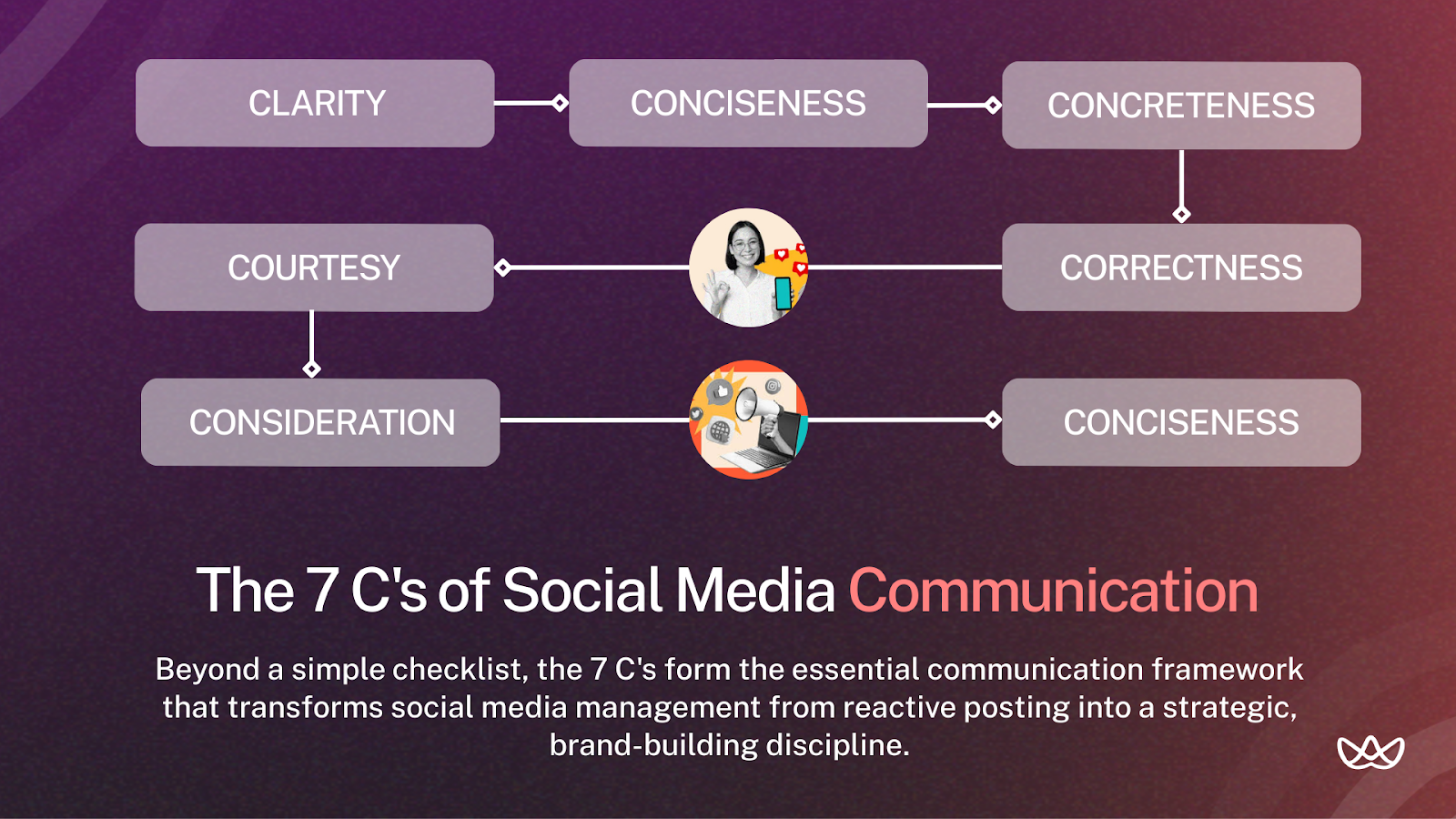
The 7 C's of Social Media Communication are a foundational framework used by top social media managers to ensure every interaction is strategic, professional, and impactful. Adhering to these principles helps maintain brand credibility and fosters meaningful audience engagement:
1. Clarity
Messages must be immediately understandable. In a fast-scrolling feed, you have seconds to convey your point. Avoid industry jargon unless your audience specifically expects it.
Clear communication reduces confusion, prevents misinterpretation, and ensures your audience knows exactly what you mean, which dramatically increases engagement.
2. Conciseness
Social media platforms are built on brevity. Algorithms and audience attention spans reward messages that get straight to the point. Removing filler words and redundant phrases ensures your message has maximum impact without diluting its core value, respecting the audience's time and attention.
3. Concreteness
General statements fall flat. High-impact communication uses specific details, numbers, examples, and tangible benefits rather than vague claims.
For example, "We increased engagement by 45%" is far more concrete and compelling than "We improved our engagement a lot." Concreteness builds trust and makes claims more believable.
4. Correctness
Grammar, spelling, and factual accuracy are non-negotiable. Errors undermine professional credibility and erode trust in your brand's authority. A key duty of a social media manager is to always verify information before posting and thoroughly proofread all copy.
5. Courtesy
A professional and respectful tone is essential for building a positive community around your brand. This applies especially to handling negative feedback or complaints. Engaging with courtesy, empathy, and grace builds community trust and prevents social media interactions from escalating into a public relations crisis.
6. Consideration
Effective communication is audience-centric. It requires understanding your audience's perspective, needs, and preferences. A manager must consider what the audience gains from a post - creating content that serves them, not just pushing a brand's objectives. This builds genuine rapport and loyalty.
7. Completeness
While conciseness is key, completeness ensures the audience has enough information to take the desired next action. This includes providing necessary context, relevant links, clear calls-to-action, or instructions. A complete message empowers the audience to move forward in their journey with your brand.
Qualifications and Experience Requirements
A qualified social media manager requires 3-5+ years of experience with a portfolio proving quantifiable ROI (leads, ROAS, engagement), moving beyond vanity metrics. Essential technical skills include proficiency in analytics platforms (Google Analytics, Meta Insights), scheduling tools, and ad managers. Crucial soft skills for success in a remote environment are exceptional written communication, autonomy, data interpretation, and adaptability.
Educational Background (What Actually Matters)
Educational background matters less than what a candidate can actually do. A degree in marketing or communications can help, but it doesn’t guarantee effective performance.
What counts are proven results on real accounts, solid understanding of platform mechanics, and consistent execution.
Relevant Certifications & Practical Training
Certifications that add credibility:
- Meta Blueprint Certification.
- HubSpot Social Media Marketing.
- Hootsuite Platform Certification.
- Google Analytics Certification.
- TikTok Academy completion.
Certifications indicate baseline knowledge but do not replace portfolio evidence.
Agency Experience vs. In-House vs. Freelance Background
Candidates with agency, in-house, or freelance experience develop different ways of working. Which background fits best depends on your team and how you operate day to day.
Agency experience: Candidates understand multi-client workflows, tight deadlines, and brand switching. Strong preparation for agency roles.
In-house experience: Deep knowledge of single brand, often more strategic involvement. May need adjustment to agency pace.
Freelance experience: Self-management skills and diverse exposure. Verify consistency and ability to work within team structures.
Years of Experience by Level
Experience level generally indicates how much autonomy and oversight a social media manager requires. Junior managers focus on execution with guidance, mid-level can manage campaigns more independently, and senior managers handle strategy and mentor others while requiring minimal supervision.
Salary Expectations in 2026
Salary expectations for social media managers vary based on the hiring model you choose (in-house/US remote vs. offshore remote) and the candidate's experience level.
U.S. in-house roles typically pay the most, while LATAM full-time hires offer a more cost-effective option with comparable skills. Freelance and offshore options provide flexibility but may have variable rates or asynchronous workflows.
How Seniority, Skill Depth & Industry Impact Pay
Experience level, specialized expertise, and the industry a social media manager works in all play a major role in determining their pay.
- Seniority adds 20-40% per level jump.
- Specialized platform expertise (TikTok, LinkedIn B2B) commands premiums.
- Regulated industries (healthcare, finance) pay more for compliance knowledge.
- Video editing and paid social skills increase rates 10-20%.
Full-Time vs Freelance vs Agency Billing Rates
Full-time social media managers give you predictable costs and full-time focus on your accounts. Freelancers offer flexibility and the ability to scale up or down quickly, but their availability can be inconsistent.
Agencies can handle end-to-end social media management, but their billing usually runs 2-3 times higher than hiring an individual because of overhead and built-in margins. Choosing the right model depends on your budget, desired control, and how critical social media is to your operations.
Why LATAM Has Become a Competitive Talent Market
LATAM has become a strong option for social media talent because it offers time zone overlap with North America, cost savings, and a growing pool of skilled professionals. You can collaborate in real time and reduce salaries by 40-60% compared to U.S. hires, while maintaining quality.
Cultural alignment and improving digital infrastructure make it easier for LATAM managers to integrate into U.S.-based teams for full-time, long-term roles.
Career Path & Growth Opportunities
Career paths for social media managers typically involve moving up the leadership track from Specialist to Director/CMO, specializing horizontally into high-demand areas like Paid Media or Analytics, or launching their own freelance consultancy or agency.
In 2026, top growth opportunities include mastering AI tools, producing effective short-form video, and building cross-functional business skills to increase impact and career value.
Social Media Manager Career Progression
Social media managers have several clear pathways for career progression, depending on whether they wish to move into leadership, specialize in a niche area, or become an entrepreneur.
1. Leadership Track
This is the traditional corporate path, involving increased responsibility and team management:
- Coordinator/Specialist: Entry-level content and scheduling.
- Manager: Handles strategy, content, analytics, campaigns.
- Director/Head: Oversees budgets, strategy, and team.
- VP/CMO: Leads all marketing operations.
2. Specialization Track
Managers can choose to become highly valued experts in specific, high-demand areas:
- Paid Social Strategist: Manages paid campaigns.
- Social Media Analyst: Focuses on data and ROI.
- Community Manager: Builds brand communities.
- Content Marketing Manager: Guides cross-channel content strategy.
3. Entrepreneurial Track
Many experienced managers transition into running their own businesses:
- Freelance Consultant: Provides strategy and execution independently.
- Agency Owner: Runs a social media management agency.
Upskilling Paths for Long-Term Success
Upskilling is crucial for a social media manager's long-term success due to rapid changes in algorithms, AI, and audience behavior. Effective upskilling paths should focus on high-impact areas that provide a competitive advantage and career progression opportunities.
Skills that accelerate advancement:
- Paid social advertising expertise.
- Video production and editing.
- Data analysis and visualization.
- AI tool mastery.
- Client presentation and relationship management.
Sample Social Media Manager Job Description (Copy-Ready)
You can use the template below as a ready-to-go job description or adapt it to match your team’s structure and expectations
Remote Social Media Manager
Location: Remote (U.S. or strong time zone overlap)
Company: [Your Company Name]
Employment Type: Full-Time
Compensation: [$55k - $75k Annually]
The Opportunity
We need a results-oriented Remote Social Media Manager to own our brand presence and drive measurable ROI. This isn't just about posting; it's about strategy, data analysis, and generating leads.
Key Responsibilities
- Strategy & Growth: Develop and execute data-driven social strategies across relevant platforms (e.g., LinkedIn, Instagram, TikTok).
- Content & Engagement: Create high-quality content and manage community interactions effectively.
- Analytics & Optimization: Define KPIs, track metrics, and use data to optimize campaigns for conversions and ROI.
- Paid Social: Manage and optimize paid advertising campaigns to drive targeted leads and sales.
Required Qualifications
- Experience: 3+ years managing business social media with proven, quantifiable results (leads, sales, ROAS).
- Skills: Expertise in analytics tools (Google Analytics, Meta Insights), ad managers, and content creation tools (Canva, Buffer).
- Attributes: Highly autonomous, excellent written communicator, and self-motivated with a focus on outcomes over activity.
Why Join Us?
We offer a flexible, results-oriented culture committed to growth. [List 1-2 specific benefits, e.g., Flexible PTO, health insurance].
How to Apply
Send your resume and a brief note to [Email/Link]. Crucially, include links to past campaigns you managed and the specific results achieved.
Related Job Descriptions
The template above is for a generalist Social Media Manager role, a common hire for many agencies and startups.
Crucially, the job description must change if you are hiring for a specialized role.
While related, titles like "Senior Manager," "Community Manager," or "Paid Social Specialist" require vastly different emphasis on responsibilities and qualifications. Use the guide below to understand how the focus shifts for each specific position to ensure you attract the right talent:
The key takeaway: Ensure your "Responsibilities" and "Required Qualifications" sections are highly specific to the exact duties of the role you are filling. A great community manager may not be a great paid ads specialist, and your job description needs to reflect that distinction.
Getting Started
LATAM social media managers offer agencies a practical solution to common hiring challenges. Time zone alignment enables real-time collaboration. Cost efficiency allows hiring experienced talent within budget constraints. Agency backgrounds mean faster ramp-up and familiarity with multi-client workflows.
The social media manager job description has expanded significantly, but the talent to fill these roles exists. Understanding what to look for in skills, experience, and qualifications helps you find the right fit.
Start scaling your social media team by hiring vetted LATAM managers with Floowi. Book your free consultation today.
Frequently Asked Questions
What Should a Social Media Manager Job Description Include?
A strong job description must include clear, measurable KPIs (Key Performance Indicators) and a focus on outcomes over hours logged. Essential elements are: specific responsibilities (strategy, content, analytics, ads), required technical skills (analytics/ad tools), soft skills (autonomy, communication), salary expectations, and a call for a portfolio demonstrating quantifiable ROI.
How Do Responsibilities Differ Between Agency and In-House Social Media Managers?
Agency Managers juggle multiple clients, focusing on efficiency, rapid iteration, and immediate, measurable results (ROI, lead gen).
In-House Managers focus on deep brand immersion, long-term community building, and cross-functional collaboration across internal departments (sales, product, etc.).
What Are the Key Duties and Responsibilities of a Social Media Manager?
Key duties include strategy development, content creation (copy, visuals), community management (engagement, moderation), data analysis (tracking KPIs, optimizing), and often paid advertising (managing ad spend and campaigns).
How Do Social Media Managers Directly Impact Client Retention?
Social media managers impact retention by proactively managing brand reputation, providing prompt customer service through social channels, fostering community and loyalty, and gathering feedback that helps improve the product or service, ultimately increasing customer satisfaction.
What Technical Skills Are Non-Negotiable in 2026?
Non-negotiable skills in 2026 include proficiency in Google Analytics 4 (GA4), advanced expertise in paid social media ad platforms (Meta Ads Manager), familiarity with AI tools for efficiency, and strong data visualization capabilities.
How Do Analytics Skills Translate Into Measurable Business Impact?
Strong analytics skills allow managers to translate data into actionable business insights. They can identify which strategies drive leads, optimize ad spending to reduce CPA, measure ROI effectively, and justify budget allocation with hard numbers, directly impacting the bottom line.
What Creative Skills Set Candidates Apart in Agency Environments?
Beyond basic design (Canva), skills that set candidates apart in fast-paced agencies include strong short-form video production (TikTok/Reels), compelling storytelling ability, and the capacity to adapt creative concepts quickly across diverse industries and client needs.
How Does Agency Experience Differ from Freelance Backgrounds?
Agency Experience: Develops speed, organization, and a wide range of industry knowledge through managing multiple clients.
Freelance Background: Cultivates strong autonomy, self-motivation, ownership, and adaptability, as they manage their own business and workflow (ideal for remote roles).
How Do Coordinators Transition Into Social Media Managers?
Coordinators transition into management by moving from execution-focused tasks (scheduling, basic engagement) to strategic planning, managing data analytics and ROI reporting, and eventually leading campaigns and potentially junior team members. Upskilling in strategy and analytics is crucial.
What Does Social Media Manager Career Progression Look Like?
Career progression typically moves from Coordinator to Manager, then to Director of Social Media or Head of Marketing. Other paths involve specialization in areas like Paid Media or Analytics, or launching their own freelance consultancy or agency.
How Do U.S. Salaries Compare to LATAM Compensation Ranges?
LATAM full-time rates typically run 40-60% lower than US equivalents for comparable experience levels. A mid-level SMM costing $60K in the US might cost $30-40K through LATAM hiring.


