

%20-%20With%20Hiring%20Examples.png)




Social media manager responsibilities in 2026 span far more than posting content and replying to comments. Hiring managers evaluating candidates need to understand the full scope: AI-assisted content workflows, multi-platform coordination, crisis response, and data-driven strategy execution.
Algorithm requirements across Instagram, TikTok, and LinkedIn demand faster adaptation cycles than ever. Community engagement drives reach more than posting frequency alone. The managers who deliver results combine creative execution with analytical skills and can switch between brand voices without losing quality.
For agencies managing multiple clients, finding talent who operates at this level remains one of the harder hiring challenges. Many now hire vetted LATAM social media managers to get multi-brand execution and U.S. time zone coverage at better rates.
This guide breaks down the key social media manager responsibilities companies must evaluate in 2026.
What a Social Media Manager Actually Does for Agencies & Growing Companies
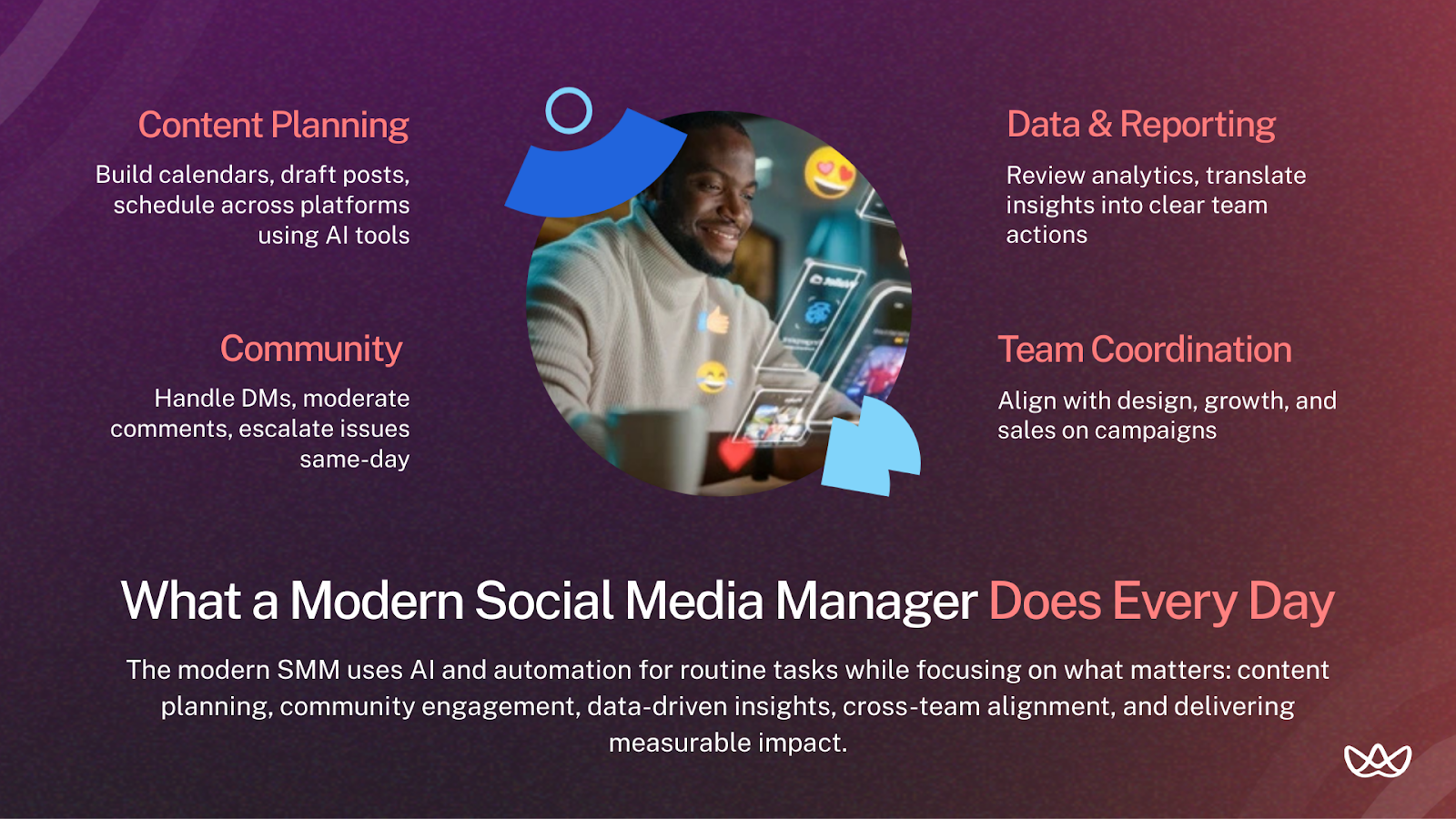
A social media manager (SMM) is responsible for building and maintaining a company's brand presence and engaging with its audience across various social media platforms. The role is dynamic and typically includes strategic planning, content creation, community engagement, data analysis, and project management. It’s also shifting from manual content handling to a more strategic function, where the SMM uses AI to automate routine tasks so they can focus on higher-level strategy, data interpretation that requires judgment, and steady, authentic community building.
What a Social Media Manager Is (Modern Definition)
A modern social media manager manages a brand’s presence across social platforms, combining content planning, posting, community management, and basic reporting. The role has shifted from purely manual posting to using automation and AI tools for routine tasks, while the manager focuses on reviewing content, interpreting data, and maintaining consistent brand voice.
Core responsibilities include:
• Building and maintaining content calendars
• Drafting or refining posts, including AI-generated first passes
• Preparing assets and scheduling across platforms
• Managing comments, messages, and escalations
• Reviewing analytics from platform dashboards and AI tools
• Translating data into clear next steps for the team
• Coordinating with design, growth, and sales
• Supporting campaigns and basic paid optimization work
The SMM’s main role is to ensure daily social activity aligns with the brand and supports business goals, while using tools to make routine work more efficient.
Evaluate the Role for Hiring Managers
When assessing social media manager candidates, focus on four key areas:
- Output quality: Are their posts polished, on-brand, and well-structured?
- Execution speed: Can they meet deadlines reliably across platforms?
- Communication clarity: Do they explain ideas and report results clearly?
- Consistency over time: Do they deliver steady results rather than occasional successes?
A strong candidate should have a portfolio showing measurable results across multiple platforms. Look for examples where they adapted content for different audiences without losing the brand voice.
Strategic thinking is another important factor. Ask yourself:
- Did they only post content, or did they create systems to manage content efficiently?
- Can they explain why certain content worked and others didn’t?
- Do they understand that social media success comes from sustained engagement, not one-off viral posts?
Why This Position Impacts Client Results & Revenue
Social media managers influence customer acquisition cost, brand perception, and retention. A manager can support CAC management by building organic reach. They help maintain brand reputation by addressing negative comments or issues promptly. They also contribute to retention by keeping existing customers engaged through consistent content.
For agencies, this often affects client satisfaction and contract renewals. Clients notice when their social presence consistently supports leads, maintains reputation, and aligns with sales activity. The value of a social media manager is reflected in steady, practical outcomes rather than follower counts or other superficial metrics.
Core Social Media Manager Responsibilities
Assess Content Planning & Scheduling
Content planning separates reactive social media management from strategic execution. A capable manager builds editorial calendars that align with business objectives, seasonal trends, and audience behavior patterns. They understand that posting randomly generates random results.
When evaluating candidates, look for evidence of systematic planning. Ask to see past content calendars. Check whether their posting schedules reflect an understanding of platform-specific best practices. A strong candidate can explain why they chose specific content types for specific days and how that ties to KPIs.
• Do they use scheduling tools consistently (Later, Hootsuite, Metricool)?
• Can they show how content themes align with campaign goals?
• Do they plan for platform algorithm requirements (posting frequency, optimal times)?
• Is there evidence of A/B testing different content approaches?
Verify Platform Management & Engagement
Platform management covers the daily work of maintaining a brand's social presence. This includes publishing content on schedule, responding to direct messages, moderating comments, and escalating issues when necessary. Excellence in this area means fast response times, on-brand communication, and consistent quality across interactions.
Excellent execution looks like this: DMs answered within 2-4 hours during business hours. Comments that require responses addressed same-day. Negative feedback handled professionally with appropriate escalation. Community members feel heard and valued. The brand voice remains consistent whether the manager is posting a celebration or handling a complaint.
Hiring managers should request examples of engagement work. Look at how candidates have handled difficult situations. Check whether they maintained professionalism under pressure. The best managers build systems for engagement that scale rather than relying on ad hoc responses.
Assess Analytics & Reporting
Analytics and reporting transform social media from a guessing game into a measurable channel. A skilled manager tracks the metrics that matter: reach, engagement rate, saves, shares, click-through rate, and conversion metrics where tracking allows. They synthesize this data into actionable insights.
The key metrics to evaluate competency include: understanding of platform-specific analytics (Instagram Insights, TikTok Analytics, LinkedIn Analytics), ability to calculate and interpret engagement rates, familiarity with CPM and cost metrics for paid integration, and experience creating reports that leadership can actually use.
Ask candidates to walk you through a report they created. How did they decide which metrics to highlight? What recommendations did they make based on the data? Did leadership act on those recommendations? The answers reveal whether someone is data-fluent or just data-adjacent.
Evaluate Community Building & Moderation
Community building goes beyond responding to comments. It involves cultivating an audience that actively engages with and advocates for the brand. Strong community managers identify power users, encourage user-generated content, and create spaces where meaningful conversations happen.
Moderation skills protect the brand from risk. This includes recognizing and handling trolls, managing sensitive topics appropriately, and knowing when to escalate issues to leadership or legal. A single mishandled situation can generate significant negative press, so these skills directly impact brand safety.
During interviews, present hypothetical scenarios. How would they handle a viral complaint? What is their process for deciding whether to delete, hide, or respond to a negative comment? Their answers reveal both judgment and experience.
Assess Campaign Development & Execution
Campaign development requires coordination across creative, strategy, and execution. A capable social media manager can take a campaign brief, develop platform-specific content plans, coordinate with designers and copywriters, and execute the launch on schedule. They own the social component of campaigns from concept to completion.
Speed matters in campaign work. Social media moves fast, and the ability to turn around campaign assets quickly without sacrificing quality distinguishes strong candidates. Ask about their typical turnaround times. What is their process for rapid creative iteration?
• Campaign planning and creative briefing capabilities.
• Cross-functional approval flow management.
• Launch timeline coordination and execution.
• Post-campaign analysis and reporting.
Evaluate Collaboration & Cross-Functional Alignment
Social media managers rarely work in isolation. They collaborate with graphic designers on visual assets, copywriters on messaging, growth teams on acquisition strategies, and sometimes sales teams on demand generation content.
Strong collaboration supports better output and smoother workflows. When evaluating candidates, consider:
- Can they give clear creative direction to designers?
- Do they provide constructive feedback to teammates?
- Can they adapt when resources or priorities change?
Verify Content QA & Editing
Content quality assurance ensures brand standards are maintained and mistakes are caught before publishing. A solid QA process addresses grammar, tone, formatting, and compliance issues. In regulated industries, this responsibility is especially important.
A thorough QA checklist may include:
- Grammar and spelling checks
- Alignment with brand voice
- Visual consistency across posts
- Proper hashtag usage and link functionality
- Legal disclaimers where required
- Accessibility considerations
When interviewing candidates, ask about their quality control process and examples of mistakes they’ve caught before publication.
Assess Cross-Platform Asset Management
Organizing content assets efficiently is essential, especially when managing multiple brands or campaigns. Poor asset management can lead to wasted time, outdated content being used, or confusion among team members.
Evaluate candidates on how they handle:
- File naming conventions (e.g., Brand_Platform_Date_Version)
- Folder structure organization
- Version control and updates
- Tools used for asset storage and retrieval
Candidates with agency experience often have stronger systems because they have managed multiple clients and complex campaigns simultaneously. Ask them to describe their approach and examples from past work.
Advanced Responsibilities Modern Teams Expect in 2026
1. Evaluate AI-Assisted Workflows & Automation
AI integration has become a standard expectation in 2026. Social media managers now use ChatGPT and similar tools for caption drafts, content ideation, and research. They leverage automation for scheduling, reporting, and repetitive tasks. The goal is not to replace human creativity but to amplify it.
When evaluating candidates, consider:
- Do they use AI tools for first drafts and refine content for brand standards?
- Can they set up automation workflows to improve efficiency while maintaining quality?
- Are they keeping up with new tools and updates relevant to their workflow?
2. Assess Trend-Spotting & Rapid Creative Adaptation
Social platforms reward timely, trend-relevant content. A skilled manager monitors emerging trends through tools like TikTok Creative Center, TrendTok, and platform-native trend sections. More importantly, they know how to adapt trends to fit brand voice and objectives quickly.
Evaluation points:
- Can the candidate identify which trends are relevant to the brand?
- How do they adapt trends without compromising brand consistency?
- Can they provide examples of trends they acted on and trends they chose not to pursue?
3. Evaluate Multi-Brand & Multi-Platform Coordination
Agency social media managers often handle 4 to 10 brands simultaneously. This requires strong organizational systems, clear switching between brand voices, and efficient workflows that prevent cross-contamination. A single wrong post on the wrong account can damage client relationships.
Key assessment questions:
- How do they keep brand voices separate across platforms?
- What systems do they use to prevent errors when managing multiple accounts?
- Can they provide examples of maintaining quality across several clients?
4. Assess Crisis Communication & Brand Protection
Crisis communication skills protect brands when things go wrong. This includes recognizing early warning signs of potential issues, having prepared response templates, knowing escalation procedures, and documenting incidents for future prevention. In social media, problems escalate in hours, not days.
Evaluation approach:
- Ask scenario-based questions about potential crises.
- How would they respond to a product issue or coordinated negative campaign?
- At what point would they involve leadership?
5. Evaluate Strategic Audience Segmentation & Persona-Based Content
Effective social media requires understanding different audience segments and tailoring content accordingly. Examples include:
- Cold audiences unfamiliar with the brand
- Warm audiences who engage but do not convert
- Existing customers
- Brand advocates
Assessment points:
- Can candidates show examples of content created for different segments?
- Do they understand how content performance varies by audience type and platform algorithm behavior?
Why LATAM Talent Performs Well in Execution, Speed & Multi-Brand Management
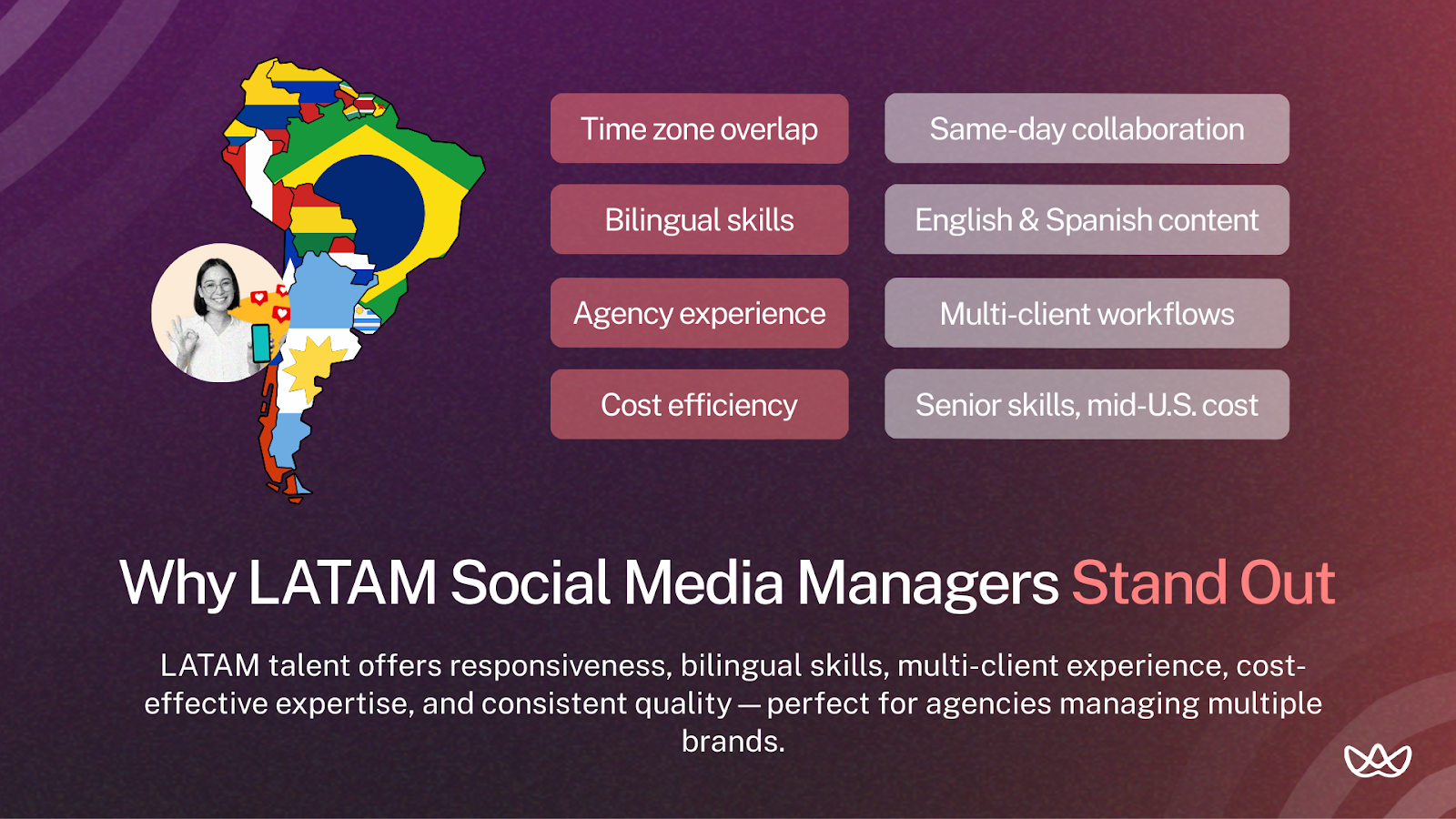
LATAM social media managers bring specific advantages to agency environments. Time zone alignment with U.S. markets enables real-time collaboration and same-day response times. Bilingual capabilities open opportunities for Spanish-language content and Hispanic audience targeting.
Cultural familiarity with American brand expectations reduces onboarding friction. LATAM social media talent often comes from agency backgrounds where multi-brand management is standard practice.
The cost structure also favors LATAM hiring. Agencies can access senior-level talent at rates that would only afford junior talent domestically. This is not about finding cheap labor but about finding excellent value. Many LATAM professionals have worked with U.S. clients for years and understand American marketing expectations thoroughly.
Essential Skills & Qualifications
Evaluate Technical Skills Hiring Managers Should Prioritize
Technical skills are the foundation of effective social media management. Focus on candidates who can show proficiency in the following areas:
- Platform-native tools: Meta Business Suite, TikTok Business Center, LinkedIn Campaign Manager.
- Scheduling and management tools: Hootsuite, Later, Buffer, Metricool, Sprout Social.
- Design basics: Canva, basic Photoshop, or Figma understanding.
- Analytics platforms: Google Analytics 4, native platform analytics, Looker or similar.
- Paid advertising basics: Boosted posts, ad objectives, audience targeting.
- AI tools for content assistance: ChatGPT, Jasper, or similar.
Assess Soft Skills Indicating Cultural Fit & Long-Term Potential
Soft skills determine whether a technically capable candidate will succeed in your environment. Key traits include:
- Adaptability: Platforms and algorithms change constantly.
- Proactive communication: Prevents small issues from becoming bigger problems.
- Ownership mindset: Treats client accounts with care and responsibility.
During interviews, observe how candidates interact:
- Do they ask questions about your specific challenges?
- Can they describe how they handled ambiguity in past roles?
- Are they comfortable giving and receiving constructive feedback?
These behaviors often predict long-term fit more reliably than resume entries or certifications.
Verify Certifications & Training That Matter in 2026
Certifications vs Real Portfolio Impact
Certifications from Meta Blueprint, HubSpot, Hootsuite, and similar platforms show baseline knowledge and a willingness to learn. However, practical experience and measurable results are more important. A candidate with no certifications but a strong portfolio typically performs better than someone with multiple certificates but little hands-on work. Use certifications as a tiebreaker, not a primary filter.
Tools Mastery: Meta Business Suite, TikTok Creative Center, Hootsuite, Metricool, and More
Evaluate candidates through practical demonstrations rather than self-reported skills. Ask them to:
- Walk through setting up a campaign in Meta Business Suite
- Demonstrate reporting in their preferred analytics tool
- Explain their workflow in scheduling software
Other key checks:
- Can they navigate Meta Business Suite without guidance?
- Do they know TikTok Creative Center’s trend discovery features?
- Can they build and export reports from analytics tools?
- Do they have experience with Canva or similar design tools?
When to Hire Junior, Mid-Level, or Senior Talent
The right seniority level depends on your existing team structure, workflow maturity, and supervision capacity. Junior talent (0-2 years) works well when you have strong processes and can provide regular guidance. They execute tasks but need direction on strategy. Mid-level talent (2-5 years) can work more independently and handle campaigns with less oversight. Senior talent (5+ years) can lead strategy, mentor others, and handle complex multi-brand situations autonomously.
Evaluate When Companies Need a Strategist vs. an Executor
Not every hire needs to be a strategist. Consider your existing workflow:
- If content direction and campaign approval are already managed, hiring for execution speed and quality may suffice.
- If strategic roles are unfilled, prioritize candidates who can shape strategy.
Being clear about your actual needs ensures you hire for the skills your team requires.
What Agencies Can Expect From Vetted LATAM Social Media Managers
Agencies working with vetted LATAM talent through Floowi’s social media manager hiring solutions can expect:
- Familiarity with U.S. market standards.
- Clear English communication.
- Work during overlapping business hours.
- Agency experience with multi-client management.
- Comfort with fast turnaround and consistent quality.
Why Agency Experience Is a Strong Advantage for Offshore Candidates
Candidates with agency backgrounds understand multi-client environments, tight deadlines, and variable workloads. They have experience switching between brand voices quickly and managing competing priorities. This translates directly to offshore roles where they serve multiple accounts or brands.
Agency experience also indicates familiarity with performance pressure. These candidates know what it means to deliver results that keep clients happy. They understand the business impact of their work beyond just creative satisfaction.
Assess Strengths & Limitations of In-House Backgrounds
In-house experience brings deep brand knowledge and often more strategic involvement. These candidates may have participated in broader marketing planning and understand how social fits within overall business objectives. However, they might struggle with the pace and variety of agency work initially.
When hiring in-house backgrounds for agency roles, evaluate adaptability carefully. Can they handle multiple brands? Are they comfortable with faster turnaround expectations? The transition is manageable but requires the right mindset.
Evaluate Freelance Experience: When It's a Plus & When It's a Risk
Freelance experience demonstrates entrepreneurial initiative and self-management skills. These candidates know how to deliver without supervision. However, freelance backgrounds can also indicate inconsistency. Some freelancers struggle with team environments or structured workflows.
Evaluate freelance candidates on their longest client relationships and most structured work. Did they maintain retainer clients over extended periods? Have they worked within agency processes before? The answers differentiate freelancers who will thrive in your environment from those who will chafe at structure.
Why Nearshore Social Media Managers Outperform Freelancers in Consistency & Execution
Nearshore professionals working through established partners offer advantages over ad hoc freelancer arrangements. Time zone alignment enables real-time collaboration. Vetting processes ensure consistent quality. Backup coverage prevents single-point-of-failure risks. Bilingual capabilities open additional market opportunities.
The consistency factor matters significantly. Freelancers can disappear, take on conflicting clients, or become unavailable during critical periods. Nearshore talent through proper channels comes with accountability structures that protect your operations.
Salary Expectations & Market Trends in 2026
Average Salaries by Region (U.S. vs LATAM):
Salaries for social media managers vary widely by region, experience, and seniority. U.S.-based talent generally commands higher rates, reflecting local market standards, while LATAM professionals offer comparable skills at lower cost. Understanding these ranges helps agencies and companies plan budgets, set competitive offers, and align expectations with the candidate’s experience level
Factors That Influence Offshore & Remote Social Media Manager Rates
Several factors affect what you will pay for offshore social media talent. Seniority and years of experience remain the primary drivers. Platform specialization matters as well, with TikTok experts commanding premiums in 2026. Industry vertical experience (healthcare, finance, tech) increases rates due to specialized knowledge requirements. Tool proficiency, particularly with paid advertising platforms, adds value.
English fluency levels also impact pricing. Native-level English speakers cost more than those with professional proficiency. Consider whether native fluency is actually necessary for your specific needs or if professional-level communication suffices.
How to Write a Job Description That Attracts Strong Candidates
Evaluate Clear Responsibilities to Include:
Job descriptions should clearly define:
- Platforms managed (Instagram, TikTok, LinkedIn, etc.)
- Posting frequency (e.g., X posts per week per platform)
- Reporting requirements (weekly or monthly analytics)
- Collaboration expectations (e.g., working with designers, attending meetings)
Assess Required Skills & Experience That Filter the Right Talent:
Focus on skills that truly affect performance. For example:
- Instead of “strong communication,” specify “ability to write on-brand captions in multiple tones.”
- Separate required skills from preferred qualifications to attract candidates who meet actual needs.
Verify Portfolio Expectations & Evaluation Steps
Clarify what candidates should include:
- Links to live accounts.
- Screenshots of analytics.
- Campaign case studies.
Consider short practical assignments (under two hours) to evaluate real working style:
- Writing captions for sample products.
- Creating a one-week content calendar.
- Analyzing a brand’s social presence and suggesting improvements.
Highlight Key Responsibilities for Algorithm-Proof Execution
Emphasize systematic workflows rather than platform-specific tactics. Focus on:
- Building engaged communities
- Creating shareable content
- Developing repeatable testing and optimization approaches
These capabilities remain relevant even as algorithms evolve.
Your Next Step
Social media managers who perform well in 2026 think strategically, execute reliably, and adapt as platforms change. Agencies need someone who can manage multiple brands without losing quality, respond same-day, and take real ownership of client accounts.
LATAM talent fits these needs effectively:
- Time zone overlap enables same-day collaboration.
- Bilingual skills support English and Spanish content.
- Agency experience ensures familiarity with multi-client workflows.
- Lower cost than U.S. market rates.
If you're looking to hire vetted offshore Social Media Managers in LATAM, Floowi connects agencies with bilingual, experienced talent in under 15 days. Book your free consultation today.
Frequently Asked Questions
What Do Social Media Managers Actually Do Day to Day?
Daily work includes scheduling and publishing content, responding to comments and messages, monitoring brand mentions, reviewing analytics, and coordinating with team members on upcoming campaigns. The exact mix varies by role but combines creative execution with community management and data analysis.
How Do Agencies Measure the Value of a Social Media Manager's Responsibilities?
Agencies typically measure value through engagement rates, follower growth, content production volume, response times, and client satisfaction scores. Advanced agencies also track pipeline influence, lead generation from social, and brand sentiment changes over time.
Which Responsibilities Matter Most in 2026?
Community building and engagement have become increasingly important as organic reach declines. AI workflow integration enables efficiency gains. Crisis communication skills protect against escalating brand risks. Multi-platform coordination remains essential as audiences fragment across channels.
What Technical Skills Are Non-Negotiable in 2026?
Proficiency with native platform tools (Meta Business Suite, TikTok Business Center) is essential. Competency with at least one scheduling platform is expected. Basic analytics interpretation and reporting capabilities are required. Familiarity with AI assistance tools has become standard.
How Do Responsibilities Shift Between Campaign & Always-On Content?
Campaign work involves intensive planning, cross-functional coordination, and deadline-driven execution. Always-on content requires consistent quality maintenance, community nurturing, and ongoing optimization. Strong managers balance both modes effectively.
How Do Managers Handle Algorithm Changes Across Multiple Platforms?
Effective managers monitor industry news, test new formats proactively, and build diversified content strategies that do not depend on single platform features. They adapt quickly when changes occur rather than complaining about reduced reach.
How Do Managers Build Authentic & Safe Online Communities?
Community building requires consistent engagement, clear moderation guidelines, encouragement of user participation, and authentic brand personality. Safety comes from established escalation procedures, proactive monitoring, and clear policies for handling negative situations.
What Strengths Do Vetted LATAM Social Media Managers Bring to Agencies?
LATAM professionals offer time zone alignment with U.S. markets, bilingual capabilities, cultural familiarity with American brands, cost efficiency, and often strong agency backgrounds with multi-client experience. Many have worked with U.S. clients for years.


