

%20U.S.%20vs%20LATAM%20Pay%20Guide.png)




Hiring social media talent changed a lot these past few years. Teams need people who can manage content, engage audiences, and keep campaigns running smoothly, but budgets haven’t kept up. U.S. salaries keep rising, while LATAM markets offer skilled managers with strong English and platform knowledge at much lower costs.
Agencies and startups now compare both regions before making offers. It’s not about the cheapest option, but controlling costs without lowering quality. LATAM social media managers typically cost 40-60% less while delivering the speed and collaboration U.S. teams expect. That’s why nearshore hiring has become a standard choice.
Let’s break down 2026 salary ranges, hourly rates, and key factors so you can plan your team and hire with confidence.
What Does a Social Media Manager Do?
A social media manager plans, creates, and oversees content across platforms like Instagram, LinkedIn, TikTok, and Facebook. They handle posting schedules, engagement, analytics, and campaign execution to build brand presence and drive business results.
Responsibilities expand with experience, which directly impacts salary brackets.
Key responsibilities and Scope for Global Teams
Most social media managers working with U.S. companies handle:
- Content calendar planning and daily posting.
- Community management and response monitoring.
- Paid social campaign setup and optimization.
- Performance tracking through analytics, with AI sometimes used for insights.
- Collaboration with designers, copywriters, and marketing leads.
- Trend identification and competitive analysis.
- Brand voice consistency across all channels.
The role expands for senior managers who also develop strategy, manage budgets, and coordinate cross-functional teams.
Essential Skills for High-Performing SMMs
Effective social media managers combine creative and analytical abilities. They write clear captions, coordinate with designers, and use platforms like Meta Ads Manager, Hootsuite, or Sprout Social.
Data literacy is key - they interpret metrics and adjust campaigns based on performance. Familiarity with AI tools for content suggestions, scheduling, or basic analytics can improve efficiency. Bilingual ability adds value for brands targeting diverse audiences.
Compare Social Media Manager Salaries: U.S. vs LATAM
Salaries for social media managers differ sharply between the United States and Latin America, largely due to variations in cost of living and local market conditions. U.S. companies can often save 50-60% by hiring experienced remote talent from LATAM without compromising quality or communication.
U.S. Salary Ranges for Social Media Managers
In the United States, salaries vary by experience and location. Entry-level roles typically start at $40,000-$55,000, with higher starting salaries in larger coastal cities.
Mid-level professionals with 3-5 years of experience generally earn $60,000-$85,000, while senior managers or team leads can make $90,000-$130,000. Freelancers charge differently, with hourly rates ranging from $50-$150 depending on skills and portfolio strength.
LATAM Salary Ranges (Mexico, Colombia, Argentina, Brazil)
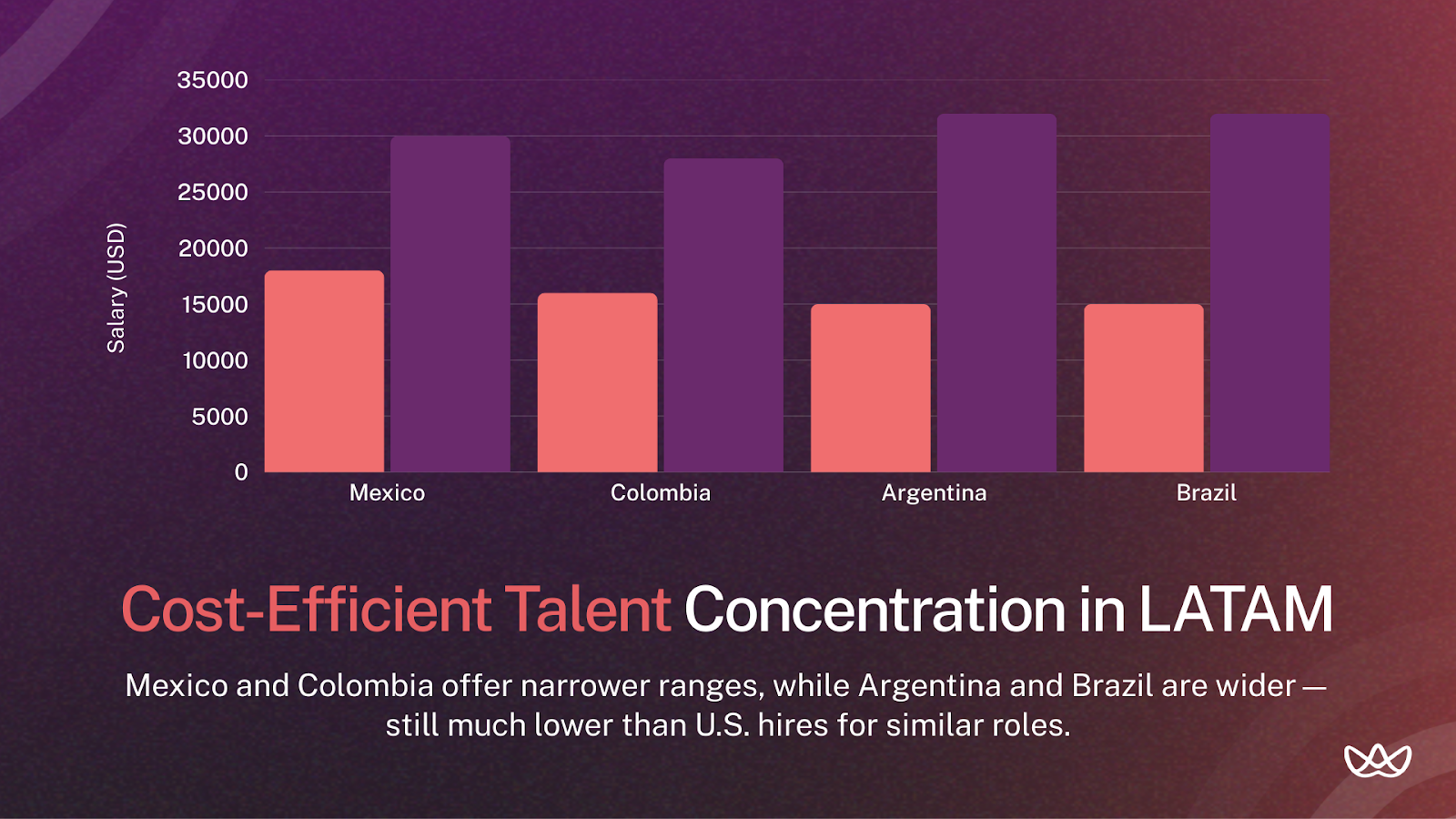
LATAM markets provide experienced social media managers at a lower cost. In Mexico, mid-level roles range from $18,000-$30,000, and Colombia is similar at $16,000-$28,000.
Argentina and Brazil fall in the $15,000-$32,000 range depending on experience and market. These salaries reflect local purchasing power and cost structures, offering professionals competitive compensation while remaining cost-efficient for U.S. employers.
Compare Full-Time vs Freelance Salary Differences
Full-time employees receive consistent monthly pay and benefits, such as health insurance, while freelancers bill hourly or per project without benefits. U.S. freelancers may gross higher amounts, but must cover their own taxes and insurance.
LATAM freelancers typically charge $20–$45/hour, and full-time hires through compliant employer-of-record services cost significantly less than U.S. equivalents.
Why U.S. Companies Hire SMMS in LATAM
U.S. companies hire social media managers in Latin America to take advantage of lower costs, overlapping time zones, and access to trained, bilingual professionals. This is called nearshoring and can be more practical than hiring locally or in distant regions.
The primary reasons are:
- Lower costs: Salaries 50-70% below U.S. levels.
- Time zones: Close overlap with U.S. working hours.
- Skilled workforce: Training in social media and analytics.
- English: Many speak English and understand U.S. business norms.
- Cultural fit: Shared business practices reduce misunderstandings.
- Scalability: Teams can be expanded without local logistics.
Benchmark Salary by Experience Level
Social media manager pay grows with experience. Entry-level roles need supervision, mid-level handle work independently, and seniors lead teams and budgets. LATAM salaries are lower than U.S. ones but still cover similar skills and responsibilities.
Entry-Level (0-2 years)
Entry-level managers handle day-to-day posting, basic community management, and content scheduling under supervision.
- U.S.: $40k-$55k, depending on market size.
- LATAM: $10k-$18k, varying by country and language skills.
Many entry-level LATAM candidates already manage local accounts, so practical experience can narrow the perceived quality gap despite lower formal tenure.
Mid-Level (3-5 years)
Mid-level managers typically own full accounts without constant oversight. They develop content strategies, run paid campaigns, and report performance independently.
- U.S.: $60k-$85k.
- LATAM: $16k-$30k.
This level often offers strong value, providing strategic execution at a fraction of U.S. costs.
Senior-Level (6+ years)
Senior managers lead teams, set strategy, and manage significant ad budgets.
- U.S.: $90k-$130k, higher in enterprise settings.
- LATAM: $28k-$50k.
Some companies structure hybrid teams with a U.S.-based senior strategist overseeing LATAM execution specialists to balance cost and proximity.
Evaluate Salary Variation by Company Type
Social media manager salaries vary not just by experience but also by company type.
Startups & Scale-Ups
Startups often pay below-market cash salaries but offer equity upside. Early-stage companies might pay a social media manager $50,000 to $65,000 plus 0.1-0.5% equity that vests over four years.
The equity value proposition works better in U.S. hiring contexts. LATAM professionals generally prioritize stable cash compensation over startup equity since international stock options create tax complexity.
Scale-ups with Series A or B funding typically normalize salaries closer to market rates while offering smaller equity packages.
Marketing Agency
Agencies generally pay slightly below corporate in-house salaries but provide broader experience across multiple clients.
- U.S. mid-level: $55k–$75k vs $65k–$85k in-house.
- LATAM mid-level: $15k–$26k vs $18k–$30k for direct brand hires.
Agencies benefit from nearshore hiring, allowing larger teams to manage more clients without proportional overhead increases.
Enterprise In-House Teams
Large companies with established social media departments pay premium salaries due to more complex processes, larger budgets, and cross-department coordination.
- U.S. mid-level: $70k-$95k; senior roles $110k–$150k including bonuses.
- LATAM mid-level: $22k-$35k.
Freelancers & Contractors
Freelancers face income variability but can command higher hourly rates.
- U.S.: $50-$150/hour; monthly retainers $4k-$8k for 20-30 hours.
- LATAM: $20-$45/hour; monthly retainers $1.5k-$3.5k.
They don’t receive paid benefits but gain flexibility and control over workload.
Agency vs In-House Salary Differences
In-house roles provide stability and deeper brand knowledge. Agencies offer variety and faster skill development through exposure to different challenges.
The salary gap between these contexts runs about 10-15% with agencies paying less. This holds true in both U.S. and LATAM markets.
Career trajectories differ too. Agency experience builds versatile skill sets attractive to future employers. In-house roles develop deeper strategic thinking within one brand ecosystem.
Startup-Specific Compensation
Startups often mix lower cash with equity and faster career progression.
- U.S.: Start at $55k, with potential to reach director level in 2-3 years.
- LATAM: Typically $28k-$38k for mid-level roles, prioritizing cash over equity.
Platforms handling international payroll and compliance make these arrangements smoother and reliable.
Compare Hourly & Contract Rates
Freelance and contract rates vary widely between the U.S. and LATAM.
U.S. Hourly vs LATAM Hourly Rates
- U.S. freelancers: $50-$150/hr; general $60–$90, specialists $100–$150.
- LATAM freelancers: $20-$45/hr; mid-level $25–$35, senior $40-$45.
The three-to-one cost ratio holds fairly consistent across experience levels. A company spending $8,000 monthly on a U.S. freelancer working 100 hours could hire a LATAM professional for $2,800 to $3,500 monthly at similar hours.
U.S. Freelance Rates vs Retainer Packages
Hourly billing creates variable monthly costs but pays only for actual work. Retainer packages provide budget predictability and priority access to the freelancer's time.
U.S. freelancers typically offer retainer discounts of 10-20% compared to straight hourly rates. A $100-per-hour freelancer might propose a $7,000 monthly retainer for 100 hours rather than $10,000 billed hourly.
Retainers usually include a set number of hours with overflow billed separately. They work best for ongoing needs like daily posting and community management rather than project-based work.
LATAM Freelance vs Full-Time Remote
LATAM freelancers charge premium rates compared to full-time employees in their local markets. A Colombian social media manager earning $24,000 annually as a full-time remote employee might charge $30-35 per hour as an independent contractor.
The freelancer captures higher gross income but pays their own taxes, health insurance, and handles administrative overhead. Companies avoid benefits costs but lose some stability and priority access to the freelancer's time.
Full-time remote hiring through employer-of-record services typically costs less overall while providing better retention. The total annual cost including payroll taxes and benefits runs $26,000 to $32,000 for a mid-level LATAM hire compared to $36,000 to $42,000 using freelancers full-time.
Key Factors That Influence Salary
1. Location & Cost-Of-Living Impact
Geography is a major driver of salary differences. For example:
- San Francisco: $90k needed for comparable living standards.
- Austin: $60k.
- Mexico City: $25k.
Hiring LATAM professionals leverages local cost structures, allowing competitive compensation in their region without paying below-market wages. Remote work reduces location penalties, but companies can benefit strategically by aligning salaries with local costs.
2. Industry & Campaign Complexity
Financial services, healthcare, and B2B SaaS companies often pay 10-20% above average for social media managers. These industries require deeper understanding of regulations, longer sales cycles, and more technical product knowledge.
E-commerce and direct-to-consumer brands occupy the middle of the salary range. They need strong performance marketing skills but face fewer regulatory constraints.
Restaurants, local services, and small businesses typically pay below-market rates because their social media complexity and budget levels run lower.
Experience, Certifications & Portfolio Quality
Years of experience matter, but portfolio results matter more. A social media manager who drove 40% engagement growth or managed $500K in annual ad spend commands higher rates than someone with equivalent tenure but weaker outcomes.
Certifications from Meta Blueprint, Google, or HubSpot add credibility but rarely justify significant salary premiums alone. Employers value demonstrated results over credentials.
Specialized skills like video editing, graphic design, or analytics expertise can add $5,000 to $15,000 to base compensation.
Full-Time vs Freelance vs Contract Roles
Employment structure affects total compensation significantly. Full-time employees receive steady pay, benefits, paid time off, and employment protections but typically earn lower effective hourly rates.
Freelancers charge higher hourly rates to cover their own benefits and income volatility but lack job security and consistent hours.
Contract roles through staffing agencies split the difference with moderate hourly rates and some benefits but limited long-term stability.
How Seniority Impacts Salary Progression
Career progression in social media management typically follows a 15-25% salary increase per level.
- Entry-level: $50k → Mid-level $65–70k → Senior $85–100k in the U.S.
- Moving from individual contributor to team lead/director: 30-40% jump; senior $95k → $130–150k.
LATAM salary progression follows similar percentage patterns from lower base numbers. Entry-level starts at $14,000, mid-level reaches $24,000, and senior roles hit $36,000 to $45,000.
Why LATAM Is a Competitive Option for Hiring Social Media Managers
1. Cost Efficiency Without Sacrificing Quality
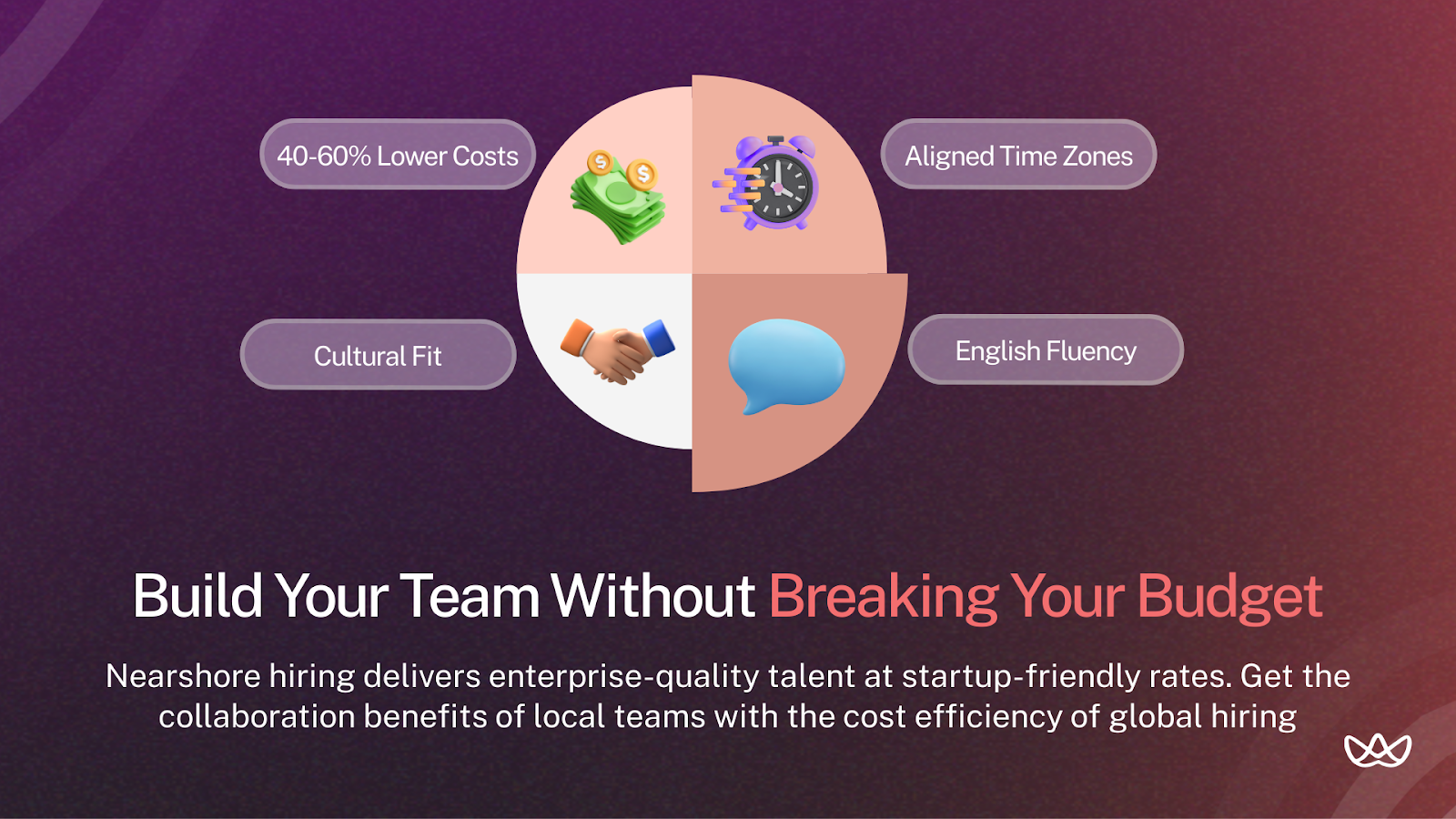
Hiring in LATAM typically costs 40-60% less than in the U.S., but the work quality remains strong. Many professionals have solid portfolios, proven results, and experience with international brands.
- Graduates often supplement studies with certifications or online courses.
- Talent includes those with multinational, agency, or remote U.S. experience.
- You get lower costs without sacrificing skill.
2. English Fluency, Aligned Time Zones & Work Culture
Most LATAM social media managers speak business-level English and understand U.S. cultural references. Time zones align closely with U.S. working hours:
- Mexico: Central Time
- Colombia/Argentina: Eastern Time
- Brazil: One hour ahead of Eastern Time
This allows same-day responses, easier scheduling, and smoother collaboration. Shared workplace norms also reduce misunderstandings compared with more distant regions.
3. Faster Hiring and Higher Retention Rates
LATAM recruitment is often faster than in the U.S., with candidates responding quickly to opportunities offering international experience and fair local pay.
Retention is generally high, as professionals gain stable compensation and career-building opportunities.
4. Salary-To-Quality Ratio
Companies can pay $25k-$35k in LATAM for work that would cost $70k-$90k in the U.S., without compromising output. Many social media managers in the region have 5+ years of experience and can develop strategy, execute campaigns, and report results independently.
How Platforms Like Floowi Support LATAM Social Media Hiring
Platforms like Floowi act as a crucial intermediary, streamlining the nearshoring process by connecting U.S. companies with skilled social media managers in Latin America (LATAM). They mitigate common challenges associated with international hiring, such as vetting, compliance, and payroll, making the process simple, affordable, and effective.
1. Pre-Vetted Talent Matched to u.s. Agency Needs
Vetting quality separates effective hiring platforms from job boards. Strong platforms screen for English fluency, portfolio quality, technical skills, and cultural fit before presenting candidates.
This eliminates the problem of sorting through hundreds of applications where 80% don't meet basic requirements. You see only candidates who've already passed multiple evaluation stages.
Matching algorithms consider industry experience, tool proficiency, time zone needs, and company culture to surface relevant candidates. This reduces time-to-hire from months to weeks.
2. Salary Guidance Based on Real Latam Data
Companies unfamiliar with LATAM markets often struggle to set appropriate compensation levels. Offering too little costs you top candidates. Offering too much wastes budget without improving results.
Platforms with deep LATAM experience provide current salary benchmarks by country, experience level, and specialization. This lets you make competitive offers confidently.
Some platforms handle compensation directly through employer-of-record services, ensuring compliance with local tax and labor laws while simplifying payroll.
3. Faster End-To-End Hiring With Minimal Risk
International hiring comes with administrative and legal complexity, which platforms help manage.
- They handle contracts, payroll, taxes, and employment compliance.
- Trial periods and performance guarantees (30-90 days) reduce hiring risk.
- This lets you focus on evaluating candidates and onboarding efficiently.
How to Benchmark and Increase Social Media Manager Salary
To benchmark and increase a social media manager (SMM) salary, you must combine market research with a strategic approach to skill development and negotiation.
Benchmarking U.S. vs LATAM Compensation Data
Start by defining the role clearly. A social media manager who only posts content differs fundamentally from one who develops strategy, manages ad budgets, and leads campaigns.
Use salary aggregation sites like Glassdoor, Payscale, and LinkedIn Salary for U.S. benchmarks. Filter by location, experience level, and company size to narrow the ranges.
For LATAM benchmarks, consult with regional hiring platforms or employer-of-record services that track current market rates. Public salary data for LATAM markets is less comprehensive than U.S. sources.
Compare total compensation, not just base salary. Include benefits, paid time off, bonus potential, and equity when calculating true costs.
Building High-ROI Portfolios
Social media managers increase their value by showing measurable results. Track metrics like engagement rate improvements, follower growth, conversion rates from social traffic, and return on ad spend.
Case studies showing how you drove specific business outcomes justify higher compensation better than tenure alone. Concrete examples like "increased qualified leads from LinkedIn by 60% over six months" carry weight.
Diversifying platform expertise also helps. Managing Instagram and Facebook is baseline. Adding TikTok, LinkedIn, YouTube, or emerging platforms makes you more valuable.
Leveraging Cross-Channel Social Expertise
Specialized skills command higher rates than generalist roles.
- Email marketing, content strategy, or influencer partnerships add value.
- Paid social expertise helps manage ad budgets and optimize campaigns profitably.
- Analytics skills allow managers to build dashboards, identify trends, and present actionable insights.
How to Benchmark Salaries Using U.S. Public Databases
Bureau of Labor Statistics publishes salary data for "Public Relations Specialists" which includes social media managers. The data updates annually and breaks down by metro area.
Glassdoor and Indeed aggregate self-reported salaries. These skew slightly high because people are more likely to report above-average compensation, but they provide useful ranges.
For LATAM data, platforms like Glassdoor have limited coverage. Your best sources are recruiting agencies, employer-of-record services, and hiring platforms operating in the region.
Getting Started
U.S. social media manager salaries range from $40k for entry-level to $130k+ for senior roles, with mid-level at $60k-$85k. LATAM offers similar quality at 40-60% lower cost.
- Experience & results: Measurable outcomes matter.
- Employment type: Full-time remote is more stable than freelancers.
- Time zones & culture: LATAM pros align with U.S. hours and norms.
- Hiring efficiency: Platforms simplify vetting and compliance.
Nearshore hiring provides quick access to skilled, vetted talent while controlling costs. Connect with Floowi and streamline your LATAM social media hiring. Book your free consultation today.
Also check The Key Components of the 7 Marketing Core Functions
Frequently Asked Questions
What is the average Social Media Manager salary in 2026?
U.S. social media managers average $65,000 to $75,000 annually depending on location and experience. Entry-level roles start at $40,000 to $55,000 while senior positions reach $90,000 to $130,000. LATAM professionals earn $16,000 to $32,000 for mid-level roles.
How do SMM salaries in LATAM compare to the U.S.?
LATAM social media manager salaries run 40-60% lower than U.S. equivalents for similar experience and output quality. A mid-level manager earning $70,000 in the U.S. might earn $24,000 to $30,000 in Colombia or Mexico. The difference reflects cost-of-living and purchasing power rather than skill gaps.
What key factors influence Social Media Manager salary?
Location drives the biggest differences, followed by experience level and industry. Technical skills like paid advertising or analytics command premiums. Full-time roles include benefits while freelancers charge higher hourly rates. Company size and type also affect compensation structures significantly.
Which industries pay the highest salaries?
Financial services, healthcare, and B2B technology companies typically pay 10-20% above average. These sectors require deeper product knowledge and navigate more complex regulatory environments. E-commerce sits in the middle range while local services and hospitality tend lower.
How do hourly rates differ between the U.S. and LATAM?
U.S. freelance social media managers charge $60 to $90 per hour for general work and $100 to $150 for specialized services. LATAM freelancers bill $25 to $35 per hour for comparable mid-level work. The roughly three-to-one ratio holds across experience levels.
Why is LATAM cost-efficient without sacrificing quality?
Cost differences stem from purchasing power parity and local economic conditions rather than skill gaps. LATAM professionals earn competitive local wages that cost U.S. companies substantially less. Many have equivalent experience, strong portfolios, and work with international brands regularly.
What advantages do LATAM SMMs offer in time zones and culture?
LATAM professionals work during U.S. business hours, enabling real-time collaboration without overnight delays. Most speak business-fluent English and understand American cultural references and consumer behavior. This creates smoother communication than Asian or European offshore alternatives.
How does Floowi help U.S. companies hire LATAM talent?
Floowi pre-vets LATAM social media managers for English fluency, technical skills, and cultural fit before presenting candidates. The platform handles payroll, compliance, and employment contracts through employer-of-record services. This reduces hiring time from months to under 15 days while minimizing administrative complexity.




