

.png)
.png)



Most social media manager candidates can schedule posts and write decent captions. That's not where hiring decisions get made anymore. The gap between average and excellent shows up in three places: whether they can read analytics and actually change strategy based on data, whether they've worked with AI tools without becoming dependent on them, and whether they understand that organic reach alone won't hit business targets.
This guide breaks down the essential social media manager skills companies need in 2026, along with examples and evaluation methods. We'll also look at why agencies are increasingly sourcing from LATAM, where bilingual talent working U.S. hours has become a competitive advantage for companies like those hiring through Floowi.
What Social Media Managers Actually Do for Agencies & Growing Companies
A lot of job posts ask for "social media help" without defining what that actually means. Posting three times a week is different from managing five client accounts with monthly reporting and ad spend oversight. Knowing which one you need shapes the entire hire.
What a Social Media Manager Is (Definition)
A social media manager owns a brand’s presence across platforms like Instagram, LinkedIn, TikTok, and X. They plan content calendars, create posts, engage with audiences, track performance metrics, and adjust strategy based on data.
The role connects marketing, customer service, and brand building, and ties daily content efforts to broader business goals.
How the Role Drives Revenue, Retention & Client Results
Social media managers directly influence customer acquisition cost, brand awareness, and customer retention. They turn followers into leads and leads into customers through targeted content and community engagement.
For agencies managing multiple clients, a skilled social media manager can handle 3-5 accounts while maintaining quality and hitting performance benchmarks.
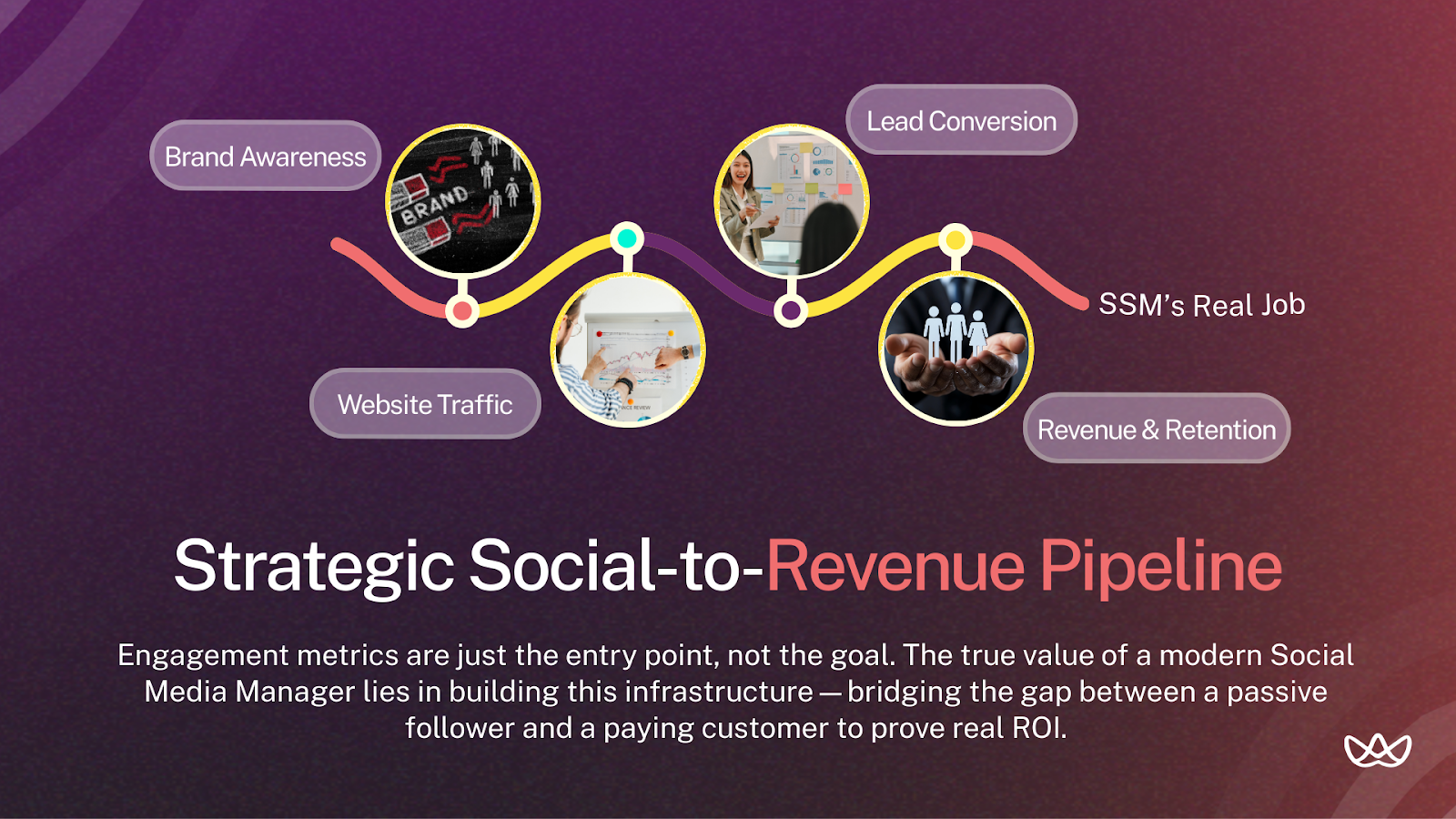
The connection to revenue is measurable. When engagement rates rise, more people visit the website. Increased traffic leads to more conversions and sales. A social media manager who understands this pipeline delivers tangible ROI rather than surface-level metrics.
Core Responsibilities Across Multi-Brand and Fast-Paced Environments
Agency social media managers switch between brands constantly. One hour, they're writing casual copy for a DTC skincare line, the next, they're drafting a formal LinkedIn post for a B2B SaaS client. Each account has different approval workflows, reporting cadences, and stakeholder expectations.
Fast-paced environments add time pressure. Trends move quickly, and approval delays can mean missing the window entirely. Managers need enough autonomy to act fast while still staying within brand guidelines.
Why These Skills Matter More Than Ever in 2026
Two years ago, you could hire someone who was good at captions and call it done. That doesn't work anymore.
The Evolution of Social Media: AI, Rapid Trends & Cross-Platform Storytelling
Algorithms track much more than likes now. They look at watch time, how many people save a post, how deep the comments go, and how often content gets shared. Instagram pushes posts that spark conversation. TikTok’s feed shifts based on shopping activity and browsing habits. LinkedIn rewards longer posts that lead to real discussion.
These updates roll out constantly. Meta removed several targeting options in early 2025. TikTok’s recommendations now use more behavioral signals from users. Managers often need to adjust plans within days because what worked last month might not work today.
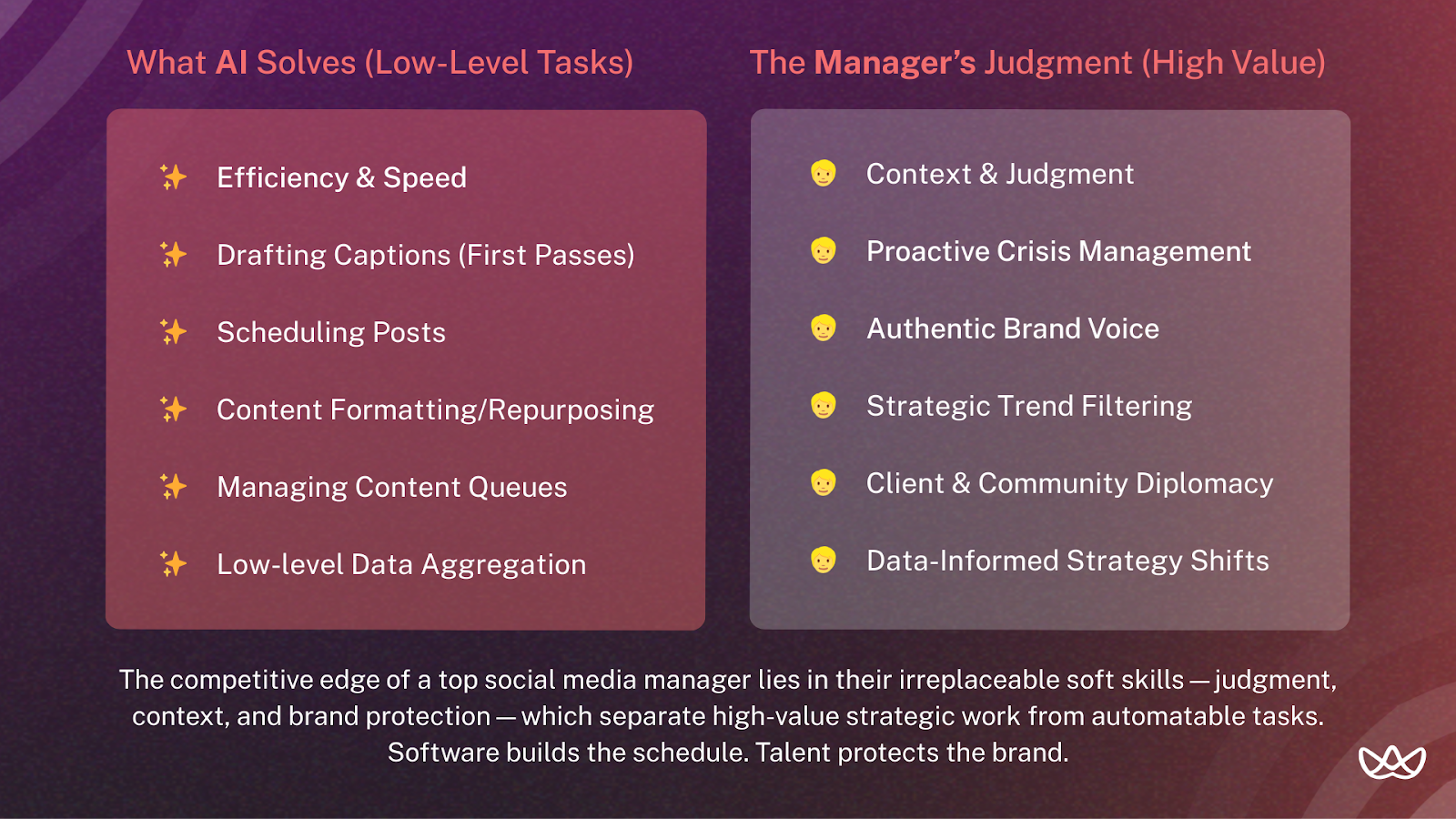
AI tools handle plenty of repetitive work. Scheduling platforms can draft basic captions, suggest posting times, and manage queues. This helps, but it also raises expectations. If software can do the simple parts, the manager has to bring the skills software can’t replace. Clear strategy, strong creative judgment, platform awareness, and the ability to make decisions that actually improve performance.
Why Agencies Prioritize Skill-Rich Offshore & LATAM Talent
The Shift From Content Creation to Revenue-Driving Social Operations
Social media drives actual sales now. Social commerce accounts for about 17% of total online sales and keeps growing. Brands with mature social strategies see around 10% year-over-year revenue growth. The channel has moved well past brand awareness.
This changes what managers need to know. Understanding attribution, conversion tracking, and how social fits into the full customer journey matters more than it used to. Someone who can create good content but can't connect it to business results isn't as useful as they were a few years ago.
AI Replacing Low-Level Tasks - Why Human Skills Matter More
Scheduling tools draft captions, AI suggests posting times, and content calendars run on autopilot. These tasks used to take hours every week.
What AI can't do: notice tension building in a comment section before it becomes a PR problem, decide whether a trend fits the brand or feels forced, manage a client who's unhappy with performance, or catch when a post might land wrong with a specific audience. Those calls require judgment, context, and experience. That's where managers earn their value now.
Why LATAM Talent Is Competitive for Agencies & Remote Teams
LATAM professionals work U.S. hours without the timezone issues that come with Asia or Europe. Many are bilingual, which opens up Spanish-language content for brands reaching Hispanic audiences, and they follow both local and North American trends.
The cost gap is real. A mid-level social media manager in the U.S. typically earns $55,000 to $75,000, while comparable experience in LATAM runs $28,000 to $42,000. Agencies increasingly work with Floowi's LATAM social media talent to tap into this pool without months of sourcing.
Top Social Media Manager Skills Companies Need
Communication & High-Impact Writing
Social media copy has about two seconds to work. A caption either stops the scroll or gets skipped. Strong writers know how to hook attention fast, adapt their tone across platforms, and say more with fewer words. The same message lands differently on LinkedIn than it does on TikTok, and good writers adjust without losing the brand's voice.
Why It Matters
Copy quality directly affects engagement. A weak caption can sink a post even if the visual is strong. For agencies juggling multiple clients, writing consistency also matters because one off-brand post can damage client trust. Managers who write well save time on revisions and produce content that actually performs.
How to Evaluate
Ask for portfolio samples showing different brand voices. Give them a quick test: here's a product, write three captions for Instagram, LinkedIn, and TikTok. Watch for how they shift tone while keeping the core message intact. If everything sounds the same across platforms, that's a red flag.
Creativity, Design & Visual Thinking
Visual thinking goes beyond making things look nice. It means understanding why certain images stop the scroll, how color and composition affect mood, and what formats work best on each platform. Good social media managers can concept a visual direction, brief a designer clearly, and create simple assets themselves when needed.
Why It Matters
People scroll fast. The image or thumbnail decides whether anyone reads the caption at all. Managers who understand visual storytelling produce content that gets attention. They also work better with design teams because they can explain what they need and why.
How to Evaluate
Look at their portfolio for visual range and consistency. Ask them to critique a brand's Instagram grid and suggest three changes. Have them brief you on a hypothetical campaign as if you were the designer. If they can't articulate what they want visually, they'll struggle to direct creative work.
Data Analytics & Performance Optimization
Analytics competency means more than reading dashboards. It's knowing which metrics matter for which goals, spotting patterns over time, and turning numbers into decisions. A good manager can look at a month of data and tell you what to change next month.
Why It Matters
Without analytics, social media is guesswork. Data tells you what's working, what's not, and where to focus. It also helps you prove value to clients or leadership. Managers who understand analytics can defend their strategy with evidence rather than opinion.
How to Evaluate
Give candidates a sample analytics report and ask them to walk you through it. What would they change based on this data? Look for specific recommendations, not vague statements like "we should post more." Ask them to describe a time they used data to shift strategy and what the outcome was.
Technical & Platform Skills
Technical proficiency means knowing how platforms actually work under the hood. That includes Business Manager setup, Creator Studio features, ad interfaces, API limitations, and how algorithm changes affect reach. It also means staying current because platforms update constantly.
Why It Matters
Managers who understand the technical layer can troubleshoot when things break, optimize content for distribution, and avoid common mistakes that kill reach. They don't need to call for help every time Facebook changes something.
How to Evaluate
Ask specific questions: How do you set up a Meta Business Suite? What happens to reach if you edit a post after publishing? How do you troubleshoot a sudden drop in engagement? Vague answers suggest surface-level knowledge.
AI-Powered Content Workflows
AI workflow integration means using tools like ChatGPT, Jasper, or Buffer's AI features to speed up content creation without losing quality. Skilled managers use AI for brainstorming, first drafts, and repurposing, then add human judgment and brand voice on top.
Why It Matters
AI can cut content production time significantly. Managers who use it well handle more accounts or produce more content per account. Those who ignore it fall behind. But managers who rely on it too heavily produce generic work that sounds like everyone else.
How to Evaluate
Ask how they use AI in their workflow today. Request examples of AI-assisted content they've refined. Look for a balanced perspective: they should see AI as a tool, not a replacement for thinking.
Cross-Platform Coordination & Automation
Cross-platform coordination means adapting content for different audiences and formats while keeping a consistent brand presence. It also includes using scheduling tools to maintain posting cadence without manually publishing everything.
Why It Matters
What works on Instagram often fails on LinkedIn. Managers who just copy-paste across platforms waste reach. Good coordinators know how to reshape content for each audience while keeping production efficient.
How to Evaluate
Ask them to take a single piece of content, say a product launch, and explain how they'd adapt it for three platforms. Look for specific changes to format, tone, and timing, not just "I'd post it everywhere."
Paid Social Basics & Ad Budget Management
Paid social competency includes understanding ad formats, targeting options, budget allocation, and how to read campaign performance. Even managers focused on organic need to understand how paid works because the two increasingly overlap.
Why It Matters
Organic reach keeps declining. Paid amplification extends the life of good content. Managers who understand paid can coordinate with advertising teams, handle small budgets independently, and make smarter decisions about what content deserves a boost.
How to Evaluate
Ask about campaigns they've run, even small ones. Test their understanding of metrics like CPM, CPC, and ROAS. Ask how they'd allocate a $500 test budget across platforms for a specific goal. Blank stares suggest they've never touched paid.
Strategic Planning & Channel Prioritization
Strategic planning means building content calendars that connect to business goals, choosing which platforms deserve investment, and sequencing content to build toward campaign objectives. It's the difference between posting reactively and executing a plan.
Why It Matters
Without strategy, social media becomes random posting. Strategic managers build campaigns that compound over time. They focus resources where the audience actually is rather than spreading thin across every platform.
How to Evaluate
Ask them to outline a 90-day strategy for a hypothetical brand. Look for how they connect content choices to business outcomes. If they can't explain why they'd prioritize one platform over another, their planning is probably surface-level.
Community Building & Real Engagement
Community building means fostering genuine relationships with followers. That includes responding to comments thoughtfully, identifying and nurturing brand advocates, and creating conversations rather than just broadcasting messages.
Why It Matters
Communities drive organic reach. Engaged followers share, save, and comment, all signals that boost distribution. Strong community management also surfaces customer feedback and catches potential issues before they escalate.
How to Evaluate
Ask how they've built community in past roles. Present a scenario: a loyal follower leaves a negative comment. How do they respond? Look for answers that show they understand community is built over time through consistent, genuine interaction.
Adaptability, Crisis Management & Trend Responsiveness
Adaptability means adjusting when platforms change, jumping on trends while they're still relevant, and handling negative attention without making things worse. Crisis management specifically covers how to respond when something goes wrong publicly.
Why It Matters
Social media moves fast. A trend window might last 48 hours. An algorithm update can tank reach overnight. Managers who can't adapt quickly miss opportunities and mishandle problems.
How to Evaluate
Present a crisis scenario and ask them to walk through their response step by step. Ask about a time they pivoted strategy quickly. Look for calm, structured thinking rather than panic or rigid adherence to the original plan.
Leadership & Cross-Functional Collaboration
Collaboration means working effectively with designers, copywriters, videographers, sales teams, and executives. Leadership applies when managing junior team members or directing external vendors.
Why It Matters
Social media touches multiple teams. Content needs design support. Strategy needs executive buy-in. Campaigns often involve sales, customer service, and product. Managers who collaborate well produce better work and keep stakeholders aligned.
How to Evaluate
Ask about projects that required coordination across teams. How did they handle competing priorities? How did they get buy-in from leadership? Look for communication skills and the ability to advocate for social media without alienating other departments.
Project Management & Organizational Skills
Project management for social media means maintaining content calendars, hitting deadlines, managing approval workflows, and keeping multiple campaigns on track at once. In agency settings, multiply that by however many clients they're handling.
Why It Matters
Missed posting windows cost engagement. Disorganized managers create chaos for clients and teammates. Strong organizational skills enable consistent output and reduce last-minute scrambles.
How to Evaluate
Ask how they organize their week. What tools do they use? How do they handle competing deadlines? Request a walkthrough of how they'd manage three client accounts simultaneously. Look for systems and processes, not just "I keep it all in my head."
Hard Skills vs Soft Skills: Which Matter Most in 2026
Both matter, but they matter differently. Hard skills get someone through the interview. Soft skills determine whether they last.
Hard Skills Tied to Measurable Outcomes
Hard skills are the things you can test: analytics proficiency, copywriting, platform knowledge, design basics, paid social competency. These produce actual deliverables. You can see them in a portfolio or verify them with a task.
Why It Matters
Hard skills determine the level of work someone can deliver. A manager who doesn’t understand analytics can’t improve performance. One who struggles with copy will keep producing weak content, even if their ideas are strong. Soft skills can be developed over time, but gaps in hard skills show up in the output right away.
How to Evaluate
Don't trust self-assessments. Someone who says they're "proficient in Meta Business Suite" might mean they've logged in once. Give candidates a real task: pull insights from this dashboard, rewrite this caption for three platforms, set up a basic ad campaign. Watch how they work, not just what they claim.
Soft Skills That Support Remote Collaboration & Client Communication
Soft skills cover communication clarity, time management, proactive problem-solving, and emotional intelligence. For remote roles, add self-direction and strong written communication. These are harder to test but just as important.
Why It Matters
Technical ability means nothing if someone can't communicate with clients, collaborate with teammates, or manage their own time. Agencies lose clients over poor communication more often than poor content. A manager who delivers great work but frustrates everyone they interact with creates more problems than they solve.
How to Evaluate
Pay attention throughout the hiring process. How quickly do they respond to emails? How clear is their writing? Do they ask good questions or just wait for instructions? In interviews, ask behavioral questions: tell me about a time a client was unhappy. How did you handle a disagreement with a teammate? Check references specifically for communication and collaboration feedback.
Skill Hierarchy for Agencies (70/20/10 Model)
For agency hiring, weight your criteria roughly like this: 70% execution skills, 20% strategic thinking, 10% creative innovation.
Execution covers writing, design, analytics, and platform knowledge. These drive daily output. Strategy includes planning, channel prioritization, and campaign development. Creative innovation means trend spotting, unique concepts, and experimentation.
This ratio reflects how agency work actually breaks down. Most days involve executing content, not reinventing strategy. Hire for execution first. Strategy and creativity matter, but they don't compensate for someone who can't produce consistent work.
Which Soft Skills Predict Long-Term Retention
Responsiveness is the biggest signal. Managers who reply promptly and communicate clearly tend to stay longer and perform better. Self-direction matters too, especially for remote roles where no one's watching the clock.
During interviews, watch for candidates who ask thoughtful questions, follow up professionally, and show genuine curiosity about the work itself. People who are just looking for any job tend to reveal that in how they engage with the process.
How Companies Should Evaluate These Skills When Hiring
Most social media manager portfolios tell you almost nothing useful.
Portfolio Elements That Reveal Business Impact
The first thing to look for: numbers. Not follower counts, but performance metrics tied to actual goals. Engagement rates, click-throughs, conversion data, revenue attribution if they have access to it. A portfolio without metrics is just a collection of screenshots.
The second thing: can they explain why something worked? When a candidate walks through a campaign, you want to hear about the strategy, the execution decisions, and what they learned from the results. If they can't articulate the thinking behind their own work, they were probably executing someone else's plan rather than driving strategy.
Red flags: portfolios that only show creative work with no context, vague claims like "managed social media for X brand" without specifics, and accounts they "contributed to" without clarity on their actual role.
Skill Assessments & Test Tasks That Matter in 2026
Resumes and interviews only go so far. Practical tests show how candidates actually work.
A few that reveal a lot:
- Hand them a flat product description and ask for three captions: one for LinkedIn, one for Instagram, one for TikTok. You'll see immediately whether they understand platform differences.
- Share an analytics report (anonymized) and ask what they'd recommend changing. This separates people who read dashboards from people who think with data.
- Give them a brand and a campaign goal, set a timer, and see what they generate. Speed and quality under pressure matters in agency work.
If the test takes more than an hour, compensate them. And never use a fictional brief that's actually a real client problem you want solved for free.
Certifications & Learning Paths That Signal Readiness
Certifications like Meta Blueprint, Google Analytics, HubSpot, or Hootsuite show someone put in the work to learn the basics. Fine. But plenty of strong managers have none, and plenty of weak ones have a stack. Certifications prove they studied; portfolios and tests prove they can actually get the job done. Focus on that.
Examples of Strong vs Weak Portfolio Signals
What gets attention:
- Specific campaign metrics with before/after context.
- Work across three or more platforms.
- Copy samples that clearly shift voice between brands.
- Examples where they changed strategy based on performance data.
What raises concerns:
- Pretty visuals with no performance data.
- Single-platform experience with no evidence of learning curve.
- Writing that sounds identical across "different" brand accounts.
- No discussion of what worked, what didn't, or what they'd do differently.
Interview Questions & Hiring Considerations for Agencies
Have candidates walk you through how they plan content for a new client. Ask for concrete examples of handling underperforming posts, or a time they disagreed with a client and how they managed it.
Good questions include:
- How do you decide which platform deserves more focus for a B2B brand?
- Tell me about a post that went viral unexpectedly. What did you learn?
- How do you keep up with platform changes and trends?
Salary Expectations & Seniority Levels When Hiring Offshore Talent
LATAM rates reflect cost-of-living differences while attracting top-tier talent. The savings enable agencies to hire more senior candidates or invest the difference in tools and training.
Red Flags During the Hiring Process
Watch for slow responses - they usually mean slow communication with clients. If candidates can’t explain why a post performed well, they likely won’t be able to replicate success. Portfolios with no performance data suggest they don’t think analytically.
Other warning signs: badmouthing previous employers, refusing feedback on test tasks, or vague answers about their role in team projects.
Behavioral Questions Tied to Content Strategy
Ask questions that reveal accountability, judgment, and analytical thinking:
- Tell me about a campaign that failed. What happened and what did you change?” Look for ownership and lessons learned.
- How have you handled a client who wanted to post content you thought would harm their brand?” Look for diplomacy paired with good judgment.
- Describe how you used data to convince a stakeholder to change direction.” This shows analytical thinking and communication in action.
Your Next Step
Hiring LATAM social media managers can make sense for agencies focused on efficiency and coverage. They work in U.S. time zones and often bring bilingual capabilities, which allows teams to manage English and Spanish content without adding overhead.
Many have experience with both U.S. and local markets, so they can adapt content for different audiences while keeping ideas practical and relevant. Strong candidates also communicate clearly, understand trends, and can handle multiple accounts without losing quality.
To hire effectively, define the skills that matter most for your team. Use assessments that test real-world capabilities, and structure interviews to reveal both hard and soft skills. Short trial projects or milestone-based periods give a clearer view of how someone performs before committing long-term.
Start building your social media manager team with Floowi. Book your free consultation today.
Frequently Asked Questions
What Are the Most Important Social Media Manager Skills in 2026?
Writing, analytics, and platform knowledge are table stakes. What separates strong candidates: the ability to use AI tools without becoming dependent on them, strategic thinking that connects content to business goals, and adaptability when platforms change their algorithms overnight.
How do companies evaluate social media manager skills effectively?
Companies effectively evaluate social media manager skills using a mix of measurable results (KPIs) from past campaigns, a review of their portfolio and strategic thinking, and scenario-based interviews or practical assignments to test their crisis management, content creation, and brand voice consistency. Key assessment areas include analytical abilities, strategic planning, adaptability, and technical tool proficiency.
What Hard Skills Align Most Directly With Measurable KPIs?
Analytics interpretation drives optimization decisions. Copywriting directly affects engagement rates. Paid social knowledge impacts cost per acquisition and ROAS. Design skills influence click-through rates. These are the skills that show up in performance dashboards.
How Do You Test Soft Skills Effectively in Interviews?
Ask for specific examples, not hypotheticals. "Tell me about a time a client was upset with results" reveals more than "how would you handle an upset client." Pay attention to how they communicate throughout the process: email response times, clarity in writing, quality of questions they ask. Reference checks should specifically ask about collaboration and responsiveness.
What Differentiators Set Top Candidates Apart in 2026?
They think beyond the task in front of them. They notice platform changes before you mention them. They bring ideas to meetings instead of waiting for direction. They flag problems early rather than letting them grow. And they communicate proactively, which matters more than most hiring managers realize.
How Do Social Media Managers Integrate AI Into Their Daily Workflows?
The good ones use AI for brainstorming, rough drafts, and repurposing content across formats. Then they edit heavily to add brand voice and fix the generic phrasing AI tends to produce. The ones to avoid either refuse to use AI at all or hand in AI-generated content without refining it.
What Portfolio Elements Show Real Business Impact for Agencies?
Metrics tied to outcomes: engagement rates, conversion data, revenue attribution if available. Case studies that explain the thinking, not just the output. Evidence of managing multiple accounts without quality dropping. Specific numbers beat vague claims every time.
How Do Agencies Evaluate Cultural & Communication Fit for Offshore Hires?
Video interviews reveal communication style and English proficiency faster than anything else. Paid test projects show work quality and how they handle feedback. Trial periods with clear milestones, usually 30 to 90 days, reduce risk for both sides.
Which Certifications Matter Most When Hiring a Social Media Manager?
Meta Blueprint shows platform knowledge. Google Analytics certification indicates data competency. HubSpot covers marketing fundamentals. None of these guarantee someone can do the job, but they show a baseline investment in learning. Weight portfolios and test results higher.
What Tools Are Most Relevant for Managing Cross-Platform Performance?
Hootsuite and Sprout Social for scheduling and analytics across platforms. Later for Instagram-heavy workflows. Buffer for AI-assisted content creation. Native analytics from each platform still provide the most detailed data, so managers should know how to pull insights directly from Meta Business Suite, TikTok Analytics, and LinkedIn's dashboard.




