


.png)



U.S. companies hire dedicated remote staff to access skilled professionals who work exclusively for their business without the cost and complexity of traditional employment. This approach is increasingly popular among founders, operators, and HR leaders facing tight labor markets.
Dedicated remote staff are full-time professionals who work solely for one company while being employed and supported by a remote staffing partner or Employer of Record (EOR).
Unlike freelancers who juggle multiple clients or in-house teams requiring office space and full benefits, dedicated remote staff operate as an extension of your company. They show up every day, attend your meetings, and report to your managers. The difference is they work from Latin America or other global regions where labor costs are substantially lower.
Why U.S. Companies Hire Dedicated Remote Staff
U.S. companies hire dedicated remote staff to access global talent with specialized skills without the cost pressure of U.S. hiring. This approach reduces expenses tied to office space and high salary structures.
Remote teams also enable extended coverage across time zones, which helps speed up delivery. By 2026, this model has become a core advantage, improving retention and allowing companies to scale while staying flexible.
Access to Specialized Global and Nearshore LATAM Talent
Hiring in the U.S. has become slower and more costly for many roles. Even with plenty of applicants, teams often struggle with long hiring cycles and rising salary expectations.
Looking to LATAM helps ease this pressure. Countries like Mexico, Colombia, Argentina, and Brazil offer experienced professionals who are familiar with modern tools and U.S. work environments.
LATAM teams tend to work well for U.S. companies because:
- Workday overlap supports real-time collaboration
- Practical English skills used in daily work
- Cultural familiarity that reduces communication friction
Significant Cost Savings Compared to Local U.S. Hiring
A U.S.-based graphic designer typically costs $50,000–$75,000 a year, plus benefits and equipment. The same role in LATAM usually costs $10,000–$25,000 annually.
Hiring in LATAM can save substantially without compromising quality, even for small creative teams.
Flexible, Scalable Remote Staffing Solutions That Grow with Your Needs
Dedicated remote staff let you scale teams quickly without the delays of traditional U.S. hiring.
- Seasonal demand: Bring on extra support agents in 2–4 weeks for busy periods.
- Shifting timelines: Adjust remote contracts more easily than full-time local roles.
- Market testing: Start small in a new region and expand as needed.
This flexibility helps businesses respond to changes without long-term commitments.
Higher Productivity Through Focused and Dedicated Roles
Freelancers split attention across multiple clients. Your project might sit idle while they finish work for someone else.
Dedicated remote staff work for you full-time. They learn your systems, understand your customers, and build institutional knowledge over time. This continuity produces better outcomes than constantly onboarding new contractors.
What "Dedicated Remote Staff" Really Means
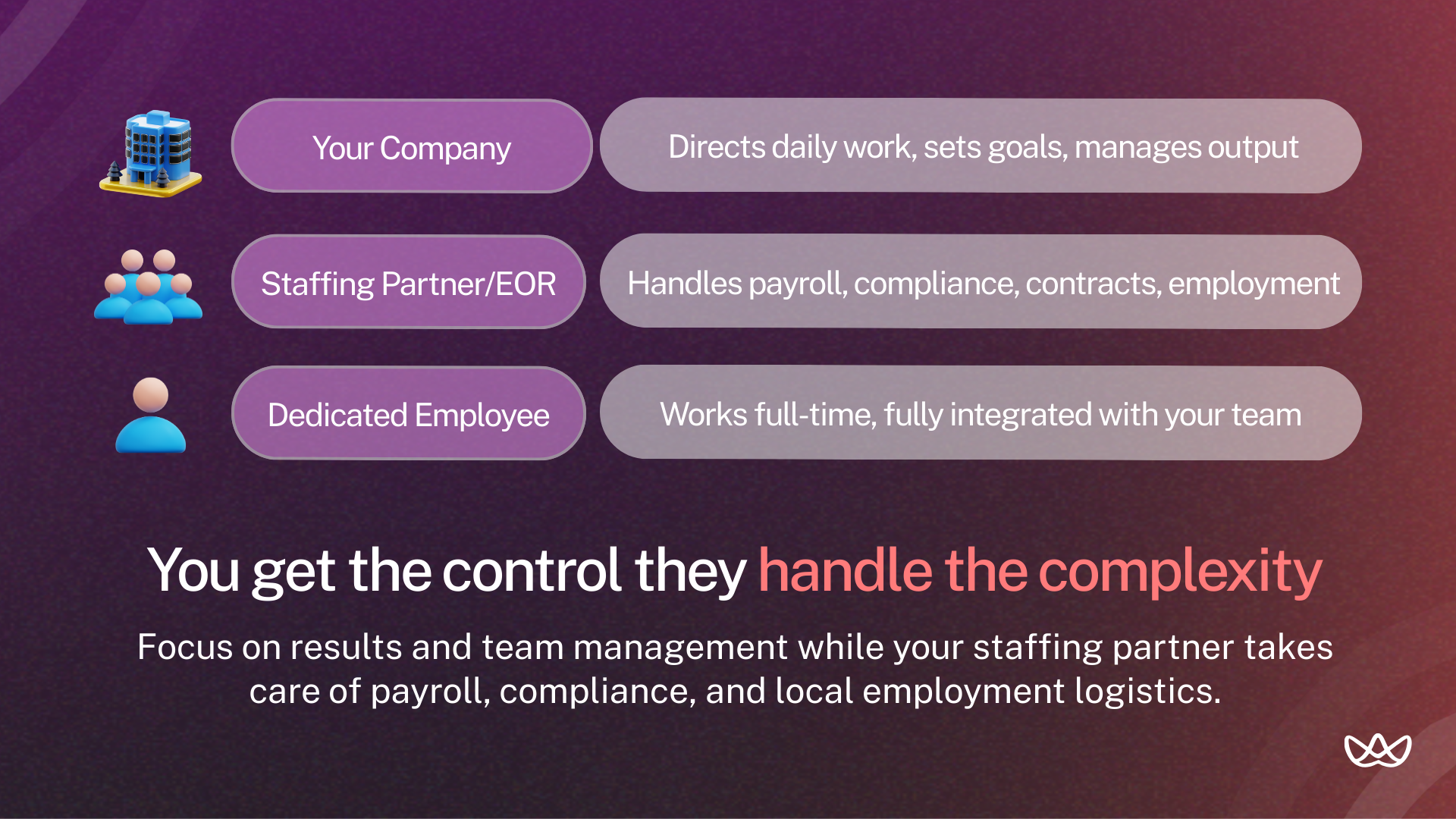
Dedicated remote staff refers to external professionals who work exclusively for your company on a full-time basis, unlike freelancers with multiple clients. They act as an extension of your team, following your workflows and culture, while a third-party provider or EOR handles payroll, taxes, and benefits.
Dedicated Remote Staff vs. Freelancers vs. Full-Time In-House Teams
Dedicated remote staff occupy the middle ground. You get commitment and continuity without administrative burden and full domestic employment costs.
When Hiring Dedicated Remote Staff Works Best
Dedicated remote staff work well for roles needing ongoing focus rather than short-term support.
- Long-term projects: Ensure continuity and consistent output
- Specialized skills: Marketing, design, or analytics roles hard to fill locally
- Around-the-clock operations: "Follow-the-sun" workflows across time zones
This approach fits teams with established digital workflows, outcome-based metrics, and the ability to integrate remote staff as part of the team.
Why Nearshore LATAM Talent Has Become the U.S. Standard

Nearshore LATAM talent has become the U.S. standard for marketing because it solves the critical need for real-time agility and cultural resonance at a fraction of domestic costs.
Companies are saving significantly on roles like performance marketing managers and SEO specialists without the coordination challenges of distant offshore teams. Professionals in the region understand U.S. consumer trends and business practices, helping campaigns feel native rather than adapted.
The growth of AI-driven marketing in hubs like Colombia and Mexico has expanded the talent pool, with specialists skilled in data analysis and automated workflows, making LATAM a practical option for scaling marketing operations efficiently.
Cost Considerations When You Hire Dedicated Remote Staff
Hiring costs vary widely by region. U.S. salaries are the highest, while LATAM offers 40–60% lower rates with time-zone alignment, good English, and cultural compatibility. Eastern Europe provides strong technical talent at moderate cost but with some time-zone gaps. Asia is the most affordable but has significant coordination challenges due to distance and time differences.
Salary Differences Across Key Hiring Regions
For most U.S. companies, LATAM provides 40-60% savings while enabling collaboration that closely mirrors working with a U.S.-based team.
Payroll, Compliance, Contracts and Cross-Border Legalities
Hiring internationally means navigating different employment laws. You can either establish a local entity (makes sense for large teams) or use an Employer of Record (EOR).
The EOR becomes the legal employer on paper, handling payroll, taxes, and compliance while you direct day-to-day work.
Equipment, Onboarding and Operational Setup
For remote staff in Latin America, most professionals already have their own laptops, internet, and basic setup.
You may still need to budget for software licenses, collaboration tools, or optional stipends for peripherals or upgraded internet. Some companies provide small allowances for local purchases, while others simply grant access to necessary software.
This keeps onboarding simple and avoids the higher equipment costs typical of U.S.-based hires.
Recruitment, Vetting and Remote Staffing Acquisition Costs
Working with a nearshore staffing partner typically reduces total acquisition costs because they have existing candidate networks. The fee often costs less than internal time spent recruiting.
You can connect to us for an instant, detailed pricing breakdown on hiring dedicated remote staff in Latin America, including recruitment, vetting, and ongoing staffing costs.
The Step-by-Step Process to Hire Dedicated Remote Staff
Hiring dedicated remote staff works best when you follow a clear process - from defining the role and finding candidates to vetting and onboarding - so everything runs smoothly from day one.
1. Define Roles, Deliverables and Success Metrics Clearly
Document exactly what you need before recruiting. A solid definition includes title and function, primary responsibilities, required skills, experience level, success metrics, working hours, and reporting structure.
2. Choose the Right Hiring Channel for Remote Staffing Solutions
Next, pick the channels that are most likely to reach candidates who fit your role.
- Remote Job Boards: General platforms like LinkedIn and We Work Remotely attract high volume but can include a lot of noise.
- Freelance Marketplaces: Upwork and Fiverr work well for project-based needs but are less suited for full-time dedicated staff.
- Professional Networks: Employee referrals often perform better and have higher retention.
- Staffing Agencies and Nearshore LATAM Talent Partners: These agencies pre-vet candidates, handle compliance, and match you with professionals who fit your requirements. You can explore Floowi's vetted LATAM talent profiles to see dedicated remote roles.
- Specialized Global Talent Hubs: Platforms focused on specific regions surface candidates you wouldn’t find on general job boards.
3. Screen, Vet and Interview Candidates Thoroughly
Core Remote-Work Interview Questions:
- Describe your home office setup and daily equipment.
- How do you structure your workday when no one is watching?
- Tell me about resolving a miscommunication with a remote colleague.
- What tools do you use to stay organized?
- How do you handle being blocked when your manager is unavailable?
Role-Specific Questions:
For marketing roles, review portfolios, ask about campaign results and metrics, and discuss experience with different channels and tools. For support roles, present scenarios. For admin roles, test organizational systems with practical exercises.
4. Manage Legal, Contracts, Payroll and Compliance Early
Decide upfront whether you'll use an EOR, set up your own entity, or engage contractors directly. Key contract elements include scope of work, compensation, IP assignment, confidentiality, and termination provisions.
5. Onboard, Train and Integrate Remote Staff Seamlessly
Pre-start: Equipment ordered, accounts created, manager notified, first-week schedule prepared.
Week one: Welcome call, company overview, role training, initial low-stakes tasks, daily check-ins.
First 30 days: Weekly 1:1s, gradual responsibility increase, cross-functional introductions, feedback on early work.
How to Manage and Scale a High-Performing Remote Team
To manage and scale a high-performing remote team, focus on outcomes with clear OKRs and asynchronous communication. A documentation-first approach and AI-driven tools help streamline coordination, while regular virtual check-ins support retention and maintain culture across time zones.
Set Clear KPIs, Processes and Ownership
Define KPIs for each role, document processes so team members can reference them on their own, and make ownership of projects explicit.
Build a Culture of Communication and Feedback
Use asynchronous updates, record key meetings, create channels for both work and casual chat, and hold regular 1:1s and retrospectives. Encourage feedback to flow both ways.
Enhance Engagement, Trust and Autonomy
Focus on outcomes instead of activity. Keep people engaged with recognition, growth opportunities, involvement in decisions, and genuine care for their wellbeing.
Use the Right Collaboration and Project Management Tools
Standardize tools for communication (Slack/Teams), video calls (Zoom/Meet), project management (Asana/Jira), and documentation (Notion/Confluence).
Invest in Training, Upskilling and Continuous Development
Provide access to online courses, mentorship, virtual conferences, and learning platforms. People who see growth opportunities stay motivated and perform better.
Common Challenges When You Hire Dedicated Remote Staff
Hiring remote staff involves finding the right talent, checking skills and fit, managing compliance and time zones, and keeping the team engaged.
Finding Qualified Talent in Competitive Remote Hiring Markets
The remote hiring market has matured. Good candidates have multiple options, and the best ones don't stay available long. Move fast when you find someone strong. Compress your interview process to two weeks or less.
Partnering with a staffing agency gives you access to pre-vetted candidates who are ready to start quickly.
Validating Skills, English Fluency and Cultural Fit
Resumes don't tell the whole story. Someone might look great on paper but struggle with spoken English or work differently than you expect. Conduct live video interviews to assess communication in real time. Include practical assessments relevant to the role. Trial periods of 30-90 days before full commitment reduce risk considerably.
Navigating Payroll, Compliance and Cross-Border Regulations
Employment law varies by country. Getting it wrong creates legal exposure and damages relationships. Use an Employer of Record unless you have resources for local entities and compliance management. EORs handle the complexity so you can focus on the work.
Managing Time-Zone Differences (and Why Nearshore LATAM Solves This)
A team split across 12 time zones struggles to collaborate in real-time. Meetings happen at bad hours. Decisions take longer. Prioritize nearshore hiring whenever possible.
LATAM teams share most of the U.S. workday. A developer in Bogotá overlaps completely with New York. Even Buenos Aires, one hour ahead of EST, provides substantial overlap.
Ensuring Engagement, Alignment and Long-Term Retention
Remote employees can feel disconnected without intentional effort. Regular communication, recognition, career development, and competitive compensation all contribute to retention. Treat remote staff as full team members, not second-class workers. Include them in company events, celebrate their wins, and invest in their growth.
Best Practices Before You Hire Dedicated Remote Staff
Before hiring dedicated remote staff, having a clear plan ensures a smooth start and long-term success. Begin by clarifying expectations around working hours, availability, and communication norms. Documenting these upfront avoids confusion and sets a professional tone.
Use a multi-step interview process to carefully evaluate candidates. This should include:
- Resume screening
- Video interviews
- Skills assessments
- Team interviews
- Reference checks
Focus on remote-ready skills and accountability. Strong written communication, self-direction, comfort with technology, proactive problem-solving, and reliability are critical traits for remote staff.
For high-impact roles, consider starting with a trial period of two weeks to one month. This allows both the employee and your team to confirm fit and workflow before committing fully.
Prepare a thoughtful virtual onboarding plan, covering the first 30 days:
Finally, set performance metrics and reporting cadence early. Weekly updates, monthly reviews, and quarterly check-ins provide consistent feedback, keep employees aligned, and support long-term engagement.
Frequently Asked Questions
How Do Dedicated Remote Staff Reduce Costs Compared to Local U.S. Hires?
The main savings come from lower base salaries in LATAM. For example, a role paying $120,000 in the U.S. may cost $40,000–$60,000 in Latin America. Additional savings come from reduced office space, utilities, and benefits. These cost differences allow companies to scale teams without the overhead of domestic hiring.
What Is the ROI of Hiring Nearshore LATAM Talent vs. Offshore Teams?
Nearshore LATAM talent often delivers higher ROI than offshore options because teams overlap U.S. work hours, making communication easier and reducing delays. While costs may be slightly higher than some Asian markets, the efficiency gained from synchronous collaboration and faster decision-making often outweighs the difference.
How Do Dedicated Roles Improve Productivity Compared to Freelancers?
Dedicated staff work exclusively for your company, giving them more context, stronger relationships, and deeper understanding of your processes. Unlike freelancers managing multiple clients, dedicated employees produce more consistent results and integrate more smoothly into your workflows.
When Does Hiring Dedicated Remote Staff Make the Most Sense for U.S. Companies?
This model is best for ongoing, skilled work where consistency matters, when reducing costs is a priority, when local talent is scarce, or when you need to scale quickly. It’s less suited for short-term or highly variable project work.
What Interview Questions Reveal Whether a Candidate Is Truly Remote-Ready?
Ask about their home office setup, how they structure their day without direct supervision, the tools they use to stay organized, how they handle miscommunications, and how they solve problems when a manager isn’t immediately available.
How Do Nearshore Teams Solve Time-Zone and Communication Challenges?
LATAM teams share most of the U.S. workday. Employees in Mexico City, Bogotá, or other nearby regions can join meetings during regular hours and respond in real time, making collaboration smoother and avoiding the delays common with teams many hours ahead or behind.
What Are the Top Platforms to Hire Dedicated Remote Talent in LATAM?
Floowi is the top choice for hiring dedicated remote staff in LATAM, as it provides pre-vetted professionals, handles compliance, contracts, and payroll, and focuses on full-time, long-term roles. Other options include general job boards like LinkedIn and Upwork, as well as regional and niche talent hubs that focus on Latin American professionals, giving you additional reach as you build your team.
Your Next Step
Hiring dedicated remote staff lets U.S. companies access skilled professionals at lower costs. Nearshore LATAM talent works well for time zone alignment, cultural fit, and strong English.
The key is to define roles clearly, vet candidates carefully, onboard thoughtfully, and manage with clear KPIs. When approached deliberately, dedicated remote staff integrate smoothly and become a reliable part of your team.
Hire dedicated remote staff with Floowi and build your nearshore team with vetted LATAM talent. Book your free consultation today.




