






The first question most companies ask about outsourcing web design is the wrong one. They ask "how much will it cost?" when they should ask "what kind of partner do I actually need?"
That single mistake leads to 6-month projects dragging into 12, budgets doubling, and founders wondering why their $8,000 "affordable" redesign looks worse than a Squarespace template.
Outsourced web design services work - but only when you match the right model to your actual situation.
Let's get into what actually works for outsourcing web design in 2026.
Outsourced Web Design Services Explained
Outsourced web design is the practice of hiring external teams or individuals to handle design work instead of building an in-house department. This model has become more common because it solves a real problem: finding experienced designers is hard and expensive, especially in competitive markets like the U.S.
The shift toward remote work has made this approach more common. U.S. companies now work directly with talent across Latin America without geographic limits. A startup in San Francisco can collaborate with a senior UI designer in Argentina or a Webflow developer in Colombia, working in the same or overlapping time zones.
For agencies, outsourcing plays a practical role in scaling delivery. Client demand changes, and keeping a large design team on payroll year-round often does not make financial sense. Outsourced teams help cover capacity gaps, manage overflow work, and provide specialized skills that internal teams may not have.
What Are Outsourced Web Design Services?
Outsourced web design services refer to the delegation of website design, UX/UI work, and related tasks to external providers rather than handling them internally. These providers can be agencies, studios, or individual contractors located domestically or internationally.
The typical workflow follows a structured process:
- You define project requirements, goals, and deliverables.
- The outsourced team provides estimates, timelines, and a project plan.
- Design work proceeds through iterative review cycles.
- Final assets are delivered in agreed formats with handoff documentation.
Communication typically happens through project management tools like Notion, Asana, or ClickUp. Design collaboration runs through Figma, which allows real-time feedback and version control.
Most Common Services Companies Outsource
The scope of outsourceable design work has expanded significantly. Here are the services companies most frequently delegate to external teams:
- UX research and strategy
- Wireframing and prototyping
- UI design and visual systems
- Landing page and conversion design
- E-commerce store design
- Webflow and WordPress development
- Design system creation and maintenance
- Mobile-first responsive design
- Accessibility audits and implementation
Why Businesses Choose Outsourced Teams Over In-House Hiring
The decision to outsource usually comes down to practical considerations rather than ideological preferences.
Cost efficiency is the most obvious factor. A senior web designer in the U.S. costs $80,000 to $130,000 annually in salary alone. Add benefits, equipment, and overhead, and total cost can reach $150,000 or more. An equivalent designer in Latin America typically charges $30,000 to $55,000 for similar quality work.
Flexibility matters for project-based work. You can scale up for a major redesign and scale back when the project wraps, without layoffs or awkward employment conversations.
Specialization fills gaps that generalist hires cannot. Need a Webflow expert for three months? An e-commerce conversion specialist for a product launch? Outsourcing gets you exactly the skills required without long-term commitments.
Why Outsource Web Design?
Outsourcing web design lets companies access specialized expertise and modern technologies - like advanced personalization tools and interactive 3D elements - without the high costs of a full-time in-house team. This approach can reduce expenses by 40-70% while helping projects stay on schedule, enabling businesses to launch websites and digital products more efficiently.
1. Access to Specialized Global Talent
The global talent pool includes designers with experience across every platform, industry, and design discipline. You are not limited to whoever happens to live within commuting distance of your office.
This is particularly valuable when you need niche expertise. Motion design specialists, accessibility consultants, and conversion rate optimization experts are hard to find locally. Outsourcing opens doors to professionals who have built entire careers around specific skills.
When evaluating candidates, look for designers with portfolios that match your project needs.
2. Lower Costs Without Sacrificing Quality
Cost savings from outsourcing range from 40% to 70% compared to U.S. hiring, depending on the region and skill level. These savings come from differences in cost of living, not differences in ability.
A designer earning $45,000 annually in Buenos Aires or Mexico City lives comfortably in their local economy. The same designer would struggle in San Francisco on that salary. This arbitrage benefits both parties: companies reduce costs while designers earn competitive wages for their market.
Quality remains consistent because talent is distributed globally. Design education, online resources, and professional communities have erased geographic advantages that once existed.
3. Faster Execution and Scalable Capacity
Outsourced teams can start work within days rather than the weeks or months required to hire internally. This speed matters when deadlines are tight or opportunities are time-sensitive.
Scalability works in both directions. Need five designers for a large project? You can assemble a team quickly. Project finished? You wind down without severance packages or unemployment claims. This elasticity is impossible to replicate with permanent staff.
Consider a typical scenario: an agency wins a major client project requiring a complete website redesign. The internal team is already at capacity. With outsourcing, additional designers can be onboarded within a week, the project stays on schedule, and the agency maintains its reputation for reliable delivery.
4. Advanced UX/UI Capabilities and Modern Tooling
Outsourced designers often work across multiple clients and industries, which keeps their skills current. They cannot afford to fall behind on tools or techniques because their livelihood depends on staying competitive.
Modern design work requires proficiency in:
- Figma for collaborative design and prototyping
- Webflow for no-code website development
- Framer for interactive prototypes
- Principle and After Effects for motion design
- Hotjar and analytics tools for user research
Outsourced partners typically invest in training and certifications because these credentials help them win contracts. The result is access to designers who are genuinely skilled with modern tools, not just familiar with them.
When Should You Use Outsourced Web Design Services?
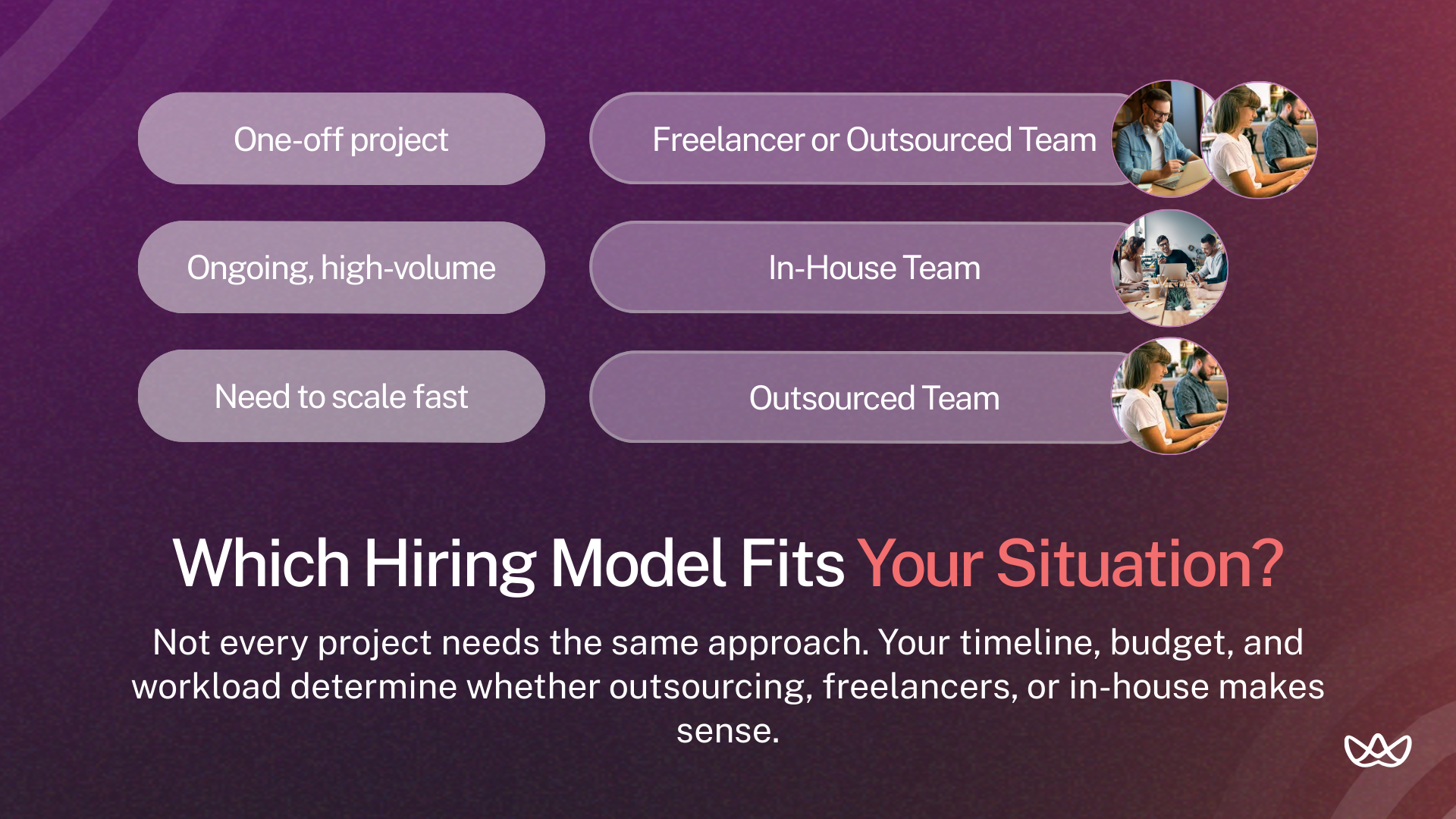
Use outsourced web design when your team can’t keep up or needs specialized skills. It’s great for quick redesigns, updates, or handling extra client work, letting you get experienced designers without hiring full-time.
1. When Internal Teams Are Overloaded or Lack Expertise
Capacity constraints hit every growing company eventually. Your design team has a fixed number of working hours, and adding more projects means something gives. Quality suffers, timelines slip, or team members burn out.
Outsourcing provides relief without the commitment of new hires. You can bring in support for specific projects while keeping your core team focused on strategic work.
Skill gaps are another trigger. If your team excels at brand design but lacks web development experience, outsourcing the development work makes more sense than expecting designers to learn Webflow overnight.
2. When You Need Rapid Redesigns or Iterative Updates
Website redesigns typically fall outside normal operating rhythms. They require concentrated effort over weeks or months, followed by periods of relative quiet. Hiring full-time designers for a six-month project creates awkward situations when the project ends.
Outsourcing aligns resources with actual needs. You engage designers for the redesign phase, complete the project, and part ways professionally. No performance improvement plans, no difficult conversations about role changes.
Ongoing iteration benefits from outsourcing too. A/B testing landing pages, refreshing seasonal campaigns, and updating product pages all require design capacity without justifying permanent headcount.
3. When Scaling Agency Delivery or Meeting Client Demand
Agencies face unique pressures around capacity planning. Client work arrives unpredictably, and maintaining a bench of designers waiting for projects erodes margins quickly.
The solution many agencies have adopted is a hybrid model: a core internal team handles client relationships and strategic work while outsourced partners execute production tasks. This structure keeps fixed costs low while maintaining the ability to take on large projects.
White-label outsourcing has become common. External designers work under the agency's brand, clients never know the difference, and the agency maintains its reputation without overextending resources.
What Web Design Services Can Be Outsourced?
Most web design tasks can be outsourced: UI/UX wireframing, visual design, layouts, branding, and responsive design. Some designers also handle frontend implementation through tools like Webflow or WordPress. Specialized tasks like custom animations, design systems, and accessibility audits are commonly delegated to external experts.
1. UX Strategy, User Flows and Wireframes
UX work forms the foundation of effective web design. Outsourced UX professionals can conduct user research, develop personas, map customer journeys, and create wireframes that guide visual design.
Common UX deliverables from outsourced teams include:
- Competitive analysis and UX audits
- Information architecture and site maps
- Low and high-fidelity wireframes
- User flow diagrams
- Clickable prototypes for testing
2. UI Design, Layouts, Branding and Visual Systems
Visual design is perhaps the most commonly outsourced function. This includes creating the look and feel of websites, establishing brand guidelines, and developing design systems that ensure consistency.
Nearshore UI/UX teams often handle this work by producing polished interfaces, icon sets, typography hierarchies, and reusable component libraries. These assets help teams maintain visual consistency and speed up future design and development work.
3. Web Development (Webflow, WordPress, Custom Builds)
Design and development now work more closely together. Many outsourced designers also support implementation, especially on platforms like Webflow that focus on visual development.
WordPress development remains in demand for content-driven websites. Commonly outsourced work includes custom theme builds, plugin customization, and WooCommerce integrations.
For projects that require custom code, outsourced developers often work directly from design files to build fully functional sites using frameworks like React or Next.js.
4. E-Commerce Design and Conversion Optimization
E-commerce projects have specific requirements around product displays, checkout flows, and conversion optimization. Outsourced specialists understand platform-specific constraints on Shopify, WooCommerce, and BigCommerce.
Conversion rate optimization (CRO) is a specialized discipline that combines design skills with analytical thinking. CRO specialists create landing page variants, optimize checkout experiences, and improve product page layouts based on data.
5. Responsive and Mobile-First Design
Mobile traffic now accounts for more than half of all web visits. Responsive design is no longer optional but a baseline requirement. Outsourced designers routinely deliver layouts optimized for phones, tablets, and desktops.
Mobile-first methodology prioritizes the smallest screen sizes during initial design, then progressively enhances for larger displays. This approach produces leaner, faster sites that perform well on mobile devices.
Outsourced Web Design vs. In-House vs. Freelancers
Outsourced teams, in-house designers, and freelancers each fulfill different needs. In-house teams offer the most control but come with higher fixed costs. Outsourced agencies provide scalable, structured delivery, while freelancers offer flexibility at a lower cost with more hands-on management.
1. Cost and Timeline Comparison
Each hiring model carries different cost structures and time implications. In-house teams require salary, benefits, equipment, and management overhead. Freelancers charge hourly or project rates with minimal commitment. Outsourced agencies and teams fall somewhere between.
Time to productivity varies significantly. Internal hires need weeks for recruiting plus months to reach full productivity. Freelancers can start immediately but may require extensive direction. Outsourced teams combine quick availability with established processes.
2. Capabilities and Scalability
Internal teams develop deep knowledge of your business but may have narrow skill sets. Freelancers bring specialized expertise but work alone. Outsourced agencies offer breadth across multiple disciplines with the ability to assign different specialists as projects require.
Scalability favors outsourcing. Adding or removing capacity takes days rather than months. Internal headcount changes involve HR processes, while freelancer availability is unpredictable.
3. Quality, Communication and Project Control
Quality depends more on individual talent than hiring model. Great designers exist in all categories. The difference lies in accountability and process.
Communication works differently across models. Internal teams share context naturally through office interactions. Remote outsourced teams rely on structured communication and documentation. Freelancers often operate independently with less oversight.
LATAM-based outsourced teams offer advantages for U.S. companies. Time zone overlap enables real-time collaboration that is difficult with Asian or Eastern European partners. Cultural alignment reduces friction in communication styles and work expectations.
How to Choose the Right Outsourced Web Design Partner
To choose the right outsourced web design partner in 2026, follow these five essential steps:
1. Define Your Goals, Scope and Success Metrics
Before evaluating vendors, clarify what you actually need. Vague requirements lead to misaligned expectations and disappointing results.
Document specific deliverables, not general outcomes. Instead of asking for a website redesign, specify: 12 page templates, responsive designs for 3 breakpoints, a component library with 40 elements, and handoff files in Figma.
Define success metrics upfront. How will you know if the project succeeded? Increased conversion rates? Faster page load times? Positive user feedback? Clear metrics help both parties stay aligned.
2. Evaluate Vendor Portfolios, Case Studies and Processes
Portfolios reveal capabilities, but case studies reveal process. A strong portfolio shows what a team can produce. A detailed case study shows how they approach problems, collaborate with clients, and handle challenges.
Look for evidence that matches your situation:
- Industry experience relevant to your sector
- Project complexity similar to yours
- Platform expertise (Webflow, WordPress, Shopify)
- Results achieved for previous clients
When researching how to hire a web designer, prioritize candidates who can walk through their decision-making process, not just show finished work.
2. Check Communication Style, Availability and Workflows
Communication failures cause more project problems than skill gaps. Test how potential partners communicate before committing.
Ask about:
- Response time expectations
- Preferred communication channels
- Meeting cadence and format
- How they handle feedback and revisions
- Project management tools they use
Time zone compatibility matters for real-time collaboration. LATAM partners working in U.S. time zones enable same-day feedback cycles that are impossible with distant offshore teams.
3. Review Pricing Models, Contracts and Ongoing Support
Pricing models vary widely. Fixed-price projects work when scope is well-defined. Hourly rates suit exploratory or evolving work. Retainer arrangements provide predictable capacity for ongoing needs.
Contract terms should address:
- Intellectual property ownership
- Revision limits and change order processes
- Payment schedules and milestones
- Termination clauses
- Post-launch support options
Outsourced Web Design Pricing by Region
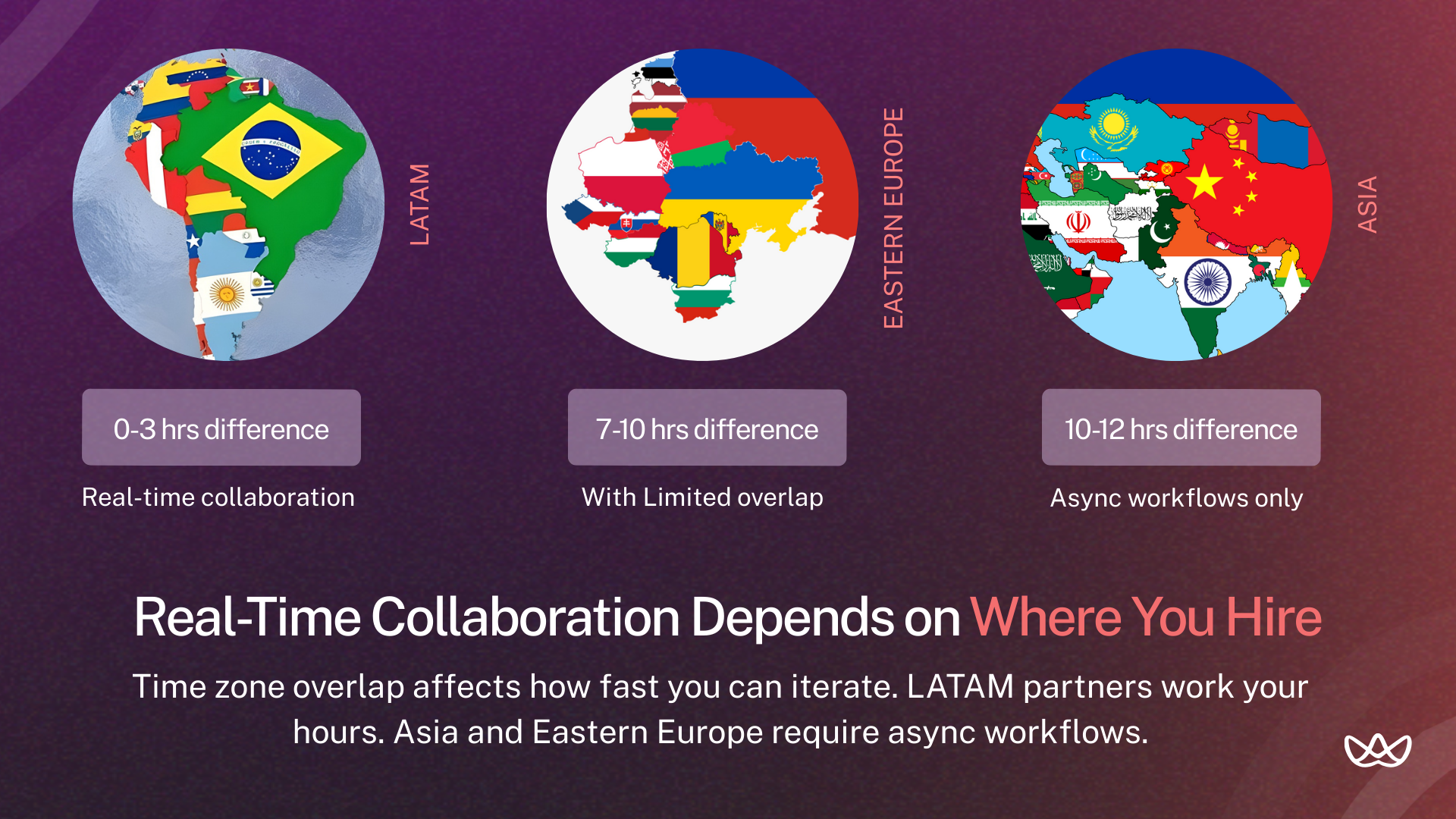
Web design costs differ by region based on skills and time zones. North America and Western Europe are pricier but align closely with U.S. teams. Latin America and Eastern Europe offer a good mix of cost and expertise, while Asia is cheapest but often requires async collaboration.
North America: Typical Ranges and Service Levels
U.S. and Canadian outsourced design services remain the most expensive option. Agencies typically charge $100 to $200 per hour, with full website projects ranging from $15,000 to $75,000 or more.
Premium pricing reflects higher labor costs, not necessarily superior quality. North American vendors may be appropriate when regulatory requirements, security concerns, or specific industry experience justify the premium.
Western Europe: Pricing and Expertise
Western European rates fall slightly below North American levels, typically $80 to $150 per hour. Countries like Germany, the UK, and the Netherlands have strong design communities with excellent English proficiency.
Time zone differences create challenges for U.S.-based companies. A 6-8 hour gap limits synchronous collaboration and extends feedback cycles.
Latin America: Nearshore Advantages and Vetted Partners
Latin America has emerged as the preferred nearshore destination for U.S. companies. Countries like Argentina, Mexico, Colombia, and Brazil offer experienced designers at $30 to $70 per hour.
The nearshore advantage goes beyond cost. Time zone alignment with U.S. business hours enables real-time collaboration. Cultural similarities reduce communication friction. Many LATAM designers have worked with U.S. clients extensively and understand American business expectations.
Vetted LATAM partners like Floowi provide pre-screened talent that meets quality standards, eliminating the risk of working with unproven contractors.
Asia & Eastern Europe: Affordability and Specialization
Asia offers the lowest rates, typically $15 to $40 per hour for quality work. India, the Philippines, and Vietnam have large pools of English-speaking designers.
Eastern Europe, particularly Ukraine, Poland, and Romania, provides strong technical skills at $35 to $70 per hour. These regions excel at development work and technical implementation.
Both regions present time zone challenges for U.S. companies. Asynchronous workflows become necessary, which can extend project timelines and complicate collaboration.
Key Factors That Influence Outsourcing Costs
Outsourced web design costs depend on location, project complexity, and technical requirements. The engagement model and tight deadlines can increase expenses, while ongoing maintenance, security, and SEO add to the overall budget.
1. Project Complexity, Features and Integrations
Project scope directly impacts cost. A simple 5-page marketing site costs far less than a 50-page enterprise platform with custom integrations, user authentication, and complex data handling.
Features that increase complexity and cost:
- Custom animations and interactions
- Third-party integrations (CRM, payment, analytics)
- Multi-language support
- User account systems
- E-commerce functionality
2. CMS Choice (Webflow, WordPress, Custom)
Platform selection affects both initial build cost and ongoing maintenance. Webflow projects typically cost 20-40% more upfront but require less ongoing development work. WordPress sites have lower initial costs but may need more maintenance and security updates.
Custom builds using frameworks like Next.js or Gatsby cost the most initially but offer complete flexibility. These make sense for complex applications where template-based solutions fall short.
3. Timeline Urgency and Revision Cycles
Rush projects command premium rates. Designers may need to work overtime, reprioritize other clients, or add team members to meet aggressive deadlines.
Revision cycles also affect cost. Most contracts include 2-3 rounds of revisions. Additional rounds typically incur extra charges. Clear feedback and consolidated revision requests help control costs.
4. Maintenance, Optimization and Long-Term Needs
Initial build costs represent only part of total ownership. Ongoing maintenance, content updates, performance optimization, and periodic refreshes add up over time.
Understanding web designer salary benchmarks helps you evaluate whether ongoing retainers make more sense than project-based engagements.
How to Outsource Web Design Successfully
Successful web design outsourcing relies on strategic partnership. Start with a clear brief, vet partners carefully, and begin with a small trial. Secure IP and NDA agreements, then use regular check-ins to keep the project aligned with your brand and evolving design standards
1. Set Clear Objectives, Deliverables and Timelines
Success starts with clarity. Document exactly what you need before engaging any vendor.
A proper project brief includes:
- Business goals and success metrics
- Target audience and user personas
- Specific deliverables and formats
- Timeline with key milestones
- Brand guidelines and design references
- Technical requirements and constraints
2. Establish Communication Channels and Feedback Loops
Define how you will communicate before the project begins. Unclear communication causes more problems than skill gaps or technical challenges.
Effective communication structures include:
- Weekly status meetings with video calls
- Slack or Teams channels for day-to-day questions
- Project management tools for task tracking
- Figma comments for design-specific feedback
- Response time agreements (e.g., 24-hour turnaround)
3. Use Collaborative Tools for Design and Development
Modern design tools enable seamless collaboration regardless of location. Figma has become the industry standard for design collaboration, allowing multiple people to work simultaneously and comment directly on designs.
Recommended tool stack for outsourced projects:
- Design: Figma, Adobe XD
- Prototyping: Figma, Principle, ProtoPie
- Project management: Notion, Asana, ClickUp
- Communication: Slack, Loom for async video
- File sharing: Google Drive, Dropbox
4. Conduct Testing, QA and Accessibility Reviews
Quality assurance should be built into the project timeline, not added as an afterthought. Plan for testing phases that cover browser compatibility, responsive behavior, and accessibility compliance.
Key testing areas:
- Cross-browser testing (Chrome, Safari, Firefox, Edge)
- Device testing (iOS, Android, various screen sizes)
- Performance testing (load times, Core Web Vitals)
- Accessibility audits (WCAG 2.1 compliance)
- User acceptance testing
5. Plan for Iteration, Updates and Ongoing Improvements
Websites are never truly finished. Plan for ongoing updates, content changes, and iterative improvements based on user feedback and performance data.
Establish post-launch support arrangements before the project ends. Options include:
- Monthly retainer for ongoing design work
- Hourly rate for ad-hoc updates
- Quarterly review and optimization cycles
- Training for internal team to handle basic updates
Outsourcing Success Checklist
Use this checklist to ensure a smooth outsourcing process and keep every stage of your web design project on track.
- Project brief documented with clear deliverables
- Success metrics defined
- Timeline with milestones agreed
- Communication channels established
- Contract with IP and revision terms signed
- Collaborative tools set up with proper access
- QA and testing plan in place
- Post-launch support arrangement confirmed
Best Countries for Outsourced Web Design Services in 2026
In 2026, the best countries for outsourced web design are Latin America, Eastern Europe, and Asia. Latin America works well for U.S. teams with overlapping time zones and cultural fit. Eastern Europe is strong in technical expertise, while Asia offers large talent pools at lower rates, often requiring asynchronous collaboration.
1. Latin America (Best for U.S. Nearshore)
Latin America offers the strongest combination of quality, cost, and compatibility for U.S. companies. Argentina, Mexico, Colombia, and Brazil lead the region in design talent.
Key advantages include:
- Time zone overlap with U.S. business hours (0-3 hours difference)
- Cultural alignment with American work styles
- Strong English proficiency among professionals
- Growing design communities and education programs
- 40-60% cost savings compared to U.S. rates
2. Eastern Europe (Technical Excellence)
Poland, Ukraine, Romania, and the Czech Republic have developed strong tech sectors with skilled designers and developers. These regions excel at technically complex projects requiring both design and development expertise.
The main challenge is time zone difference. Eastern European teams operate 7-10 hours ahead of U.S. East Coast, which limits synchronous collaboration.
3. Asia (Cost-Effective for High-Volume Builds)
India, Pakistan, the Philippines, and Vietnam offer the lowest rates in the global market. These regions suit high-volume projects where cost is the primary concern and asynchronous workflows are acceptable.
Asian outsourcing works well for:
- Template-based website production
- Large-scale content updates
- Projects with well-defined specifications
- Development work with detailed design handoffs
Quick Summary: Why Companies Choose Outsourced Web Design Services
In 2026, companies outsource web design to reduce costs and access specialized talent quickly. Key advantages include:
- Lower cost: 40-70% cheaper than U.S. in-house teams.
- Faster delivery: Teams ready to start immediately.
- Scalable capacity: Adjust resources as project demands change.
- Modern expertise: Skilled in current tools, UX/UI, and conversion-focused design.
- Global talent: Access niche skills from around the world.
- Operational efficiency: Agile workflows and AI tools streamline projects.
Your Next Move
Outsourced web design gives you access to specialized talent, saves costs, and adds flexibility. The key is picking the right partner, setting clear goals, and keeping communication smooth. LATAM nearshore teams work well with U.S. time zones and culture. In-house teams handle ongoing work, freelancers take on short-term projects, and outsourced teams provide scalable support.
Key takeaways:
- Access global talent and save 40-70% compared to U.S. rates.
- Scale capacity and speed up delivery when internal teams are stretched.
- LATAM partners offer strong alignment with U.S. teams.
- Evaluate partners based on expertise, communication, and pricing.
- Clear briefs, structured communication, and QA drive successful outcomes.
Explore outsourced web design services with Floowi to access vetted LATAM designers for high-quality, cost-effective results. Book your free consultation today.
Frequently Asked Questions
What Exactly Are Outsourced Web Design Services?
Outsourced web design services involve hiring external teams or individuals to handle website design work rather than using internal employees. This can include UX research, UI design, development, and ongoing maintenance. Companies outsource to access specialized skills, reduce costs, and scale capacity without permanent hiring commitments.
How Does Outsourced Web Design Work in Practice?
The process typically begins with a project brief that outlines requirements and deliverables. Outsourced teams provide proposals, timelines, and cost estimates. Work proceeds through iterative review cycles with regular check-ins. Communication happens through tools like Slack, Figma, and project management platforms. Final deliverables are handed off with documentation.
How Does Outsourcing Provide Access to Specialized Global Talent?
Geographic barriers no longer limit hiring. Remote work tools and collaboration platforms enable companies to work with designers anywhere. This opens access to specialists in motion design, accessibility, conversion optimization, and platform-specific expertise that may not be available locally.
What's the Cost Advantage Compared to U.S. Hiring?
Cost savings typically range from 40% to 70% compared to U.S. rates, depending on the region. LATAM designers charge $30-$70 per hour versus $100-$200 for U.S.-based designers. These savings come from cost-of-living differences, not quality differences.
When Is Outsourcing the Best Option for Rapid Redesigns?
Outsourcing makes sense for redesigns because these projects require concentrated effort over a defined period. Hiring full-time staff for a six-month project creates awkward employment situations afterward. Outsourcing aligns resources with actual project needs.
How Do Agencies Evaluate Vendor Availability and Workflows?
Ask potential vendors about their current capacity, team structure, and typical response times. Request references from recent clients. Conduct a small paid trial project to assess communication quality and workflow compatibility before committing to larger engagements.
What Portfolio Signals Indicate a Strong Vendor?
Look for diversity in project types, evidence of results achieved, and case studies that explain process rather than just showing finished work. Portfolios should demonstrate relevant industry experience and platform expertise that matches your needs.
How Does CMS Choice Affect Cost (Webflow vs. WordPress)?
Webflow projects typically cost 20-40% more upfront but require less ongoing development work. WordPress has lower initial costs but may need more maintenance. Custom builds cost the most initially but offer complete flexibility for complex requirements.




