


.png)



Most businesses approach web design outsourcing backwards. They start with budget, pick the cheapest option, and end up redoing the project six months later. The companies that get it right start with a different question: what kind of partner actually fits this project?
Web design outsourcing means hiring external teams to handle your website design work instead of building an in-house department. This includes everything from UX research and wireframes to full Webflow or WordPress builds. The model works for agencies scaling client delivery, startups launching fast, and established companies running redesigns without adding headcount.
Let’s break down how web design outsourcing works in 2026, what it costs by region, how to evaluate partners, and when it’s the right approach for your situation.
Web Design Outsourcing: How It Works in 2026
Remote collaboration has changed how outsourcing operates. Teams no longer ship static mockups back and forth over email. Modern workflows run through Figma for design, Slack or Loom for communication, and Notion or ClickUp for project tracking.
Two models are most common:
Dedicated teams work exclusively on your projects for a set number of hours per week or month. This model suits ongoing work where context and continuity matter.
On-demand partnerships handle specific projects with defined scopes. You engage for a redesign, launch the site, and wrap up. This fits companies with irregular design needs.
Both models work remotely by default. A remote web designer in Buenos Aires collaborates with your team in real time using the same tools your in-house staff would use. The physical location becomes irrelevant when workflows are set up properly.
Async communication has also matured. Loom videos replace lengthy meetings. Figma comments replace email chains. Teams in different time zones can still move projects forward without waiting for overlapping hours.
What Is Web Design Outsourcing?
Web design outsourcing is the practice of contracting external designers or agencies to handle website design projects instead of using internal employees. The scope ranges from single landing pages to complete website redesigns with dozens of pages.
External partners handle the design execution while you maintain creative direction and final approval. The arrangement can be project-based, retainer-based, or a hybrid depending on your needs.
Common Services You Can Outsource
Nearly every design task can be delegated to an external team:
- Landing page design and optimization
- Full website redesigns
- UI/UX flows and wireframing
- Interactive prototypes
- Webflow development
- WordPress theme customization
- Design system creation
- Mobile responsive layouts
- Conversion rate optimization
- Brand identity and visual systems
The key is matching the right partner to the right task. A Webflow specialist handles implementation differently than a pure UX strategist.
Outsourcing Web Design vs. DIY: What Companies Get Wrong
The DIY approach appeals to budget-conscious founders, but it usually costs more in the long run. The most common challenges are:
DIY limitations:
- Templates look generic and hurt brand perception
- No UX research means guessing at user behavior
- Poor conversion optimization leaves money on the table
- Technical debt accumulates from workarounds
- Time spent on design pulls focus from core business
What outsourcing solves:
- Professional UX improves conversion rates
- Custom designs differentiate your brand
- Specialists move faster than generalists learning on the job
- Clean code and proper structure reduce future maintenance
Understanding what a web designer actually does helps clarify why professional execution matters. Design involves far more than arranging elements on a page.
Why Outsource Web Design?
Businesses outsource web design to access specialized global expertise and reduce costs compared to running an in-house team. This approach removes hiring and operational costs, keeps internal teams focused on core work, and allows faster delivery through established workflows. It also provides flexibility to scale and access modern design practices and security standards that are hard to maintain internally.
1. Access to Global Talent
Geographic limitations no longer restrict hiring. A company in Austin can work with senior designers in Argentina, Colombia, or Mexico who have years of experience with U.S. clients and understand American design expectations.
This global pool includes specialists that may not exist in your local market. Motion designers, accessibility experts, and conversion optimization specialists are easier to find when you search globally.
2. Cost Efficiency
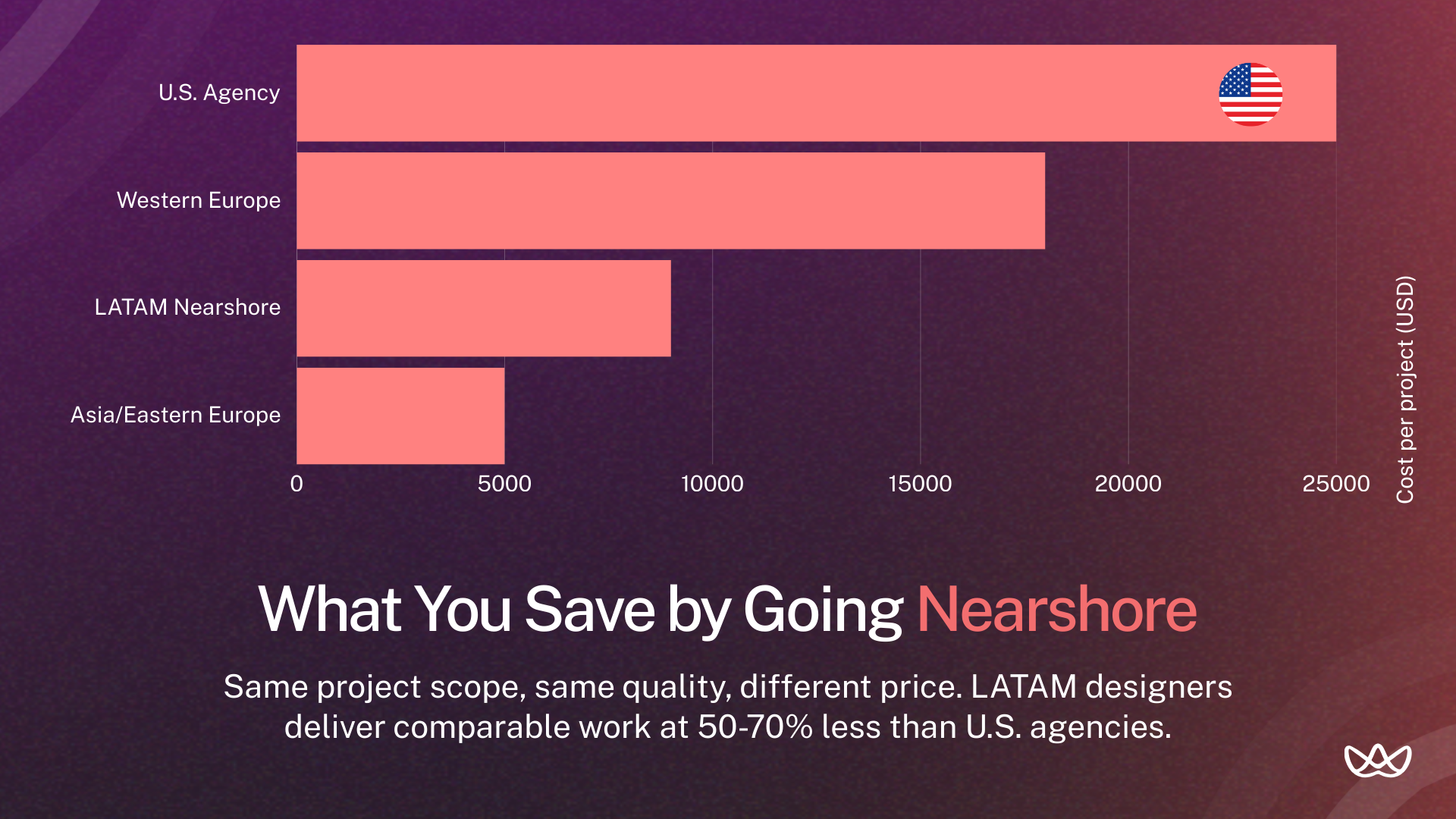
The numbers add up quickly. A senior web designer in the U.S. earns $90K to $140K annually in salary, plus benefits, equipment, and operational costs. Total expenses often exceed $150K per year.
Equivalent talent in Latin America costs $35,000 to $60,000 for the same skill level. The savings come from cost-of-living differences, not quality differences.
For project work, U.S. agencies charge $100 to $200 per hour. LATAM partners typically charge $15 to $30 per hour for comparable output.
3. Faster Project Delivery
Outsourced teams start faster because there's no recruiting delay. A typical hiring process takes 6 to 12 weeks. An outsourced partner can begin work within days.
Delivery benchmarks from experienced teams:
- Landing page: 3 to 7 days
- Multi-page marketing site: 2 to 4 weeks
- Full website redesign: 6 to 12 weeks
- E-commerce store: 4 to 8 weeks
These timelines assume clear requirements and responsive feedback cycles.
4. Advanced Design Capabilities
Outsourced designers often work across multiple clients and industries. This exposure keeps their skills current and brings cross-industry insights to your project.
Capabilities commonly available through outsourcing:
- Micro-interactions and animation
- UX research and user testing
- UI component libraries
- Conversion-focused design
- Accessibility compliance (WCAG)
- Design system documentation
In-House vs. Outsourcing vs. Freelancers
The choice between in-house, outsourcing, or freelancers depends on project scope, budget, and control. In-house teams offer alignment but carry high fixed costs. Agencies provide structured delivery with lower operational costs, while freelancers offer flexibility for specialized tasks but require more oversight. Many teams use a hybrid setup, keeping strategy in-house and outsourcing execution.
Comparing Time, Cost, and Quality
Each model comes with different considerations. The right choice depends on your project volume, budget, and how much control you need.
In-house teams build deep product knowledge but require ongoing investment regardless of workload. You pay the same whether they ship ten projects or two.
Outsourced agencies/teams provide scalable capacity with established processes. You pay for what you use, but you sacrifice some day-to-day control.
Freelancers offer flexibility and specialized skills but come with availability risks and limited capacity for larger projects.
Pros and Cons of Each Model
In-house teams offer control but carry high costs. Agencies bring expertise and scale with some coordination effort. Freelancers offer flexibility at lower cost but less consistency. Many companies manage these differences through hybrid setups with clear oversight.
In-House:
- Full control over priorities and process
- Deep understanding of brand and product
- High fixed costs regardless of utilization
- Slow to scale up or down
- Limited to skills of current team
Outsourced Teams:
- Scalable capacity on demand
- Access to diverse skill sets
- Lower cost than U.S. in-house
- Requires clear communication structures
- Less institutional knowledge
Freelancers:
- Low commitment, project-based
- Access to niche specialists
- Unpredictable availability
- Quality varies significantly
- Limited capacity for large projects
You can work with vetted LATAM designers who follow structured processes and provide nearshore cost advantages.
When Should You Outsource Web Design?
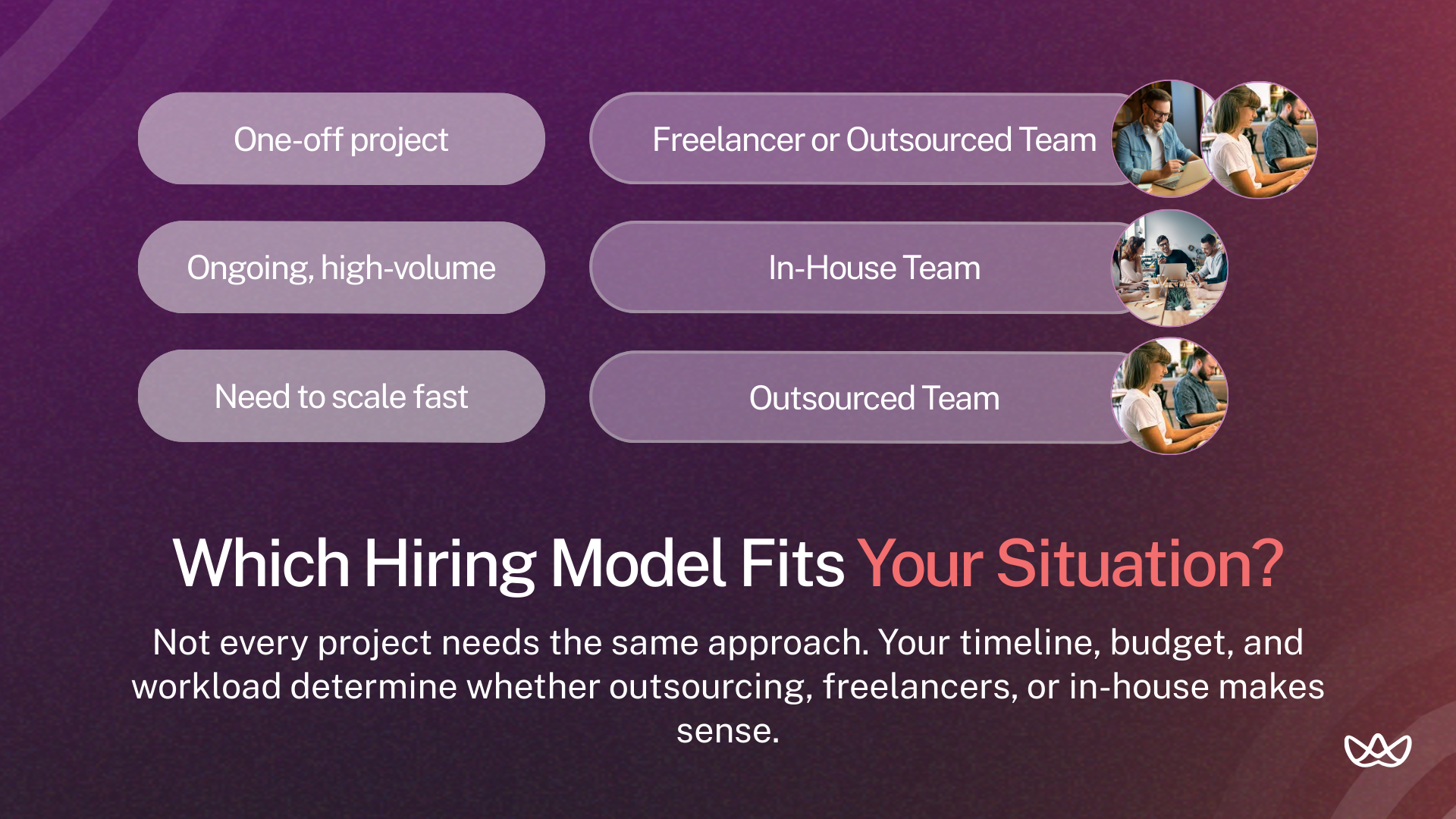
Outsource web design when your team lacks skills like AI-driven UX, advanced security, or React, or when you need a project launched fast without a long hiring cycle. It’s ideal for startups building an MVP, companies scaling redesigns, or sites needing a fresh perspective.
Ideal Project Scenarios
Outsourcing fits certain situations better than others:
- Website redesigns: Concentrated effort over 2-3 months, then minimal ongoing work.
- New product launches: Need to move fast without permanent headcount.
- Agency overflow: Client demand exceeds internal capacity.
- Specialized projects: E-commerce, accessibility, or conversion optimization requiring specific expertise.
- Startup MVP sites: Budget constraints make U.S. agencies impractical.
- Seasonal campaigns: Landing pages and microsites with defined end dates.
Signs Your Business Is Ready
You're probably ready to outsource if:
- Internal team is consistently overloaded.
- Projects keep getting delayed due to capacity.
- You need skills your team doesn't have.
- Hiring timeline doesn't match project urgency.
- Fixed design costs are eating margins.
- Quality of recent work has declined due to rushing.
How Much Does It Cost to Outsource Website Design?
Outsourcing web design can significantly reduce costs compared to hiring U.S. agencies. LATAM designers typically charge lower rates while maintaining quality, helping you get projects done efficiently.
Costs vary based on complexity, number of pages, and custom functionality (All figures are in USD):
Freelancer vs. Agency Pricing
Freelancers charge less per hour but may take longer and provide less structure. Agencies cost more but deliver established processes, project management, and accountability.
For simple projects under $5,000, freelancers often make sense. For complex projects or ongoing relationships, agency-style partners provide more reliability.
Geographic Pricing Breakdown
North America
U.S. and Canadian agencies charge premium rates: $100 to $200 per hour. Full projects start around $15,000 for basic sites and climb quickly for anything complex.
The premium reflects labor costs, not necessarily quality differences. North American partners make sense when regulatory requirements or specific industry expertise justify the cost.
Western Europe
Western European rates fall between $80 and $150 per hour. Strong design traditions in countries like the UK, Germany, and Netherlands. Time zone gap of 5-8 hours creates collaboration challenges for U.S. companies.
Latin America
LATAM has become the preferred nearshore region for U.S. companies. Rates typically range from $15 to $30 per hour with quality matching U.S. output.
Key advantages:
- Same or similar time zones (0-3 hour difference)
- Cultural alignment with U.S. business practices
- Strong English proficiency in professional settings
- Growing design communities with modern tool expertise
Asia & Eastern Europe
Lowest rates globally at $10-$25/hour, with large talent pools in India, Pakistan, the Philippines, Ukraine, and Poland.
The main things to keep in mind are the 8-12 hour time difference, which means most work will be asynchronous, and the need to carefully vet quality.
Key Factors That Influence Outsourcing Costs
In 2026, web design outsourcing costs vary by geographic location and project complexity. Simple sites are easier on the budget, while custom platforms or eCommerce builds cost more. Technology stack (AI-driven or custom frameworks), design style, and integrations all affect pricing, and ongoing maintenance adds extra to the total spend.
Project Scope and Complexity
A 5-page marketing site costs far less than a 50-page enterprise platform. Complexity multipliers include:
- Number of unique page templates
- Custom illustrations or photography needs
- Interactive elements and animations
- Third-party integrations
- Multi-language requirements
Design Features and Integrations
Specific features add cost:
- CRM integration (HubSpot, Salesforce)
- Payment processing (Stripe, PayPal)
- Custom calculators or configurators
- Video backgrounds and media handling
- Advanced filtering and search
- User authentication systems
Timeline Requirements
Rush projects cost 25-50% more. Compressed timelines require overtime, parallel workstreams, and sometimes additional team members.
Standard timelines produce better results at lower cost. Build in buffer for feedback rounds and unexpected complications.
Maintenance and Post-Launch Support
Initial build is only part of the total cost. Plan for:
- Content updates and page additions
- Bug fixes and browser compatibility
- Performance optimization
- Security patches
- Analytics and conversion tracking adjustments
Retainer arrangements typically cost $500 to $3,000 monthly depending on scope.
Steps to Outsource Web Design Successfully
1. Define Your Goals and Scope
Document specific requirements before contacting vendors:
- Business objectives (leads, sales, brand awareness)
- Target audience and user personas
- Page count and content structure
- Functionality requirements
- Brand guidelines and design references
- Success metrics and KPIs
Vague briefs lead to misaligned expectations and scope creep.
2. Research Potential Partners
Look for partners with:
- Portfolio work similar to your project
- Experience in your industry
- Clear process documentation
- Testimonials from comparable clients
- Transparent pricing structure
Check portfolios for diversity and quality consistency, not just highlight reels.
3. Interview and Evaluate Vendors
Key questions to ask:
- Who specifically will work on the project?
- What's your typical process and timeline?
- How do you handle revisions and feedback?
- What happens if the project runs over budget?
- Can you share references from recent clients?
Pay attention to communication quality during the sales process. It reflects what working together will be like.
4. Finalize Budget and Contract
Contracts should address:
- Deliverables and acceptance criteria
- Payment schedule tied to milestones
- Revision limits and change order process
- Intellectual property ownership
- Confidentiality and data handling
- Termination clauses
Get clarity on what's included and what costs extra before signing.
5. Collaborate During the Design Process
Effective collaboration requires:
- Designated point of contact on your side
- Regular check-ins (weekly for most projects)
- Timely feedback within agreed windows
- Centralized communication (avoid scattered email threads)
- Clear approval process for each phase
6. Test and Launch Your Website
Pre-launch checklist:
- Cross-browser testing (Chrome, Safari, Firefox, Edge)
- Mobile responsiveness across devices
- Form functionality and integrations
- Page load speed optimization
- SEO basics (meta tags, alt text, sitemap)
- Analytics tracking verification
- Security certificate (SSL) active
7. Plan for Ongoing Support
Decide before launch:
- Who handles content updates?
- What's the process for bug reports?
- How often will you review performance?
- What triggers a design refresh?
Outsourcing Checklist
A structured approach ensures your web design outsourcing runs smoothly. Use this checklist to define scope, compare vendors, and set up processes before the project starts.
Choosing the Right Web Design Outsourcing Partner
Pick a web design outsourcing partner with relevant industry experience and strong skills in modern stacks like React or AI-driven UX. Ensure they use reliable communication tools, follow data security standards, sign an NDA, and transfer full IP ownership in the contract.
What to Look for in a Vendor
Strong signs a partner is solid:
- Portfolio fits your style and project complexity.
- Clear, documented design and development process.
- Responsive, professional communication.
- Transparent pricing with no hidden fees.
- They ask insightful questions about your business.
- References confirm reliability.
Red Flags to Avoid
Watch out for:
- No portfolio or only templated work.
- Pricing far below market rates.
- Vague answers about process.
- Weak or missing contract terms.
- Pushy sales behavior.
- Poor communication during evaluation.
Security, Communication, and IP Protection
Make sure they:
- Are willing to sign a solid NDA.
- Follow proper data handling and storage practices.
- Vet their team thoroughly.
- Assign IP clearly in the contract.
- Provide secure access controls for accounts and assets.
Nearshore LATAM Partners
Latin American teams have become a solid choice for U.S. companies looking for quality work at reasonable rates. The nearshore setup reduces common offshore challenges like time zone gaps and communication delays.
LATAM designers often work during U.S. business hours, allowing for real-time collaboration, same-day feedback, and quick calls when needed. Cultural familiarity with U.S. business practices also helps minimize misunderstandings.
Countries like Argentina, Mexico, Colombia, and Brazil have growing design communities. Many designers have experience with U.S. clients and understand user-centered, conversion-focused design principles.
Best Countries for Web Design Outsourcing in 2026
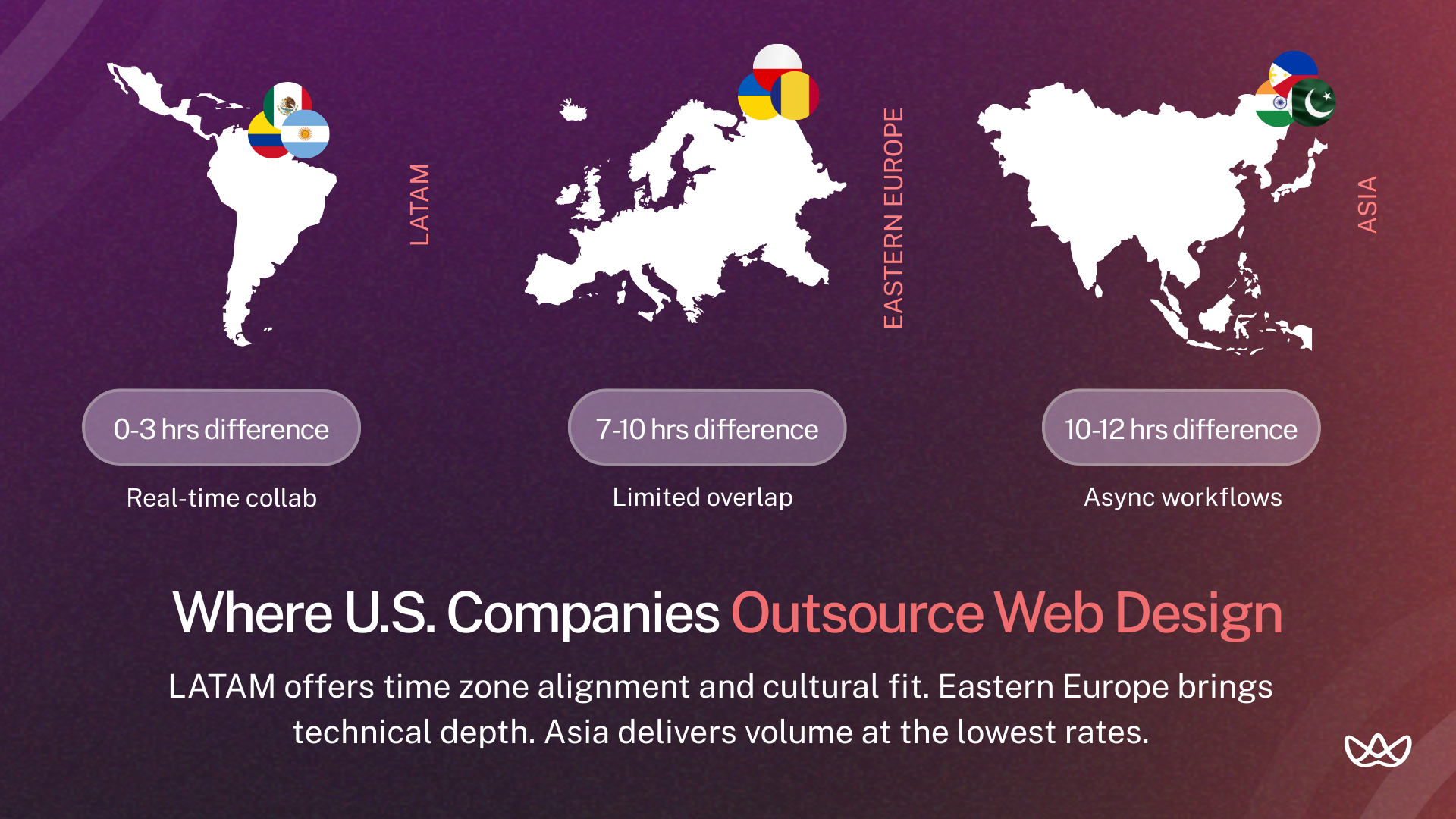
Where you outsource matters as much as who you hire. Each region comes with its own mix of cost, time zone alignment, and ease of communication.
LATAM (Top for U.S. Time Zones)
U.S. companies often work with designers in Argentina, Mexico, Colombia, and Brazil for closer time zone alignment. Many professionals have strong English skills and experience with international projects. This setup can reduce costs compared to U.S.-based teams while allowing more synchronous collaboration.
Strengths:
- 0-3 hour time difference from U.S.
- Strong English in professional settings
- Modern tool proficiency (Figma, Webflow)
- Cultural alignment with U.S. expectations
- 50-70% cost savings vs. U.S. rates
Eastern Europe (Strong Technical Fundamentals)
Countries like Poland, Ukraine, and Romania have a strong technical background, suitable for development-focused projects. Rates are generally lower than in North America, but time zone differences and regional factors may require more coordination.
Strengths:
- Strong technical education systems
- Excellent development skills
- Competitive rates ($20-$40/hour)
Challenges:
- 7-10 hour time difference
- Geopolitical considerations for some countries
Asia (Cost-Effective Large Talent Pools)
India, the Philippines, Pakistan and Vietnam offer large talent pools at lower rates. This region is often used for well-defined projects where asynchronous communication works, though quality can vary and time differences may slow real-time collaboration.
Strengths:
- Lowest rates globally ($10–$25/hour)
- Large available talent pools
- Established outsourcing infrastructure
Challenges:
- 10-12 hour time differences
- Higher quality variance
- Async workflows required
Common Challenges in Web Design Outsourcing
Common challenges in web design outsourcing include communication gaps from time zones and cultural differences, inconsistent quality from differing standards or outdated code, and security or IP risks if NDAs aren’t enforced. Hidden costs from project management, rework, or unexpected pricing can also reduce initial savings.
Communication Barriers
Misunderstandings can happen if expectations aren’t clear. Reduce them by:
- Over-documenting requirements
- Using visual references and examples
- Confirming understanding in writing
- Recording video walkthroughs for complex feedback
Time Zone Differences
For significant time gaps:
- Establish overlapping hours for calls (even 1-2 hours helps)
- Use async tools effectively (Loom, Figma comments)
- Set clear response time expectations
- Plan for longer feedback cycles
Quality Control
Keep work consistent by:
- Reviewing at defined checkpoints
- Providing specific, actionable feedback
- Requiring revisions before moving forward
- Testing thoroughly before launch
Data Security Concerns
Protect sensitive information by:
- Using NDAs with all partners
- Limiting access to only what’s needed
- Using secure file sharing (avoid personal email)
- Removing access promptly when the project ends
Tips for Managing Outsourced Web Design Teams
Manage outsourced teams by centralizing tasks in one platform, holding regular check-ins, and setting clear KPIs for speed, responsiveness, and conversions. Maintain quality with structured reviews, give visual feedback, and share your broader goals so the team works as a partner, not just a task executor.
Use Collaboration Tools
Essential stack:
- Design: Figma (real-time collaboration, commenting)
- Communication: Slack (quick questions), Loom (async video)
- Project Management: Notion, Asana, or ClickUp
- File Sharing: Google Drive or Dropbox
Set KPIs and Milestones
Track progress with:
- Weekly deliverable targets
- Phase completion dates
- Revision round limits
- Response time agreements
- Quality benchmarks at each stage
Regular Testing and Optimization
Build testing into the process:
- Review designs on actual devices
- Test functionality before visual polish
- Check performance metrics during development
- Validate against original requirements
Quick Summary: Key Takeaways on Web Design Outsourcing
Outsourcing web design helps companies manage costs, access specialized skills, and scale projects efficiently when planned carefully.
- LATAM nearshore partners offer 40-60% savings vs. U.S. rates with time zone alignment.
- Outsourcing provides access to specialized skills without permanent hiring.
- Project delivery accelerates by skipping lengthy recruitment.
- Modern tools enable seamless remote collaboration.
- Success depends on clear requirements and communication structures.
- The right model depends on project type, volume, and budget.
Your Next Move
Web design outsourcing works best when treated as a true partnership. Define your needs, choose the right model, and set up clear communication from the start.
LATAM nearshore partners offer U.S. teams good alignment on time zones, cost, and collaboration. Treat them like part of your team to get the most value.
For a reliable solution, you can explore vetted LATAM designers through Floowi for high-quality, cost-effective web design outsourcing. Schedule your free consultation today.
Frequently Asked Questions
What's the cost advantage of nearshore LATAM partners?
LATAM partners usually cost 50-70% less than U.S. agencies while working in aligned time zones. A project priced at $30K in the U.S. might cost $9K–$15K with a LATAM team at similar quality.
How do freelancer rates compare to agency pricing?
Freelancers charge $30–$150 per hour depending on experience and location. Agencies are $100–$200 per hour but include project management, multiple specialists, and established processes. Freelancers fit small projects; agencies work better for complex builds.
How does outsourcing speed up project delivery?
Outsourced teams remove the hiring step. Instead of waiting 6–12 weeks to recruit, work can start in days. Experienced teams also move faster on familiar project types.
How does outsourcing provide access to specialized global talent?
Global hiring removes geographic limits. You can engage Webflow experts, motion designers, or accessibility specialists anywhere, not just locally.
When does outsourcing deliver the best ROI?
ROI is highest for project-based work, overflow capacity, skill gaps, and time-sensitive launches. High-volume ongoing work might eventually justify in-house hires.
What signs indicate a business is ready to outsource?
Look for consistent capacity issues, project delays, skill gaps, budget limits preventing U.S. hires, or quality drops from rushing.
What qualities indicate a strong outsourcing vendor?
Check for relevant portfolios, clear processes, responsive communication, transparent pricing, solid references, and insightful questions about your business.
How do agencies maintain quality control in outsourced projects?
Quality is maintained through defined checkpoints, specific feedback, revision gates, and thorough testing. Process ensures consistency, not just talent.
What is web design outsourcing and how does it work?
Web design outsourcing means hiring external teams for design work instead of internal staff. Partners collaborate remotely, using tools to iterate on designs and deliver final products efficiently.




